Grupo de Joelho, Instituto de Ortopedia e Traumatologia, Hospital das Clínicas HCFMUSP, Faculdade de Medicina, Universidade de São Paulo, São Paulo, SP, Brazil.
Grupo de Joelho, Instituto de Ortopedia e Traumatologia, Hospital das Clínicas HCFMUSP, Faculdade de Medicina, Universidade de São Paulo, São Paulo, SP, Brazil.
Clinics (Sao Paulo). 2024 Oct 1;79:100503. doi: 10.1016/j.clinsp.2024.100503. eCollection 2024.
The objective of this study is to correlate clinical symptoms and functionality, using the KOOS (Knee Injury and Osteoarthritis Outcome Score) and KSS (Knee Society Score System) scores, with the radiographic changes, using the Kellgren-Lawrence classification, in patients with knee osteoarthritis and indications for Total Knee Arthroplasty (TKA).
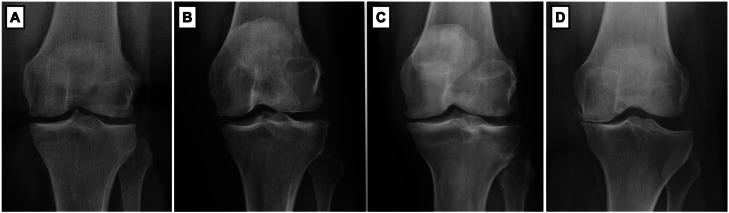
120 patients (189 knees) with gonarthrosis and indications for TKA were included in the study. Demographic questionnaires were applied, and clinical and functional assessment was carried out using the KOOS and KSS scores. Knee radiographs were taken and graded according to Kellgren-Lawrence. The clinical scores were compared with the radiographic classification to establish a correlation between these two measurements. Statistical analysis was performed using the τ-Kendall correlation test.
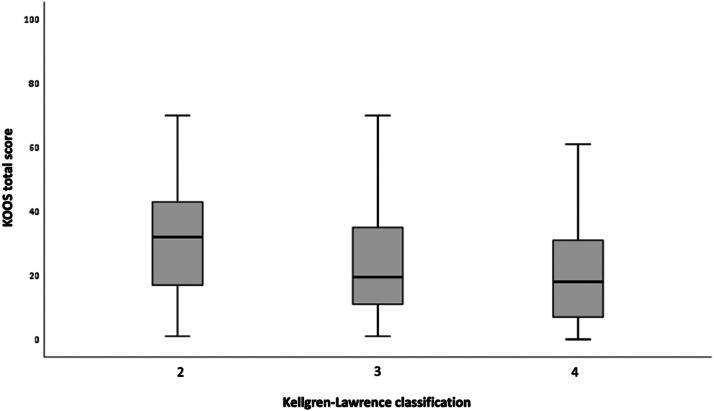
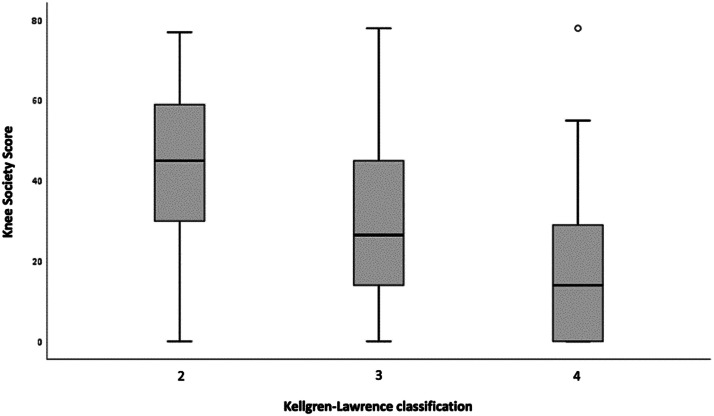
Weak and inversely proportional correlations were found between the clinical scores and the radiographic classification. Among clinical scores evaluated, KSS showed the highest correlation with Kellgren-Lawrence classification (τ = -0.356; p < 0.001), followed by KOOS-quality of life (τ = -0.176; p = 0.004), KOOS-total score (τ = -0.166; p = 0.004), KOOS-function in daily living (τ = -0.160; p = 0.005) and KOOS-symptoms (τ = -0.159; p = 0.006). KOOS-pain (τ = -0.149; p = 0.01) and KOOS-sport and recreation function (τ = -0.142; p = 0.025) scores had the weakest correlations.
There is a weak correlation between the clinical-functional scores of TKA candidates and their radiographic classification by Kellgren-Lawrence. Among clinical scores evaluated, KSS had the strongest negative correlation with the radiographic classification.
本研究旨在通过 KOOS(膝关节损伤和骨关节炎结果评分)和 KSS(膝关节协会评分系统)评分将膝关节骨关节炎患者的临床症状和功能与放射学变化(Kellgren-Lawrence 分级)相关联,并为 TKA(全膝关节置换术)患者提供适应证。
共纳入 120 例(189 膝)膝关节骨关节炎患者,行 TKA 适应证,行问卷调查、临床和功能评估,使用 KOOS 和 KSS 评分。拍摄膝关节 X 线片,根据 Kellgren-Lawrence 分级进行分级。比较临床评分与放射学分类,以确定两者之间的相关性。采用τ-Kendall 相关检验进行统计学分析。
临床评分与放射学分类之间存在弱的负相关关系。在评估的临床评分中,KSS 与 Kellgren-Lawrence 分级的相关性最高(τ=-0.356;p<0.001),其次是 KOOS 生活质量(τ=-0.176;p=0.004)、KOOS 总分(τ=-0.166;p=0.004)、KOOS 日常生活功能(τ=-0.160;p=0.005)和 KOOS 症状(τ=-0.159;p=0.006)。KOOS 疼痛(τ=-0.149;p=0.01)和 KOOS 运动和娱乐功能(τ=-0.142;p=0.025)评分相关性最弱。
TKA 候选患者的临床功能评分与放射学分类之间存在弱相关性。在评估的临床评分中,KSS 与放射学分类的负相关性最强。