Lalitha A V, Vasudevan Anil, Moorthy Manju, Ramaswamy Gopalakrishna
Department of Pediatric Critical Care, St. John's Medical College and Hospital, Bengaluru, Karnataka, India.
Department of Pediatric Nephrology, St. John's Medical College and Hospital, Bengaluru, Karnataka, India.
Indian J Crit Care Med. 2024 Sep;28(9):879-886. doi: 10.5005/jp-journals-10071-24789. Epub 2024 Aug 31.
Septic shock is associated with high mortality and there is significant heterogeneity in the host response. The aim of this study was to understand the genome-wide expression transcriptomic signatures in children with septic shock and correlate them with outcomes.
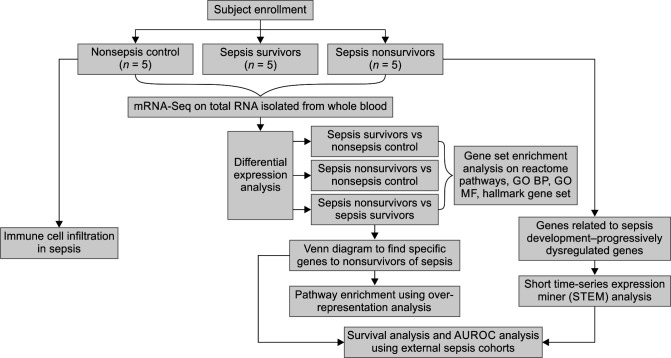
This was a prospective study conducted on children (aged 1 month to 18 years) admitted to the PICU (June-December 2021) with septic shock. Demographic details, clinical details, and administered treatment were collected. Differential gene expression analysis was performed to understand the genes and pathways affecting in different subjects.
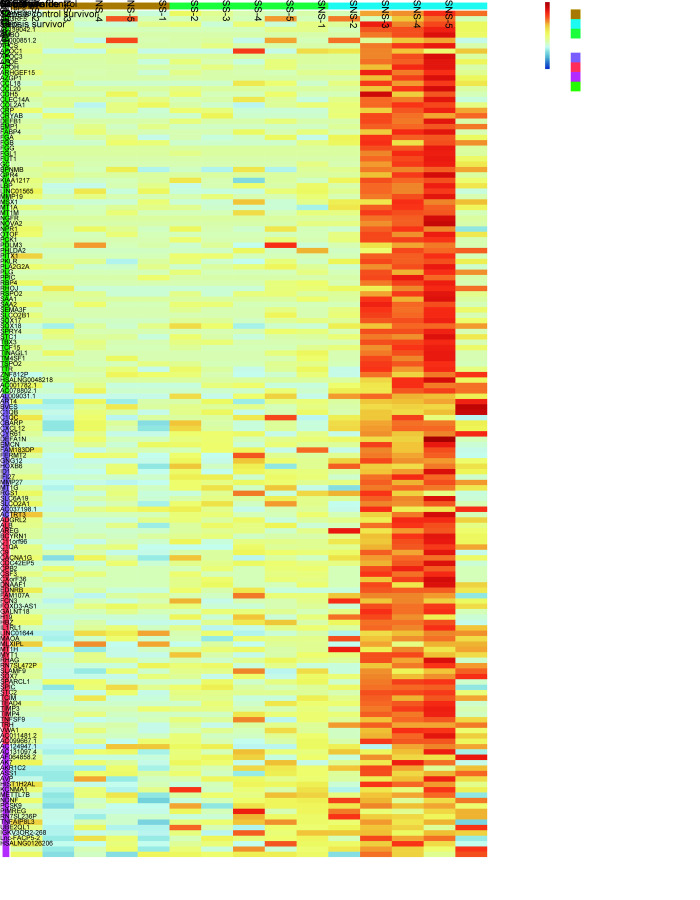
Fifteen patients were recruited (Septic shock survivors ( = 5), nonsurvivors ( = 5), and non-sepsis controls ( = 5). The median age of the patients in survivors and nonsurvivors was 15 (13, 24) months and 180 (180, 184) months, respectively. The sepsis-survivors vs nonsepsis possessed 983 upregulated and 624 downregulated genes while comparing sepsis nonsurvivors (SNS) with nonsepsis yielded 1,854 upregulated and 1,761 downregulated genes. Further, the lowest number of deregulated genes (383 upregulated and 486 downregulated) were present in SNS compared to sepsis survivors. The major Reactome pathways, found upregulated in SNSs relative to survivors included CD22 mediated B cell receptor (BCR) regulation, scavenging of heme from plasma, and creation of C4 and C2 activators while T cell receptor (TCR) signaling, the common pathway of fibrin clot formation and generation of second messenger molecules were found to be downregulated.
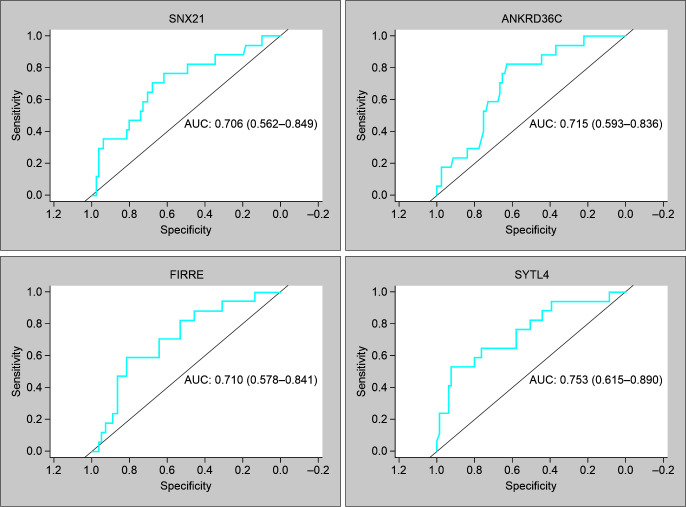
Mortality-related gene signatures are promising diagnostic biomarkers for pediatric sepsis.
Lalitha AV, Vasudevan A, Moorthy M, Ramaswamy G. Profiling Molecular Changes of Host Response to Predict Outcome in Children with Septic Shock. Indian J Crit Care Med 2024;28(9):879-886.
脓毒性休克与高死亡率相关,且宿主反应存在显著异质性。本研究的目的是了解脓毒性休克患儿的全基因组表达转录组特征,并将其与预后相关联。
这是一项对2021年6月至12月入住儿科重症监护病房(PICU)的脓毒性休克患儿(年龄1个月至18岁)进行的前瞻性研究。收集人口统计学细节、临床细节和所给予的治疗。进行差异基因表达分析以了解影响不同受试者的基因和通路。
招募了15名患者(脓毒性休克幸存者(n = 5)、非幸存者(n = 5)和非脓毒症对照组(n = 5))。幸存者和非幸存者患者的中位年龄分别为15(13,24)个月和180(180,184)个月。与非脓毒症相比,脓毒症幸存者有983个上调基因和624个下调基因,而脓毒症非幸存者(SNS)与非脓毒症相比有1854个上调基因和1761个下调基因。此外,与脓毒症幸存者相比,SNS中失调基因数量最少(383个上调和486个下调)。相对于幸存者,在SNS中上调的主要反应组通路包括CD22介导的B细胞受体(BCR)调节、从血浆中清除血红素以及产生C4和C2激活剂,而T细胞受体(TCR)信号传导、纤维蛋白凝块形成的共同途径和第二信使分子的产生则被下调。
与死亡率相关的基因特征有望成为儿童脓毒症的诊断生物标志物。
Lalitha AV, Vasudevan A, Moorthy M, Ramaswamy G. Profiling Molecular Changes of Host Response to Predict Outcome in Children with Septic Shock. Indian J Crit Care Med 2024;28(9):879 - 886.