Hwang Yoonha, Kim Jihyun, Ahn Kangmo, Jeong Kyunguk, Lee Sooyoung, Hong Soo-Jong, Jeon You Hoon, Kim Yoon Hee, Shin Meeyong, Song Tae Won, Jung Minyoung, Kim Minji, Min Taek Ki, Lee Ji Young, Kim Min Jung, Lee Yong Ju, Lee Jeongmin, Park Young A, Jang Gwang Cheon, Ahn Young Min, Lee So-Yeon, Kim Jeong Hee
Department of Pediatrics, Busan St. Mary's Hospital, Busan, Korea.
Department of Pediatrics, Samsung Medical Center, Sungkyunkwan University School of Medicine, Seoul, Korea.
Allergy Asthma Immunol Res. 2024 Sep;16(5):555-561. doi: 10.4168/aair.2024.16.5.555.
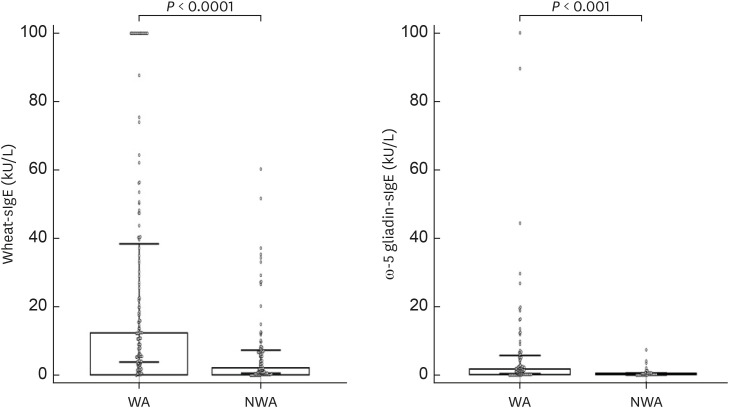
The diagnostic decision point can help diagnose food allergies while reducing the need for oral food challenge (OFC) tests. We performed a multicenter survey of children aged 0-7 years from January 1, 2018 to March 31, 2022. A total of 231 children were recruited from 18 institutions. Wheat allergy (WA) or non-wheat allergy (NWA) was determined on the basis of OFC results and symptoms. There were no differences in age, sex, family history of allergy or allergic comorbidities between the WA and NWA groups. According to receiver operating characteristic analysis for wheat-specific immunoglobulin E (IgE), the optimal cutoff value, positive decision point, and negative decision point were 10.2, 33.5, and 0.41 kU/L, respectively. For the ω-5 gliadin-specific IgE, their values were 0.69, 3.88, and 0.01 kU/L, respectively. This new diagnostic decision point may be used to diagnose WA in Korean children.
诊断决策点有助于诊断食物过敏,同时减少口服食物激发试验(OFC)的需求。我们在2018年1月1日至2022年3月31日期间对0至7岁的儿童进行了一项多中心调查。共从18个机构招募了231名儿童。根据OFC结果和症状确定小麦过敏(WA)或非小麦过敏(NWA)。WA组和NWA组在年龄、性别、过敏家族史或过敏性合并症方面没有差异。根据针对小麦特异性免疫球蛋白E(IgE)的受试者工作特征分析,最佳临界值、阳性决策点和阴性决策点分别为10.2、33.5和0.41 kU/L。对于ω-5麦醇溶蛋白特异性IgE,其值分别为0.69、3.88和0.01 kU/L。这个新的诊断决策点可用于诊断韩国儿童的WA。