Burbrink Frank T, Myers Edward A, Pyron R Alexander
Department of Herpetology American Museum of Natural History New York New York USA.
Department of Herpetology California Academy of Sciences San Francisco California USA.
Ecol Evol. 2024 Oct 2;14(10):e70263. doi: 10.1002/ece3.70263. eCollection 2024 Oct.
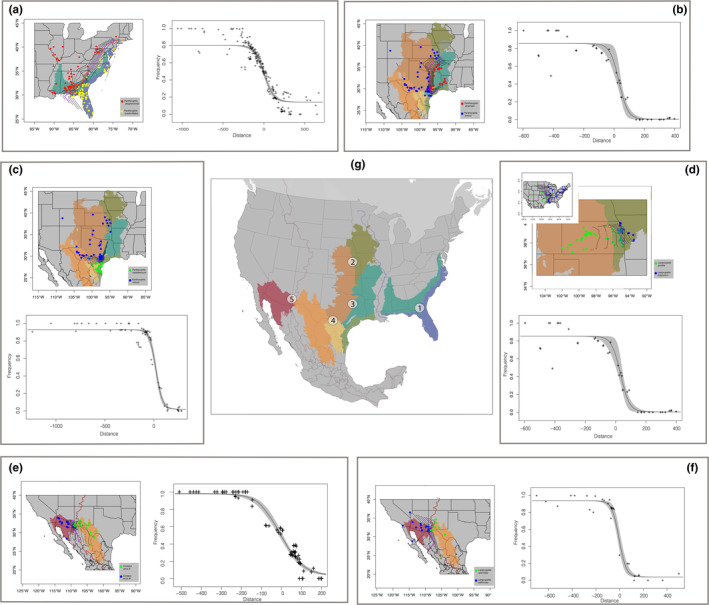
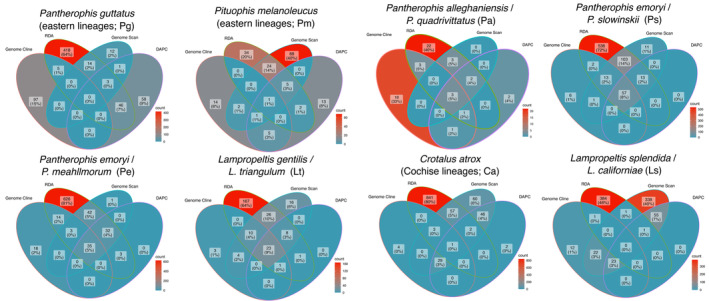
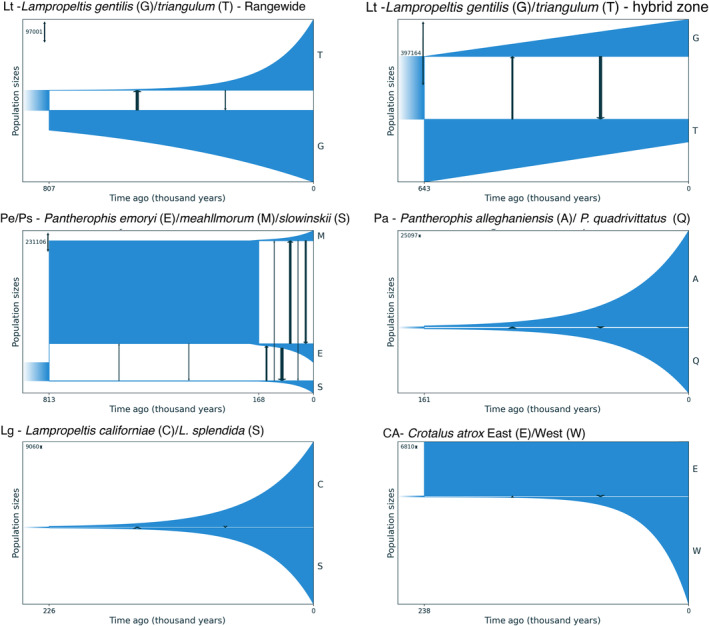
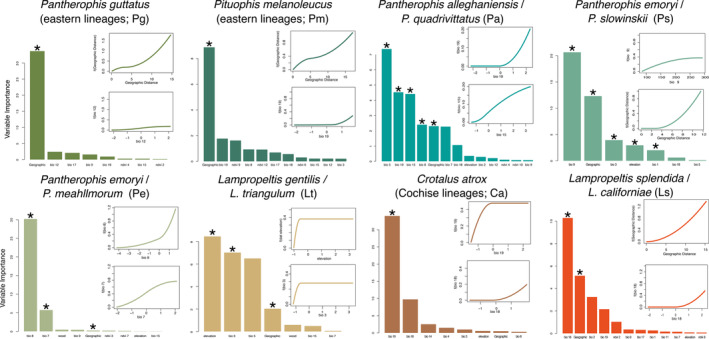
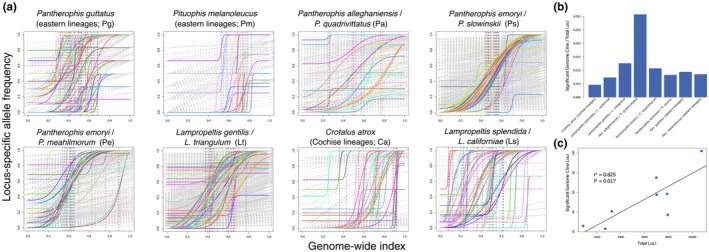
The outcomes of speciation across organismal dimensions (e.g., ecological, genetic, phenotypic) are often assessed using phylogeographic methods. At one extreme, reproductively isolated lineages represent easily delimitable species differing in many or all dimensions, and at the other, geographically distinct genetic segments introgress across broad environmental gradients with limited phenotypic disparity. In the ambiguous gray zone of speciation, where lineages are genetically delimitable but still interacting ecologically, it is expected that these lineages represent species in the context of ontology and the evolutionary species concept when they are maintained over time with geographically well-defined hybrid zones, particularly at the intersection of distinct environments. As a result, genetic structure is correlated with environmental differences and not space alone, and a subset of genes fail to introgress across these zones as underlying genomic differences accumulate. We present a set of tests that synthesize species delimitation with the speciation process. We can thereby assess historical demographics and diversification processes while understanding how lineages are maintained through space and time by exploring spatial and genome clines, genotype-environment interactions, and genome scans for selected loci. Employing these tests in eight lineage-pairs of snakes in North America, we show that six pairs represent 12 "good" species and that two pairs represent local adaptation and regional population structure. The distinct species pairs all have the signature of divergence before or near the mid-Pleistocene, often with low migration, stable hybrid zones of varying size, and a subset of loci showing selection on alleles at the hybrid zone corresponding to transitions between distinct ecoregions. Locally adapted populations are younger, exhibit higher migration, and less ecological differentiation. Our results demonstrate that interacting lineages can be delimited using phylogeographic and population genetic methods that properly integrate spatial, temporal, and environmental data.
物种形成在生物维度(如生态、遗传、表型)上的结果通常使用系统地理学方法进行评估。在一个极端情况下,生殖隔离的谱系代表了在许多或所有维度上都不同的易于界定的物种,而在另一个极端,地理上不同的遗传片段在广泛的环境梯度上渗入,表型差异有限。在物种形成的模糊灰色地带,谱系在遗传上是可界定的,但仍在生态上相互作用,预计当这些谱系在地理上定义明确的杂交区域中随着时间的推移得以维持时,特别是在不同环境的交汇处,它们在本体论和进化物种概念的背景下代表物种。因此,遗传结构与环境差异相关,而不仅仅与空间相关,并且随着潜在基因组差异的积累,一部分基因无法跨越这些区域渗入。我们提出了一组将物种界定与物种形成过程相结合的测试。通过探索空间和基因组渐变、基因型 - 环境相互作用以及对选定基因座的基因组扫描,我们能够在理解谱系如何通过空间和时间得以维持的同时,评估历史种群统计学和多样化过程。在北美八对蛇类谱系中应用这些测试,我们表明六对代表12个“良好”物种,两对代表局部适应和区域种群结构。不同的物种对在更新世中期之前或接近中期时都具有分化的特征,通常迁移率较低,具有大小各异的稳定杂交区域,并且一部分基因座在杂交区域显示出对应于不同生态区域之间过渡的等位基因选择。局部适应的种群较年轻,迁移率较高,生态分化较小。我们的结果表明,相互作用的谱系可以使用适当整合空间、时间和环境数据的系统地理学和种群遗传学方法来界定。