Timm Eliane, Ko Yobina Melanie, Hundhammer Theodor, Berlowitz Ilana, Wolf Ursula
Institute of Complementary and Integrative Medicine, Faculty of Medicine, University of Bern, Bern, Switzerland.
Eurythmy4you, Nidau, Switzerland.
Front Integr Neurosci. 2024 Sep 19;18:1472562. doi: 10.3389/fnint.2024.1472562. eCollection 2024.
Cancer is a debilitating disease with an often chronic course. One of the most taxing and prevalent sequelae in this context is cancer-related fatigue (CRF) resulting from the disease and/or associated treatments. Over the last years mindfulness-based interventions such as eurythmy therapy (ERYT), a mindful-movement therapy from anthroposophic medicine, have emerged as promising adjunct therapies in oncology. This prospective study investigated an online implementation of ERYT for CRF using a single arm repeated-measures design based on two consecutive studies.
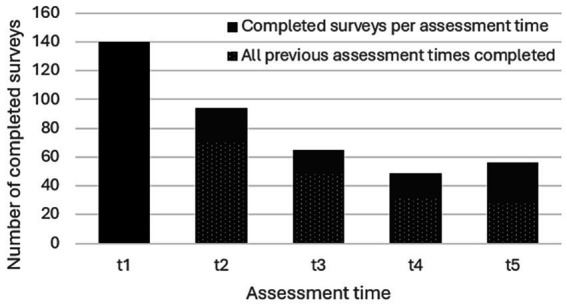
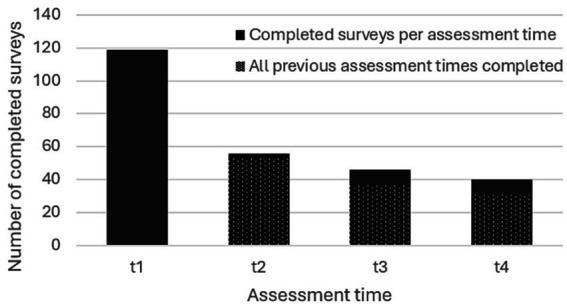
Study 1 consisted of an initial assessment before, during, after, and at follow up of a 6-week online ERYT-based program in a mixed sample of = 165 adults with or without cancer diagnosis. Study 2 involved a similar design with an adapted 8-week online ERYT-based program in a sample of = 125 adults who had been diagnosed with cancer. Outcomes were assessed using the Functional Assessment of Chronic Illness Therapy-Fatigue, Perceived Stress Scale, Mindful Attention Awareness Scale, and Insomnia Severity Index (for Study 1 all, for Study 2 only the former three). We additionally performed an exploratory analysis regarding practice frequency and duration. Data were analyzed using Linear Mixed-Effect Models per outcome; ANOVA was used for practice times.
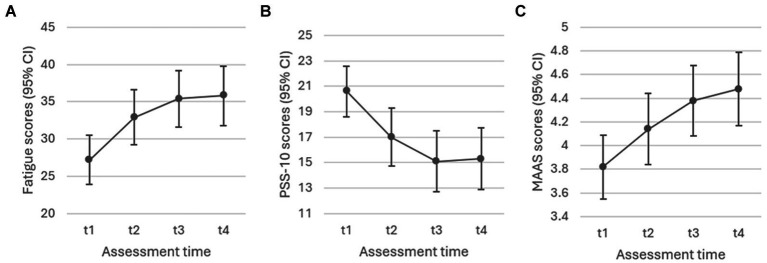
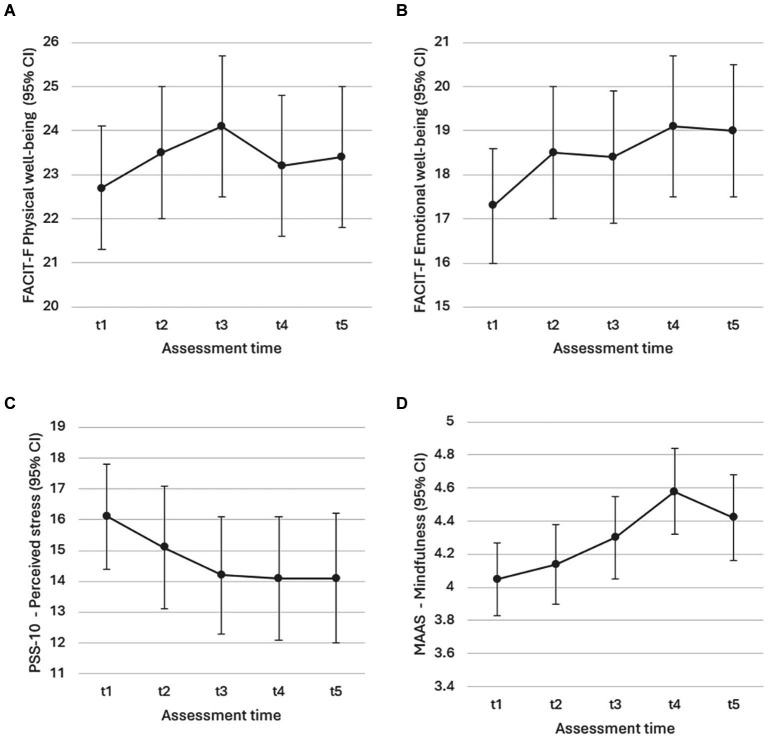
For Study 1, mixed-effects model estimates showed no significant effect on fatigue, but pointed to significantly improved emotional and physical well-being, reduced stress, as well as increased mindfulness (mixed subjects). Functional and social well-being or sleep quality did not change significantly. Study 2 model estimates on the other hand showed significantly improved CRF in conjunction with the ERYT-based online intervention, as well as improved stress and mindfulness scores (cancer-diagnosed subjects).
Taken together, while our results should be interpreted with caution given the single-arm design and relatively high dropout, they suggest online ERYT may be associated with a reduction in fatigue for individuals diagnosed with cancer, an increase in mindfulness, and benefits for stress and certain well-being indicators. The online group format is advantageous in view of affordability and accessibility, the latter being particularly relevant for individuals who due to high symptom severity cannot leave their homes. Randomized-controlled studies will be needed to confirm these findings.
癌症是一种使人虚弱的疾病,病程往往较长。在这种情况下,最费力且普遍存在的后遗症之一是由疾病和/或相关治疗导致的癌症相关疲劳(CRF)。在过去几年中,基于正念的干预措施,如优律司美疗法(ERYT),一种源自人智医学的正念运动疗法,已成为肿瘤学中有前景的辅助疗法。这项前瞻性研究基于两项连续研究,采用单臂重复测量设计,对ERYT在线治疗CRF进行了调查。
研究1在165名有或无癌症诊断的成年人混合样本中,对一个基于ERYT的6周在线项目进行了治疗前、治疗期间、治疗后及随访的初始评估。研究2采用类似设计,在125名已被诊断患有癌症的成年人样本中,开展了一个为期8周的基于ERYT的在线项目。使用慢性病治疗功能评估-疲劳量表、感知压力量表、正念注意觉知量表和失眠严重指数(研究1全部使用,研究2仅使用前三项)对结果进行评估。我们还对练习频率和时长进行了探索性分析。每个结果的数据均使用线性混合效应模型进行分析;方差分析用于练习次数。
对于研究1,混合效应模型估计显示对疲劳没有显著影响,但指出情绪和身体幸福感显著改善、压力减轻以及正念增强(混合样本受试者)。功能和社会幸福感或睡眠质量没有显著变化。另一方面,研究2的模型估计显示,基于ERYT的在线干预显著改善了CRF,以及压力和正念得分(癌症诊断受试者)。
总体而言,鉴于单臂设计和相对较高的失访率,我们的结果应谨慎解读,但它们表明在线ERYT可能与被诊断患有癌症的个体疲劳减轻、正念增加以及压力和某些幸福感指标改善有关。鉴于可承受性和可及性,在线小组形式具有优势,后者对于因症状严重无法离家者尤为重要。需要进行随机对照研究来证实这些发现。