School of Medicine, Institute for Systems Genomics, UConn Health, University of Connecticut Health, 263 Farmington Avenue, Farmington, CT, 06030, USA.
Institute of Physiology and Biochemistry 'Jean Giaja', Center for Laser Microscopy, University of Belgrade, Faculty of Biology, 11000, Belgrade, Serbia.
Sci Rep. 2024 Oct 4;14(1):22787. doi: 10.1038/s41598-024-70319-4.
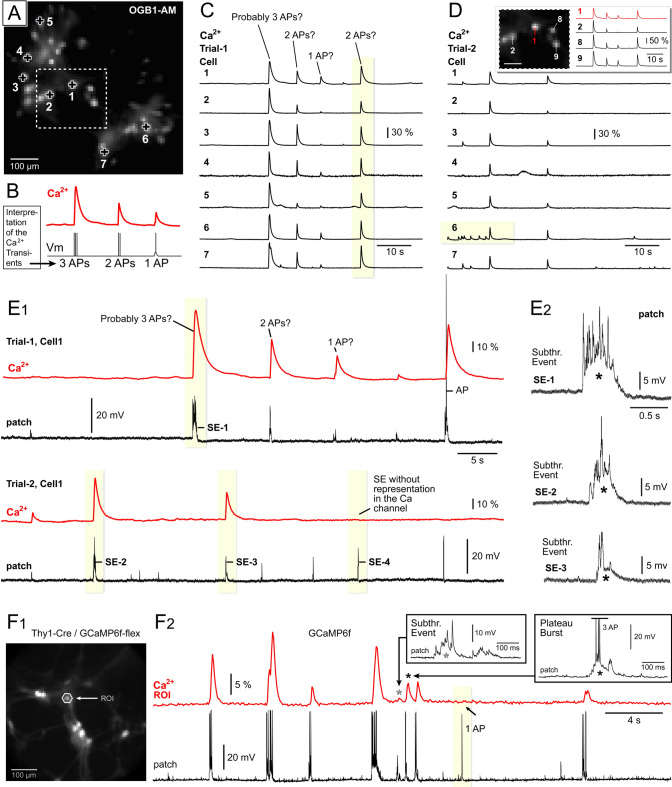
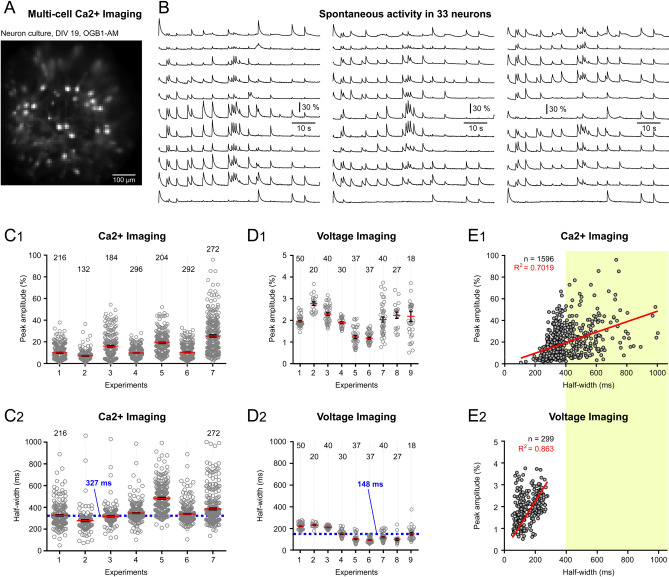
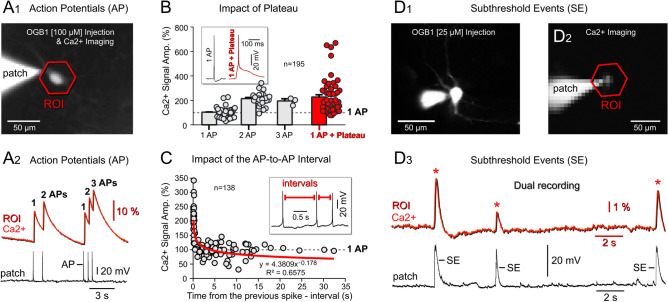
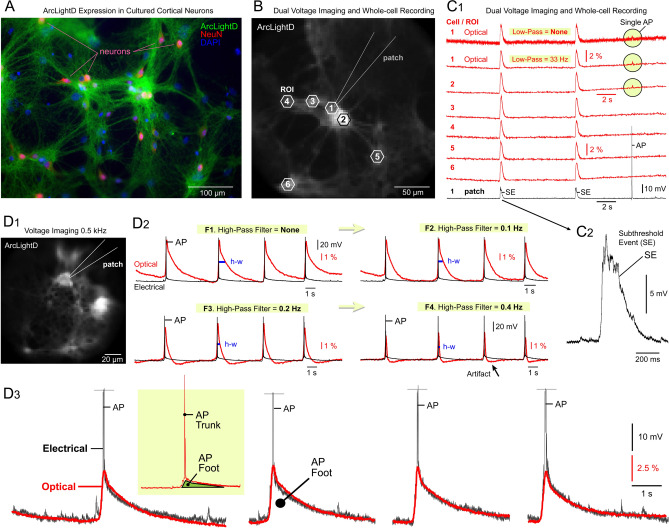
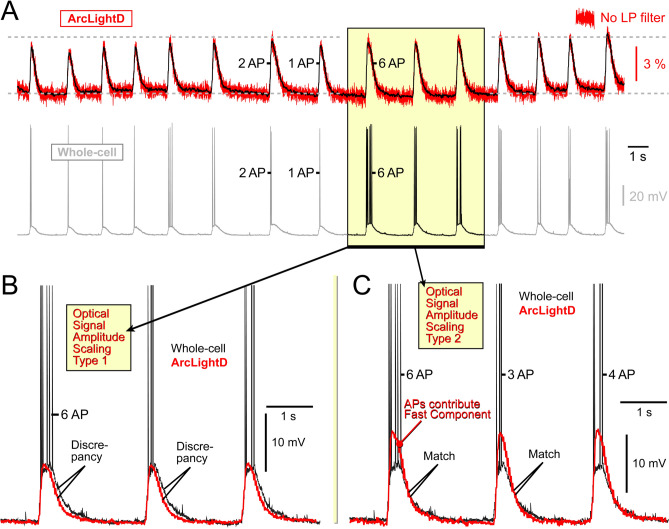
In calcium imaging studies, Ca transients are commonly interpreted as neuronal action potentials (APs). However, our findings demonstrate that robust optical Ca transients primarily stem from complex "AP-Plateaus", while simple APs lacking underlying depolarization envelopes produce much weaker photonic signatures. Under challenging in vivo conditions, these "AP-Plateaus" are likely to surpass noise levels, thus dominating the Ca recordings. In spontaneously active neuronal culture, optical Ca transients (OGB1-AM, GCaMP6f) exhibited approximately tenfold greater amplitude and twofold longer half-width compared to optical voltage transients (ArcLightD). The amplitude of the ArcLightD signal exhibited a strong correlation with the duration of the underlying membrane depolarization, and a weaker correlation with the presence of a fast sodium AP. Specifically, ArcLightD exhibited robust responsiveness to the slow "foot" but not the fast "trunk" of the neuronal AP. Particularly potent stimulators of optical signals in both Ca and voltage imaging modalities were APs combined with plateau potentials (AP-Plateaus), resembling dendritic Ca spikes or "UP states" in pyramidal neurons. Interestingly, even the spikeless plateaus (amplitude > 10 mV, duration > 200 ms) could generate conspicuous Ca optical signals in neurons. Therefore, in certain circumstances, Ca transients should not be interpreted solely as indicators of neuronal AP firing.
在钙成像研究中,钙瞬变通常被解释为神经元动作电位 (AP)。然而,我们的研究结果表明,强烈的光钙瞬变主要源自复杂的“AP 平台”,而缺乏基础去极化包络的简单 AP 则产生较弱的光子信号。在具有挑战性的体内条件下,这些“AP 平台”可能超过噪声水平,从而主导 Ca 记录。在自发活跃的神经元培养物中,与光电压瞬变 (ArcLightD) 相比,光钙瞬变 (OGB1-AM、GCaMP6f) 的幅度大约大十倍,半宽长两倍。ArcLightD 信号的幅度与基础膜去极化的持续时间呈强相关,与存在快速钠 AP 的相关性较弱。具体而言,ArcLightD 对神经元 AP 的缓慢“脚部”而非快速“主干”表现出强大的响应能力。在钙成像和电压成像两种模式下,对光信号均具有强大刺激作用的是与平台电位 (AP-Plateaus) 结合的 AP,类似于树突钙峰或锥体细胞的“UP 状态”。有趣的是,即使是无峰平台(幅度>10 mV,持续时间>200 ms)也可以在神经元中产生明显的 Ca 光学信号。因此,在某些情况下,钙瞬变不应仅被解释为神经元 AP 放电的指标。