Lakhani Hairya Ajaykumar, Lizarzaburo Penafiel Lenin Steve, Fakhoury Marc, Seide Melinda, Duran S Patricio Xavier, See Jia Whei, Dhillon Damandeep Kaur, Shah Shivendra, Khan Aysha Mohsin, Nimmagadda Marthand, Susmitha Thirumalasetty, Rai Manju
Internal Medicine, Smt. B. K. Shah Medical Institute and Research Center, Vadodara, IND.
Internal Medicine, Universidad de Las Americas, Quito, ECU.
Cureus. 2024 Sep 5;16(9):e68691. doi: 10.7759/cureus.68691. eCollection 2024 Sep.
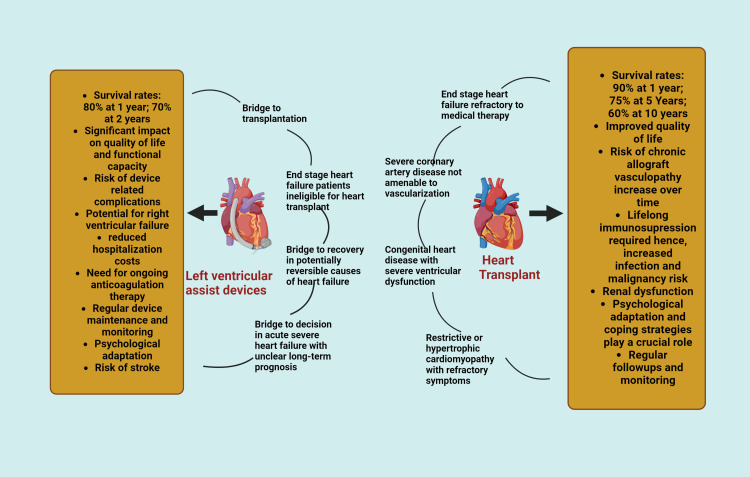
Heart transplantation and left ventricular assist devices (LVADs) have emerged as crucial interventions for end-stage heart failure, dramatically improving patient outcomes. This narrative review examines their historical context, indications, procedures, and outcomes, as well as their impact on long-term survival, quality of life, functional status, and mental health. While heart transplantation remains the optimal treatment, donor scarcity limits its application. LVADs have become a viable alternative, either as a bridge to transplantation or as destination therapy. Both interventions demonstrate similar long-term survival rates and significant improvements in health-related quality of life and functional status. However, they present distinct long-term management challenges, including immunosuppression needs for transplant recipients and device-related issues for LVAD patients. Mental health effects are considerable, necessitating psychological support and adaptive coping strategies. Complications such as infection, bleeding, and thrombosis remain concerns for both interventions. Patient selection criteria, technological advancements, and long-term management strategies are critical factors in optimizing outcomes. Future research should focus on device miniaturization, enhanced biocompatibility, and less invasive insertion techniques to further advance these therapies and improve patient care in end-stage heart failure.
心脏移植和左心室辅助装置(LVADs)已成为终末期心力衰竭的关键治疗手段,显著改善了患者的预后。本叙述性综述探讨了它们的历史背景、适应症、手术过程和结果,以及它们对长期生存、生活质量、功能状态和心理健康的影响。虽然心脏移植仍然是最佳治疗方法,但供体稀缺限制了其应用。LVADs已成为一种可行的替代方案,可作为移植桥梁或终末治疗。这两种治疗方法都显示出相似的长期生存率,并且在与健康相关的生活质量和功能状态方面有显著改善。然而,它们也带来了不同的长期管理挑战,包括移植受者对免疫抑制的需求以及LVAD患者的装置相关问题。心理健康影响相当大,需要心理支持和适应性应对策略。感染、出血和血栓形成等并发症仍然是这两种治疗方法的关注点。患者选择标准、技术进步和长期管理策略是优化治疗结果的关键因素。未来的研究应专注于装置小型化、增强生物相容性和侵入性较小的植入技术,以进一步推进这些治疗方法,并改善终末期心力衰竭患者的护理。