Farooq Amna, Trehan Shubam, Singh Gurjot, Arora Nirav, Mehta Tejal, Jain Prateek, Bector Gaurav, Jain Aayush, Arora Rajpreet S, Puri Piyush
Internal Medicine, Yale School of Medicine, Waterbury, USA.
Internal Medicine, Dayanand Medical College and Hospital, Ludhiana, IND.
Cureus. 2024 Sep 5;16(9):e68748. doi: 10.7759/cureus.68748. eCollection 2024 Sep.
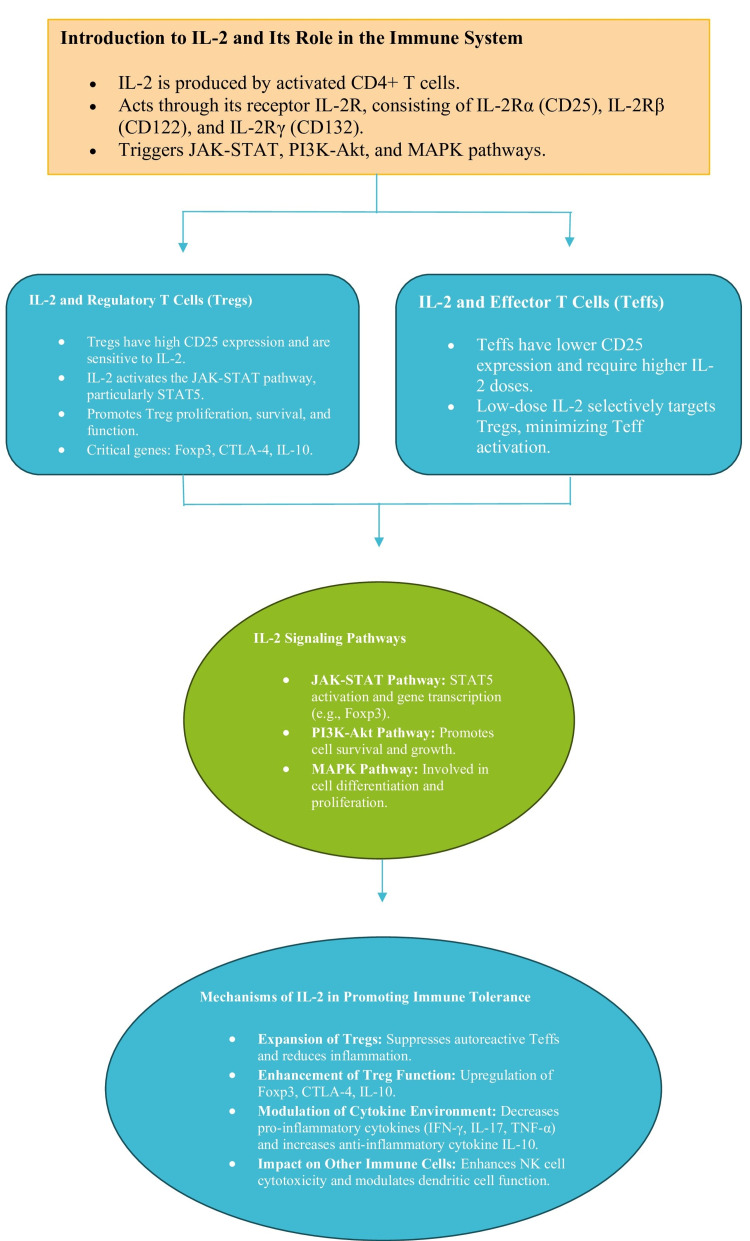
Systemic lupus erythematosus (SLE) is a chronic autoimmune disease that causes extensive inflammation and tissue destruction across several organs. Conventional therapies, such as nonsteroidal anti-inflammatory drugs (NSAIDs), corticosteroids, and immunosuppressive drugs, can have serious adverse effects and are not always successful. This study looks at the possibility of low-dose interleukin-2 (IL-2) therapy as a new treatment for SLE, focusing on its mechanics, effectiveness, and clinical applicability. Low-dose IL-2 treatment selectively increases and activates regulatory T cells (Tregs), which are essential for immunological tolerance but are often lacking in SLE patients. Unlike standard medicines, which widely inhibit the immune system, low-dose IL-2 provides a more tailored approach with fewer side effects. We examined preclinical and clinical research and discovered that low-dose IL-2 dramatically enhances Treg numbers and function, lowers disease activity, and improves clinical outcomes. The primary molecular processes include the stimulation of the Janus kinase - signal transducer of activators of transcription (JAK-STAT), phosphatidylinositol 3-kinase - protein kinase B (PI3K-Akt), and mitogen‑activated protein kinase (MAPK) pathways, which enhance Treg proliferation, survival, and activity. A thorough review of clinical studies finds that low-dose IL-2 treatment is well-tolerated and effective, with fewer side effects than biologics like belimumab and rituximab. Furthermore, IL-2 therapy provides prospects for combination therapies, which may improve therapeutic success by addressing numerous components of the immune response. Despite these encouraging findings, problems such as patient response variability and the need for long-term safety data persist. Future research should prioritize refining dose regimes, discovering biomarkers for patient selection, and investigating combination medicines. Addressing these issues might solidify low-dose IL-2 treatment as a cornerstone in SLE care, providing a more accurate and individualized approach to immune regulation while considerably improving patient outcomes.
系统性红斑狼疮(SLE)是一种慢性自身免疫性疾病,可导致多个器官发生广泛炎症和组织破坏。传统疗法,如非甾体抗炎药(NSAIDs)、皮质类固醇和免疫抑制药物,可能会产生严重的不良反应,且并非总是有效。本研究探讨低剂量白细胞介素-2(IL-2)疗法作为SLE新治疗方法的可能性,重点关注其作用机制、有效性和临床适用性。低剂量IL-2治疗可选择性地增加并激活调节性T细胞(Tregs),这些细胞对免疫耐受至关重要,但在SLE患者中往往缺乏。与广泛抑制免疫系统的标准药物不同,低剂量IL-2提供了一种更具针对性、副作用更少的治疗方法。我们研究了临床前和临床研究,发现低剂量IL-2可显著增加Treg数量并增强其功能,降低疾病活动度,并改善临床结局。主要分子过程包括对Janus激酶-信号转导子和转录激活子(JAK-STAT)、磷脂酰肌醇3激酶-蛋白激酶B(PI3K-Akt)和丝裂原活化蛋白激酶(MAPK)途径的刺激,这些途径可增强Treg的增殖、存活和活性。对临床研究的全面回顾发现,低剂量IL-2治疗耐受性良好且有效,副作用比贝利尤单抗和利妥昔单抗等生物制剂更少。此外,IL-2疗法为联合治疗提供了前景,通过解决免疫反应的多个组成部分,可能提高治疗成功率。尽管有这些令人鼓舞的发现,但患者反应变异性和长期安全性数据需求等问题仍然存在。未来的研究应优先优化剂量方案、发现用于患者选择的生物标志物以及研究联合用药。解决这些问题可能会巩固低剂量IL-2治疗作为SLE治疗基石的地位,提供一种更精确、个性化的免疫调节方法,同时显著改善患者预后。