Arabaci Burak, Yerlikaya Fırat, Basci Akduman Nursabah Elif
Faculty of Pharmacy, Department of Analytical Chemistry, Hacettepe University, Ankara 06230, Türkiye.
Elixir Pharmaceutical Research and Development, Ankara 06800, Türkiye.
ACS Omega. 2024 Sep 17;9(39):40346-40357. doi: 10.1021/acsomega.4c01183. eCollection 2024 Oct 1.
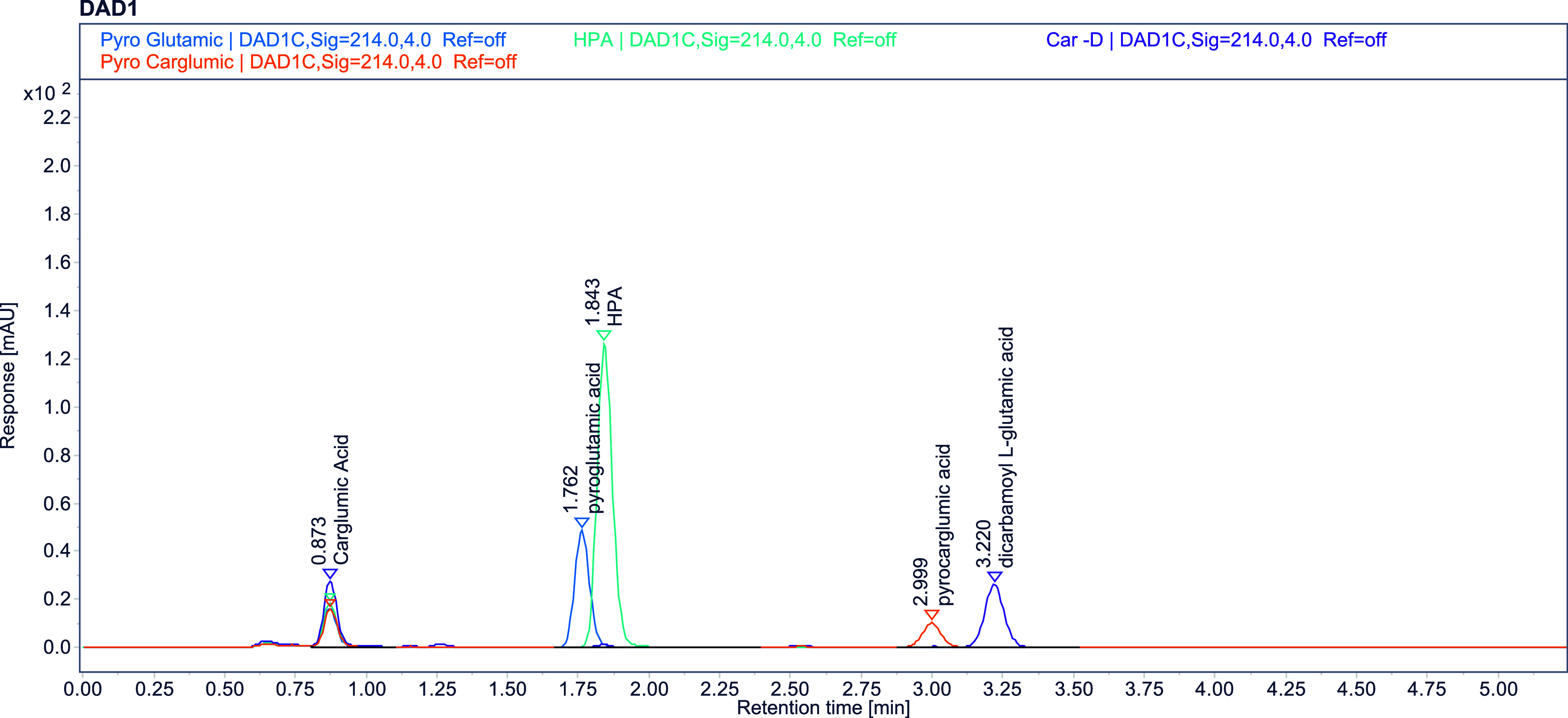
Carglumic acid, also known as N-carbamyl-l-glutamic acid, is a medication used in the treatment of a rare genetic disorder called N-acetylglutamate synthase (NAGS) deficiency. To the authors' knowledge, there was no method reported in the literature for the determination of degradation products suitable for quality control analyses of carglumic acid. Thus, the aim of the presented study is to develop an impurity method with a UHPLC/DAD detector configuration compatible with industrial standards from the European Pharmacopeia and the United States Pharmacopeia, making the drug more accessible for developing and underdeveloped countries through its precise evaluation. The method involved the separation of carglumic acid and its degradation products using a reverse-phase C18 column (Waters, BEH 150 mm × 2.1 mm, 1.7 μm) at a flow rate of 0.39 mL/min with a stop time of 10 min. To separate all unknown and known impurities, a gradient elution (phosphate buffer, pH 2.4, and acetonitrile) system was used. The detection was performed at 214 nm. Forced degradation studies were conducted under different stress conditions, including acidic, basic, oxidative, thermal, and photolytic stress. Placket-Burman statistical experimental design was used to demonstrate the robustness of this method, and the suitability of the method was confirmed under the applied conditions. Box-Behnken design was used to provide the optimum resolution between the peaks determined to be critical during the optimization. The developed method was validated according to ICH guidelines for specificity, linearity, accuracy, precision, and robustness. The limit of detection and limit of quantification were 0.7 and 0.15 μg/mL for carglumic acid, respectively.
卡谷氨酸,也称为N-氨甲酰-L-谷氨酸,是一种用于治疗罕见遗传疾病N-乙酰谷氨酸合酶(NAGS)缺乏症的药物。据作者所知,文献中未报道适用于卡谷氨酸质量控制分析的降解产物测定方法。因此,本研究的目的是开发一种杂质分析方法,采用超高效液相色谱/二极管阵列检测器(UHPLC/DAD)配置,符合欧洲药典和美国药典的行业标准,通过精确评估使该药物在发展中国家和不发达国家更容易获得。该方法包括使用反相C18色谱柱(沃特世,BEH 150 mm×2.1 mm,1.7μm)分离卡谷氨酸及其降解产物,流速为0.39 mL/min,运行时间为10分钟。为了分离所有未知和已知杂质,使用了梯度洗脱(磷酸盐缓冲液,pH 2.4,和乙腈)系统。检测波长为214 nm。在不同的应激条件下进行了强制降解研究,包括酸性、碱性、氧化、热和光解应激。采用Placket-Burman统计实验设计来证明该方法的稳健性,并在所应用的条件下确认了该方法的适用性。采用Box-Behnken设计在优化过程中为确定为关键的峰之间提供最佳分离度。所开发的方法根据ICH指南进行了特异性、线性、准确性、精密度和稳健性验证。卡谷氨酸的检测限和定量限分别为0.7和0.15μg/mL。