Kim Kain, Faruque Samir C, Lam Shivani, Kulp David, He Xinwei, Sperling Laurence S, Eapen Danny J
Department of Medicine, Emory School of Medicine, Atlanta, Georgia, USA.
Division of General Medicine, Washington University School of Medicine, St. Louis, Missouri, USA.
JACC Adv. 2024 Aug 21;3(9):101184. doi: 10.1016/j.jacadv.2024.101184. eCollection 2024 Sep.
Familial hypercholesterolemia (FH) is an underdiagnosed genetic condition that leads to premature cardiovascular disease. Flag, Identify, Network, and Deliver (FIND) FH is a machine learning algorithm (MLA) developed by the Family Heart Foundation that identifies high-risk individuals in the electronic medical record for targeted FH screening.
The purpose of this study was to characterize the FH diagnostic coding status of patients detected by a MLA screening and assess for correlations with patterns in medical management and cardiovascular outcomes.
We applied the FIND FH MLA to a retrospective, cross-sectional cohort within one large academic medical center. Individual patient charts were manually reviewed and stratified by diagnosis status. Variables including baseline characteristics, medical history, family history, laboratory values, medications, and cardiovascular outcomes were compared across diagnosis status.
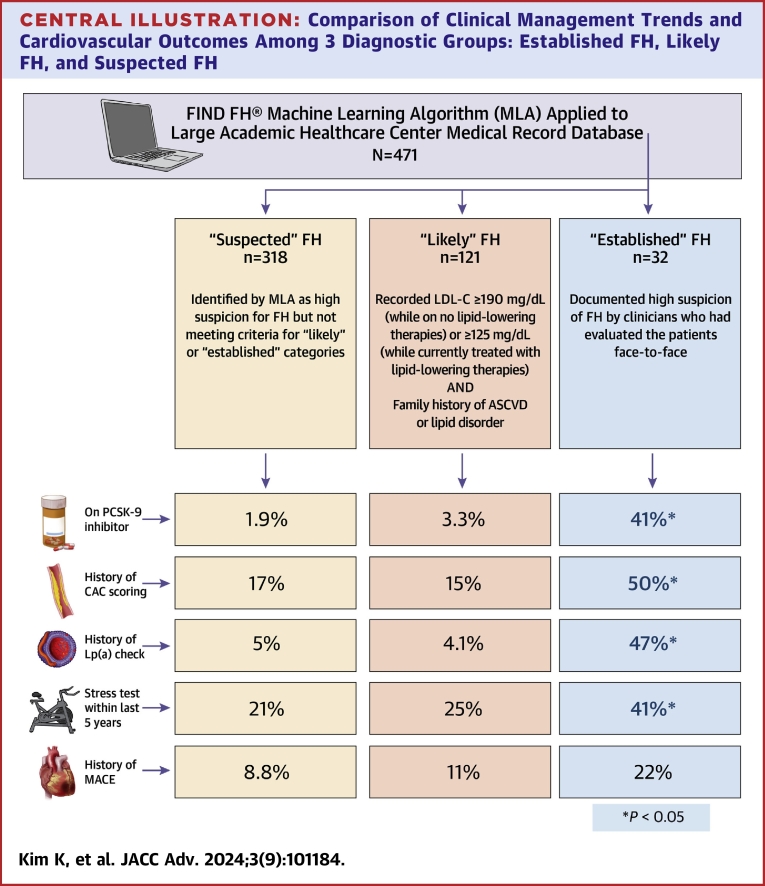
The MLA identified 471 patients over 5.5 years with a high probability for FH. 121 (26%) previously undiagnosed patients met criteria for having "likely FH." Those with established FH diagnoses (n = 32) had significantly more lipid panel monitoring, prescriptions for non-statin or combination lipid-lowering agents, visits with a cardiologist, and frequency of coronary artery calcium score (CACS) testing or lipoprotein(a) testing than undiagnosed patients with likely FH. The 2 groups had no significant differences in having had prior major adverse cardiovascular events. The remaining 318 patients were classified as having "suspected FH."
These findings suggest that implementation of a MLA approach such as FIND FH may be feasible for identifying undiagnosed individuals living with FH, as well as addressing treatment disparities in this population at increased cardiovascular risk.
家族性高胆固醇血症(FH)是一种诊断不足的遗传性疾病,可导致早发性心血管疾病。“识别、标记、联网和转诊(FIND)FH”是由家庭心脏基金会开发的一种机器学习算法(MLA),可在电子病历中识别高危个体,以进行针对性的FH筛查。
本研究的目的是描述通过MLA筛查检测出的患者的FH诊断编码状态,并评估其与医疗管理模式和心血管结局的相关性。
我们将FIND FH MLA应用于一个大型学术医疗中心内的回顾性横断面队列。对个体患者病历进行人工审核,并根据诊断状态进行分层。比较不同诊断状态下包括基线特征、病史、家族史、实验室检查值、用药情况和心血管结局等变量。
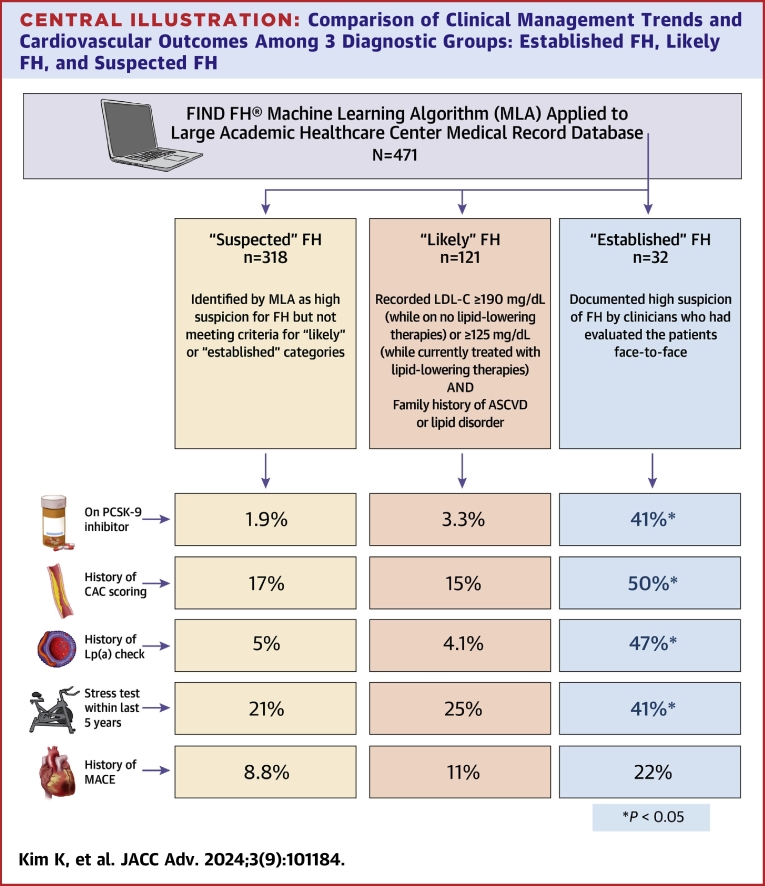
在5.5年多的时间里,MLA识别出471例FH可能性高的患者。121例(26%)之前未被诊断的患者符合“可能患有FH”的标准。与可能患有FH但未被诊断的患者相比,已确诊FH的患者(n = 32)进行血脂检测的次数明显更多,使用非他汀类或联合降脂药物的处方更多,看心脏病专家的次数更多,冠状动脉钙化评分(CACS)检测或脂蛋白(a)检测的频率更高。两组在既往发生重大不良心血管事件方面无显著差异。其余318例患者被归类为“疑似FH”。
这些发现表明,实施如FIND FH这样的MLA方法可能有助于识别未被诊断的FH患者,以及解决这一心血管风险增加人群中的治疗差异问题。