Bansal Shyam Bihari, Babras Mayur, Rana Abhyudaysingh, Mahapatra Amit, Yadav Dinesh Kumar, Sethi Sidharth Kumar
Department of Nephrology and Kidney Transplantation, Medanta Kidney and Urology Institute, Medanta-The Medicity, Gurgaon, Haryana, India.
Department of Nephrology, Seth Nandlal, Dhoot Hospital, Aurangabad, Maharashtra, India.
Indian J Nephrol. 2024 Sep-Oct;34(5):461-466. doi: 10.25259/ijn_399_23. Epub 2024 May 11.
Acute kidney injury (AKI) is common after coronavirus 2 infection (COVID-19), leading to higher morbidity and mortality. There is little prospective data from India regarding the incidence, risk factors, and outcome of AKI in COVID-19.
This study was conducted prospectively in adult patients between September and December 2020 in a tertiary care hospital in the national capital region of Delhi. A total of 856 patients with COVID-19 infection were enrolled in the study. Survivors were followed for 3 months after discharge.
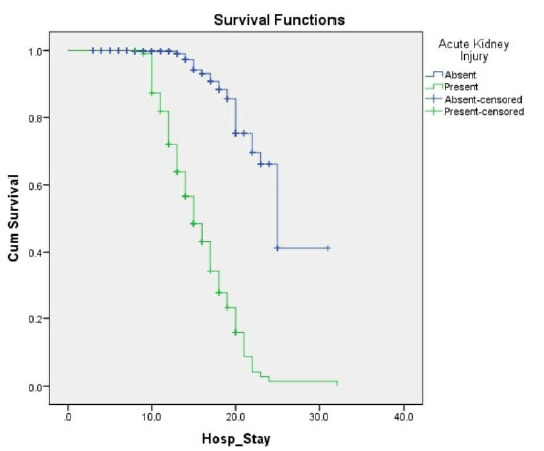
Out of 856 patients, 207 (24%) developed AKI. AKI was significantly higher in those with severe disease as compared to mild-moderate disease (88% vs. 12%, = 0.04). Out of all AKI, 3.4% had stage 1, 9.2% had stage 2, and the rest 87.4% had stage 3 AKI. 183/207 (88%) patients were on mechanical ventilators, 133 (64%) required inotropic support, and 137/207 (83.6%) patients required kidney replacement therapy. Out of 207 AKI patients, 74% (153) died as compared to 4% (27) in non-AKI group ( = 0.0001). After 3 months, chronic kidney disease (CKD) developed in 10/54 (18.5%) patients. On multivariable analysis, the presence of diabetes mellitus, severe COVID-19 disease, high levels of C reactive protein, lactate dehydrogenase, D-Dimer, and use of intravenous steroids, tocilizumab and remdesivir, were found to be significant predictors of AKI.
AKI is common after COVID-19 infection and it is a significant risk factor for mortality in COVID-19. Patients with diabetes and high levels of inflammatory markers have higher mortality. CKD may develop in many patients after discharge.
新型冠状病毒2感染(COVID-19)后急性肾损伤(AKI)很常见,会导致更高的发病率和死亡率。在印度,关于COVID-19中AKI的发病率、危险因素和结局的前瞻性数据很少。
本研究于2020年9月至12月在德里国家首都地区的一家三级护理医院对成年患者进行前瞻性研究。共有856例COVID-19感染患者纳入研究。幸存者出院后随访3个月。
856例患者中,207例(24%)发生AKI。与轻中度疾病患者相比,重症患者的AKI发生率显著更高(88%对12%,P = 0.04)。在所有AKI患者中,3.4%为1期,9.2%为2期,其余87.4%为3期AKI。207例患者中有183例(88%)使用机械通气,133例(64%)需要使用血管活性药物支持,137例(83.6%)患者需要肾脏替代治疗。207例AKI患者中,74%(153例)死亡,而非AKI组为4%(27例)(P = 0.0001)。3个月后,54例患者中有10例(18.5%)发生慢性肾脏病(CKD)。多变量分析显示,糖尿病、重症COVID-19疾病、高C反应蛋白、乳酸脱氢酶、D-二聚体水平以及使用静脉类固醇、托珠单抗和瑞德西韦是AKI的显著预测因素。
COVID-19感染后AKI很常见,且是COVID-19患者死亡的重要危险因素。糖尿病患者和炎症标志物水平高的患者死亡率更高。许多患者出院后可能会发生CKD。