Mathur Mohit, Sahay Manisha, Pereira Brian J G, Rizk Dana V
Visterra, Inc., Waltham, MA, USA.
Department of Nephrology, Osmania General Hospital and Osmania Medical College, Hyderabad, India.
Indian J Nephrol. 2024 Sep-Oct;34(5):417-430. doi: 10.25259/ijn_319_23. Epub 2024 Jun 24.
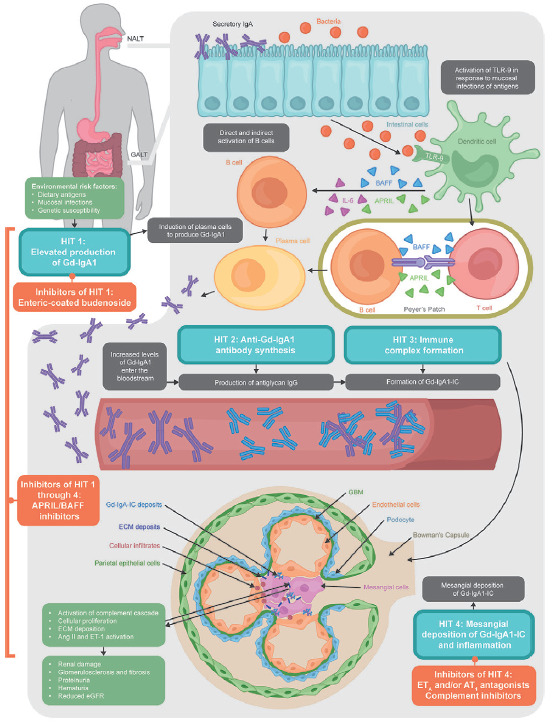
Immunoglobulin-A nephropathy (IgAN) is the most common primary glomerulonephritis in the world, with up to 40% of patients progressing to end-stage kidney disease (ESKD) within 30 years of diagnosis. IgAN is characterized by elevated serum levels of galactose-deficient IgA1 (Gd-IgA1), which leads to immune complex formation and deposition in the glomerular mesangium, causing kidney injury. A diverse disease course and the long-term follow-up required for clinically relevant endpoints (e.g., ESKD) have been barriers to the development of novel therapies in IgAN. Disease management has focused on supportive care with inhibitors of the renin-angiotensin system and, more recently, sodium-glucose transporter inhibitors to control proteinuria. The recent acceptance of proteinuria as a surrogate endpoint by regulatory bodies and a better understanding of disease pathology have helped to initiate the development of several novel treatments. Subsequently, a targeted-release formulation of budesonide and a dual endothelin/angiotensin inhibitor (sparsentan) have received accelerated approval for patients with IgAN. However, additional therapies are needed to target the different pathogenic mechanisms and individualize patient care. Several compounds currently under investigation target various effectors of pathology. There are promising clinical results from emerging compounds that target the generation of Gd-IgA1 by B cells, including inhibitors of A PRoliferation-Inducing Ligand (APRIL) and dual inhibitors of APRIL and B-cell activating factor (BAFF). Other investigational therapies target the complement cascade by inhibiting proteins of the lectin or alternative pathways. As the therapeutic landscape evolves, it will be important to revise treatment guidelines and develop updated standards of care.
免疫球蛋白A肾病(IgAN)是全球最常见的原发性肾小球肾炎,高达40%的患者在确诊后30年内进展为终末期肾病(ESKD)。IgAN的特征是血清中缺乏半乳糖的IgA1(Gd-IgA1)水平升高,这会导致免疫复合物形成并沉积于肾小球系膜,从而造成肾损伤。IgAN病程多样,且实现临床相关终点(如ESKD)需要长期随访,这些因素一直阻碍着IgAN新型疗法的开发。疾病管理主要侧重于使用肾素-血管紧张素系统抑制剂进行支持性治疗,最近则使用钠-葡萄糖转运体抑制剂来控制蛋白尿。监管机构最近将蛋白尿接受为替代终点,以及对疾病病理有了更好的理解,这些都有助于启动几种新型治疗方法的研发。随后,布地奈德的靶向释放制剂和一种双重内皮素/血管紧张素抑制剂(司帕生坦)已获得加速批准用于IgAN患者。然而,仍需要其他疗法来针对不同的致病机制并实现个体化患者护理。目前正在研究的几种化合物针对病理过程的各种效应器。针对B细胞产生Gd-IgA1的新型化合物已取得了有前景的临床结果,包括增殖诱导配体(APRIL)抑制剂以及APRIL和B细胞活化因子(BAFF)双重抑制剂。其他研究性疗法通过抑制凝集素途径或替代途径的蛋白质来靶向补体级联反应。随着治疗格局的演变,修订治疗指南并制定更新的护理标准将很重要。