Department of Clinical Laboratory, Shandong Provincial Hospital Affiliated to Shandong First Medical University, Jinan, China.
Department of Neurology, The Second Hospital of Shandong University, Cheeloo College of Medicine, Shandong University, Jinan, China.
Cancer Res Commun. 2024 Oct 1;4(10):2815-2822. doi: 10.1158/2767-9764.CRC-24-0402.
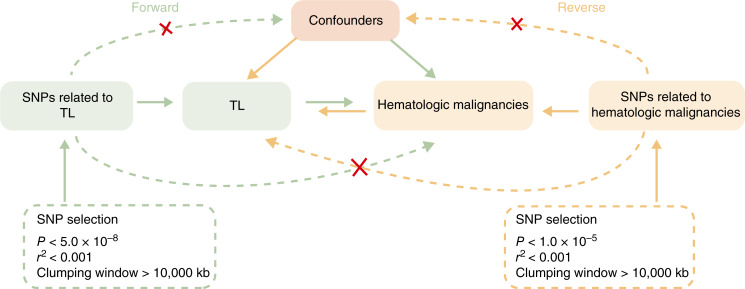
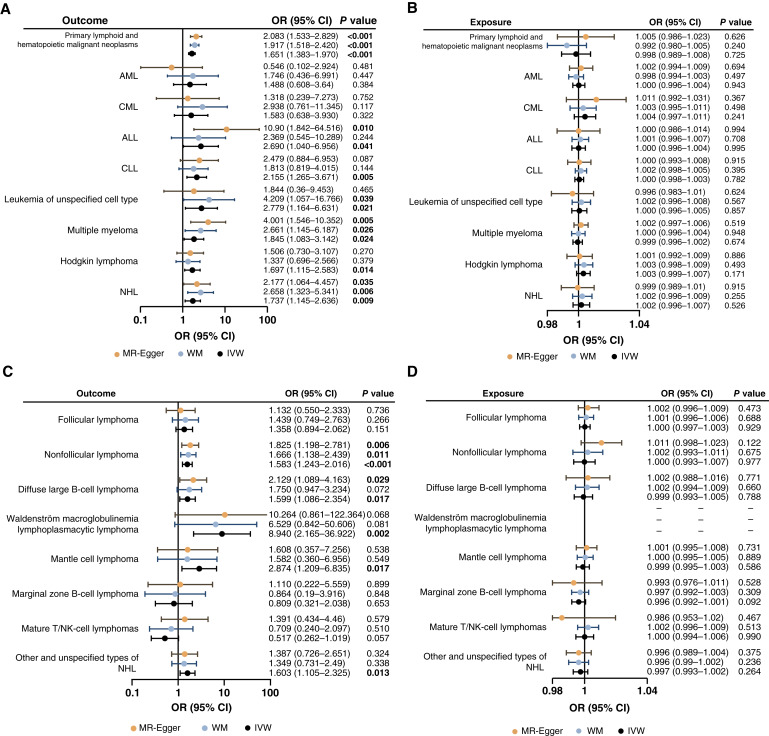
Growing evidence indicates a relationship between telomere length (TL) and the stage, prognosis, and treatment responsiveness of hematopoietic malignancies. However, the relationship between TL and the risk of hematologic malignancies remains unclear, considering the vulnerability of observational studies to potential confounding and reverse causation. A two-sample bidirectional Mendelian randomization (MR) analysis was conducted utilizing publicly available genome-wide association study data to assess whether TL was causally associated with the risk of hematologic malignancies. The inverse variance weighted approach was used as the primary assessment approach to evaluate the effects of the causes, augmented by the weighted median and MR-Egger methods. Cochran's Q test, MR-Egger intercept test, MR-Pleiotropy Residual Sum and Outlier test, and leave-one-out analysis were performed to evaluate sensitivity, heterogeneity, and pleiotropy. According to forward MR estimations, longer TL was related to an increased risk of acute lymphocytic leukemia (OR = 2.690; P = 0.041), chronic lymphocytic leukemia (OR = 2.155; P = 0.005), multiple myeloma (OR = 1.845; P = 0.024), Hodgkin lymphoma (OR = 1.697; P = 0.014), and non-Hodgkin lymphoma (OR = 1.737; P = 0.009). Specific types of non-Hodgkin lymphoma were also associated with TL. The reverse MR results revealed that hematologic malignancies had no effect on TL. This MR analysis revealed an association between longer TL and an increased risk of specific hematologic malignancies, indicating a potential role of TL in risk evaluation and management in hematologic malignancies.
In contrast to observational studies, this study uncovered the reliable causal relationships between TL and hematologic malignancies, emphasizing the potential role of telomeres in tumor development. TL maintenance may offer a promising strategy to reduce the risk of hematologic malignancies.
越来越多的证据表明端粒长度(TL)与造血系统恶性肿瘤的分期、预后和治疗反应有关。然而,考虑到观察性研究容易受到潜在混杂因素和反向因果关系的影响,TL 与血液系统恶性肿瘤风险之间的关系尚不清楚。本研究采用两样本双向孟德尔随机化(MR)分析,利用公开的全基因组关联研究数据,评估 TL 是否与血液系统恶性肿瘤的风险有因果关系。采用逆方差加权法作为主要评估方法,评估原因的影响,并结合加权中位数和 MR-Egger 法进行补充。采用 Cochran's Q 检验、MR-Egger 截距检验、MR-Pleiotropy Residual Sum and Outlier test 和逐一剔除分析来评估敏感性、异质性和多效性。根据正向 MR 估计,TL 较长与急性淋巴细胞白血病(OR = 2.690;P = 0.041)、慢性淋巴细胞白血病(OR = 2.155;P = 0.005)、多发性骨髓瘤(OR = 1.845;P = 0.024)、霍奇金淋巴瘤(OR = 1.697;P = 0.014)和非霍奇金淋巴瘤(OR = 1.737;P = 0.009)的风险增加相关。特定类型的非霍奇金淋巴瘤也与 TL 相关。反向 MR 结果显示血液系统恶性肿瘤对 TL 没有影响。本 MR 分析显示,TL 较长与特定血液系统恶性肿瘤的风险增加之间存在关联,表明 TL 在血液系统恶性肿瘤的风险评估和管理中可能发挥作用。
与观察性研究不同,本研究揭示了 TL 与血液系统恶性肿瘤之间可靠的因果关系,强调了端粒在肿瘤发展中的潜在作用。TL 的维持可能为降低血液系统恶性肿瘤的风险提供一种有前途的策略。