Division of Hematology and Oncology, Department of Medicine, Perelman School of Medicine, University of Pennsylvania, Philadelphia, PA.
Department of Hematology and Oncology, St. Luke's University Hospital, Easton, PA.
Blood Adv. 2024 Dec 10;8(23):5957-5974. doi: 10.1182/bloodadvances.2024014111.
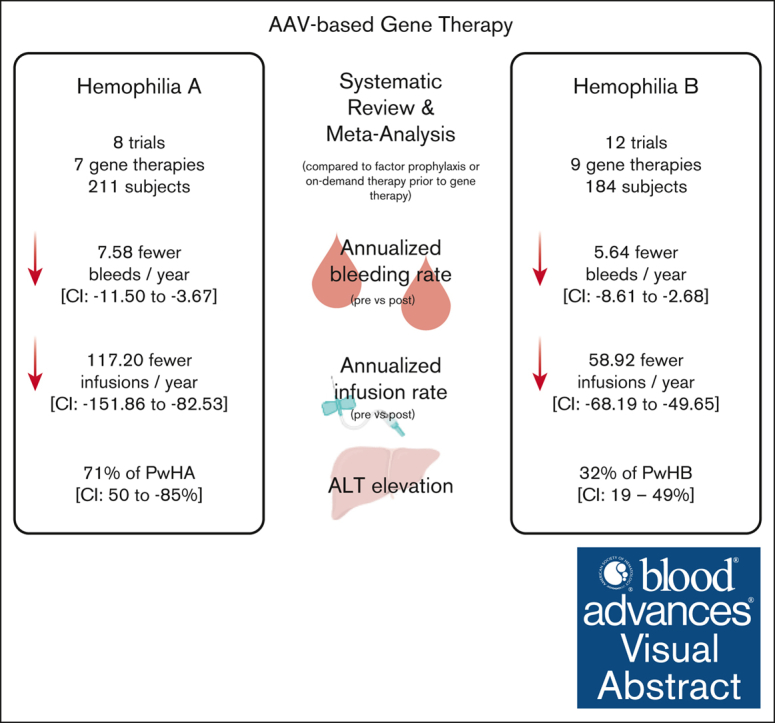
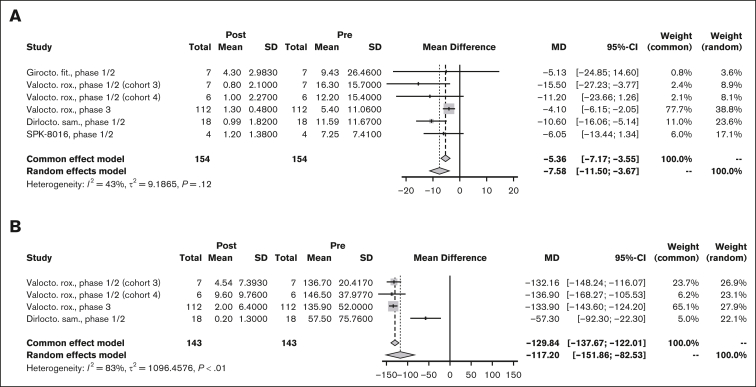
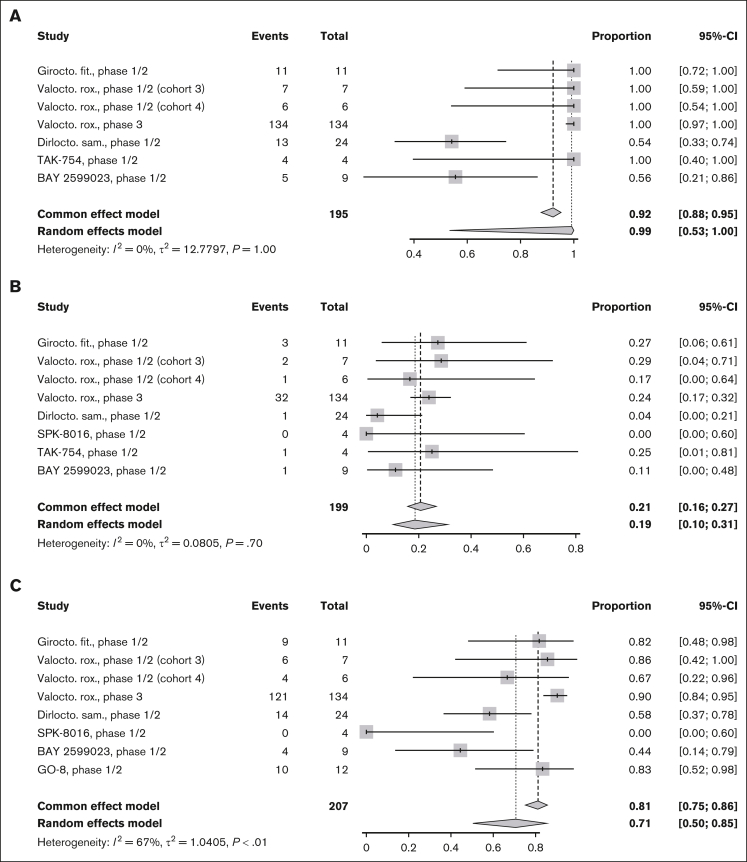
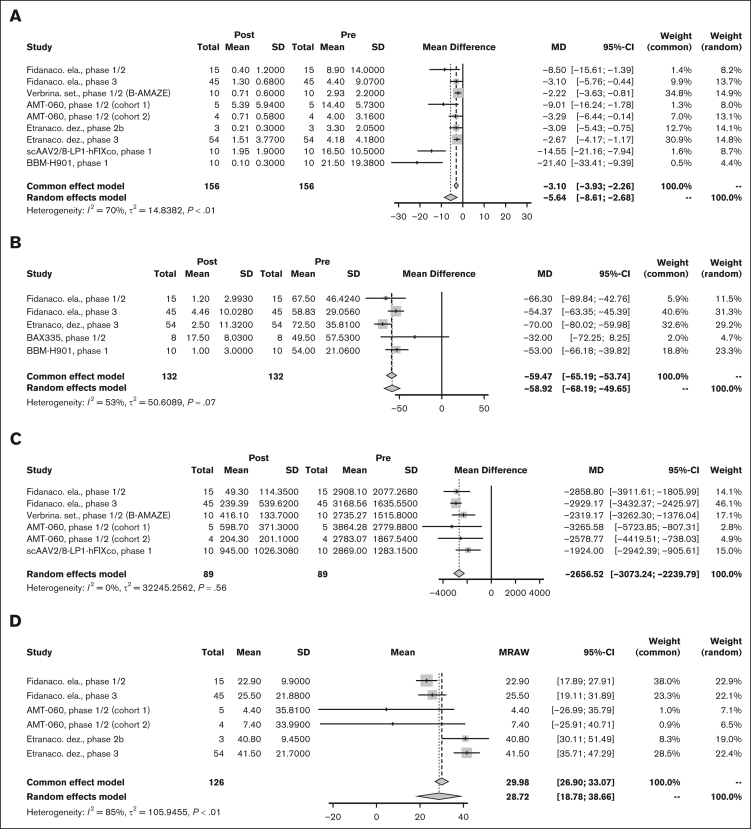
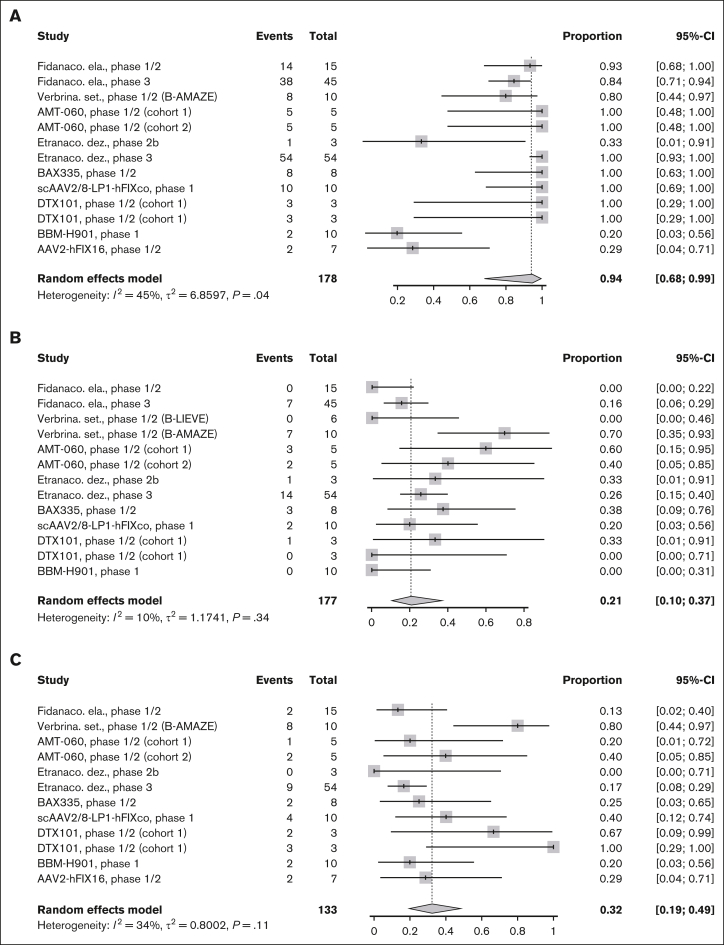
Adeno-associated virus (AAV)-based gene therapy is an emerging treatment for hemophilia A (HA) and hemophilia B (HB). In this systematic review and meta-analysis, we searched for studies of adult males with severe or moderately severe HA or HB who received AAV-based gene therapy. Annualized bleeding rate (ABR), annualized infusion rate (AIR), total factor use, factor levels, and adverse events (AEs) were extracted. Eight HA trials representing 7 gene therapies and 211 patients and 12 HB trials representing 9 gene therapies and 184 patients were included. For HA, gene therapy resulted in an annualized decrease of 7.58 bleeding events (95% confidence interval [CI], -11.50 to -3.67) and 117.2 factor infusions (95% CI, -151.86 to -82.53) compared with before gene therapy. Factor VIII level at 12 months ranged from 10.4 to 70.31 IU/mL by 1-stage assay. HB gene therapies were associated with an annualized decrease of 5.64 bleeding events (95% CI, -8.61 to -2.68) and 58.92 factor infusions (95% CI, -68.19 to -49.65). Mean factor IX level at 12 months was 28.72 IU/mL (95% CI, 18.78-38.66). Factor expression was more durable for HB than HA; factor IX levels remained at 95.7% of their peak whereas factor VIII levels fell to 55.8% of their peak at 24 months. The pooled percentage of patients experiencing a serious AE was 19% (10%-31%) and 21% (10%-37%) for HA and HB gene therapies, respectively. No thrombosis or inhibitor formation was reported. AAV-based gene therapies for both HA and HB demonstrated significant reductions in ABR, AIR, and factor use.
腺相关病毒 (AAV) 为基础的基因治疗是一种新兴的治疗甲型血友病 (HA) 和乙型血友病 (HB) 的方法。在这项系统评价和荟萃分析中,我们检索了接受 AAV 为基础的基因治疗的成年男性严重或中度严重 HA 或 HB 的研究。提取年化出血率 (ABR)、年化输注率 (AIR)、总因子使用量、因子水平和不良事件 (AE)。纳入了 8 项 HA 试验,代表了 7 种基因疗法和 211 例患者,以及 12 项 HB 试验,代表了 9 种基因疗法和 184 例患者。对于 HA,与基因治疗前相比,基因治疗导致年化出血事件减少 7.58 次(95%置信区间 [CI],-11.50 至-3.67)和年化因子输注减少 117.2 次(95%CI,-151.86 至-82.53)。12 个月时,1 期检测的因子 VIII 水平范围为 10.4 至 70.31 IU/mL。HB 基因疗法与年化出血事件减少 5.64 次(95%CI,-8.61 至-2.68)和年化因子输注减少 58.92 次(95%CI,-68.19 至-49.65)相关。12 个月时平均因子 IX 水平为 28.72 IU/mL(95%CI,18.78-38.66)。HB 的因子表达比 HA 更持久;因子 IX 水平保持在峰值的 95.7%,而因子 VIII 水平在 24 个月时降至峰值的 55.8%。HA 和 HB 基因治疗的严重 AE 发生率分别为 19%(10%-31%)和 21%(10%-37%)。没有报告血栓形成或抑制剂形成。HA 和 HB 的 AAV 为基础的基因治疗均显著降低了 ABR、AIR 和因子的使用。