Centellas Polette J, Mehringer Kyle D, Bowman Andrew L, Evans Katherine M, Vagholkar Parth, Thornell Travis L, Huang Liping, Morgan Sarah E, Soles Christopher L, Simon Yoan C, Chan Edwin P
Materials Science and Engineering Division, National Institute of Standards and Technology, Gaithersburg, USA.
School of Polymer Science and Engineering, University of Southern Mississippi, Hattiesburg, USA.
Nat Commun. 2024 Oct 7;15(1):8596. doi: 10.1038/s41467-024-52663-1.
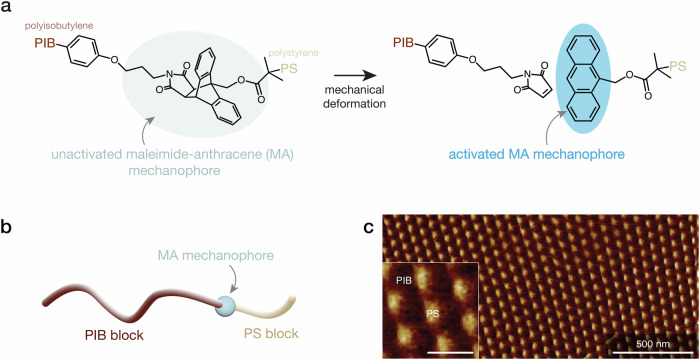
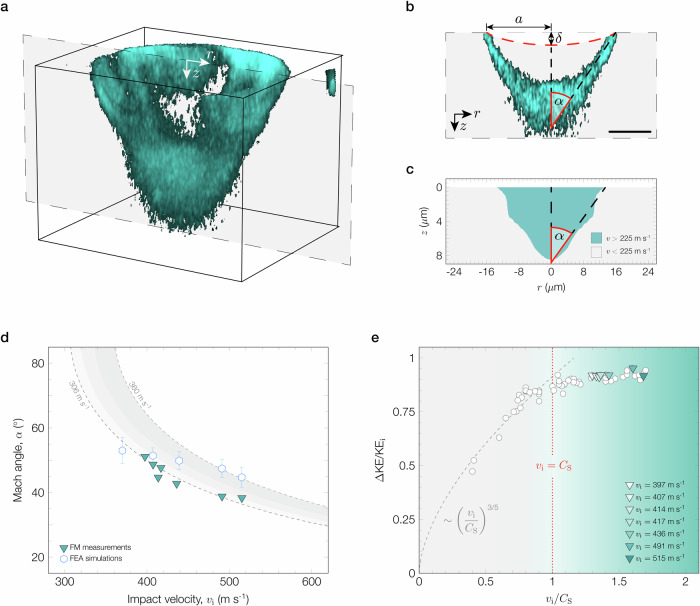
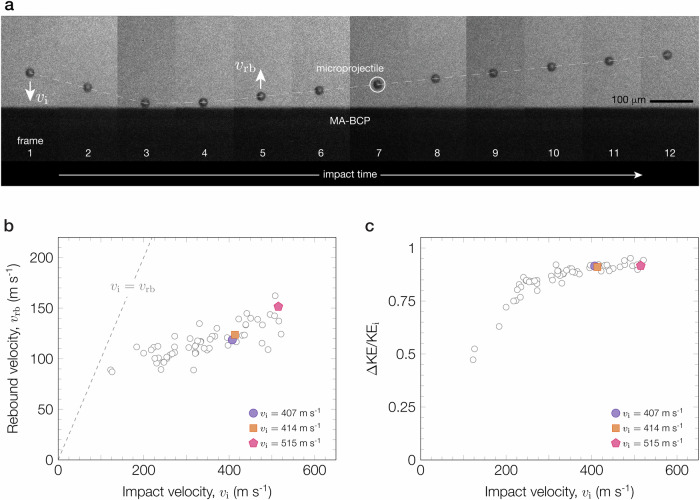
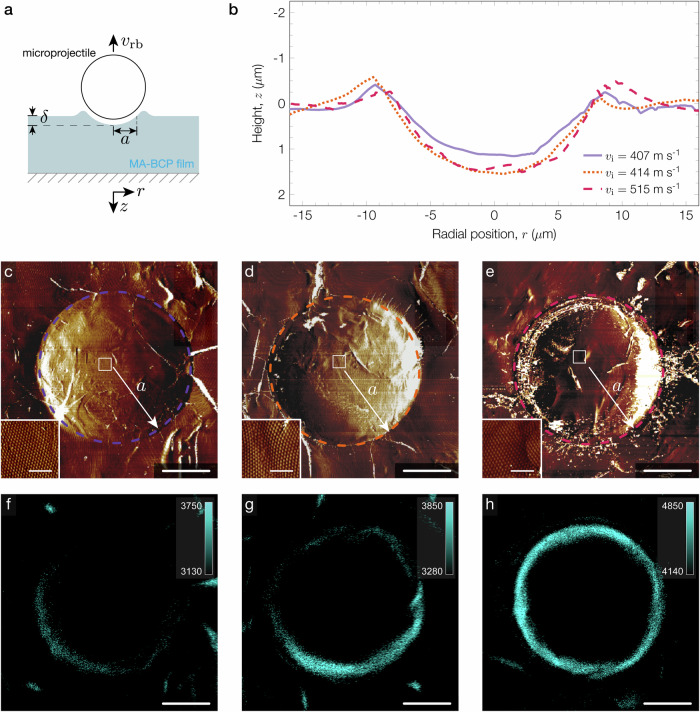
Understanding the physical and chemical response of materials to impulsive deformation is crucial for applications ranging from soft robotic locomotion to space exploration to seismology. However, investigating material properties at extreme strain rates remains challenging due to temporal and spatial resolution limitations. Combining high-strain-rate testing with mechanochemistry encodes the molecular-level deformation within the material itself, thus enabling the direct quantification of the material response. Here, we demonstrate a mechanophore-functionalized block copolymer that self-reports energy dissipation mechanisms, such as bond rupture and acoustic wave dissipation, in response to high-strain-rate impacts. A microprojectile accelerated towards the polymer permanently deforms the material at a shallow depth. At intersonic velocities, the polymer reports significant subsurface energy absorption due to shockwave attenuation, a mechanism traditionally considered negligible compared to plasticity and not well explored in polymers. The acoustic wave velocity of the material is directly recovered from the mechanochemically-activated subsurface volume recorded in the material, which is validated by simulations, theory, and acoustic measurements. This integration of mechanochemistry with microballistic testing enables characterization of high-strain-rate mechanical properties and elucidates important insights applicable to nanomaterials, particle-reinforced composites, and biocompatible polymers.
了解材料对脉冲变形的物理和化学反应,对于从软机器人运动到太空探索再到地震学等一系列应用至关重要。然而,由于时间和空间分辨率的限制,在极端应变率下研究材料特性仍然具有挑战性。将高应变率测试与机械化学相结合,能够对材料本身的分子水平变形进行编码,从而实现对材料响应的直接量化。在此,我们展示了一种机械响应基团功能化的嵌段共聚物,它能够自我报告在高应变率冲击下的能量耗散机制,如键断裂和声波耗散。一个朝着聚合物加速的微射弹会在浅深度使材料发生永久变形。在亚音速速度下,该聚合物报告了由于冲击波衰减导致的显著的次表面能量吸收,这一机制在传统上与塑性相比被认为可忽略不计,并且在聚合物中也未得到充分研究。材料的声速可直接从材料中记录的机械化学激活的次表面体积中恢复,这通过模拟、理论和声学测量得到了验证。这种机械化学与微弹道测试的结合,能够表征高应变率下的机械性能,并阐明适用于纳米材料、颗粒增强复合材料和生物相容性聚合物的重要见解。