Global Health Research Center, Duke Kunshan University, Academic Building 3038, 8 Duke Avenue, Kunshan, 215316, Jiangsu, China.
Department of Global Health, School of Public Health, Wuhan University, Wuhan, Hubei, China.
Sci Rep. 2024 Oct 7;14(1):23311. doi: 10.1038/s41598-024-74185-y.
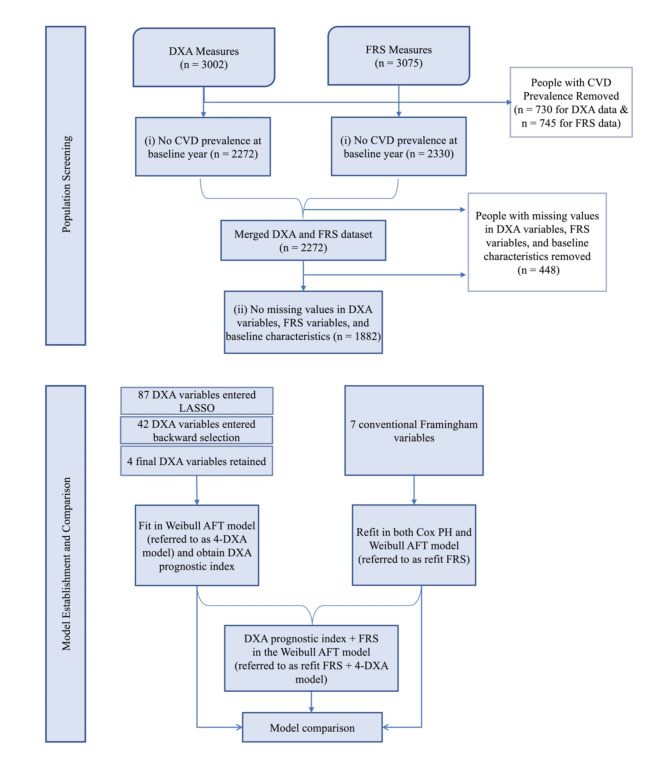
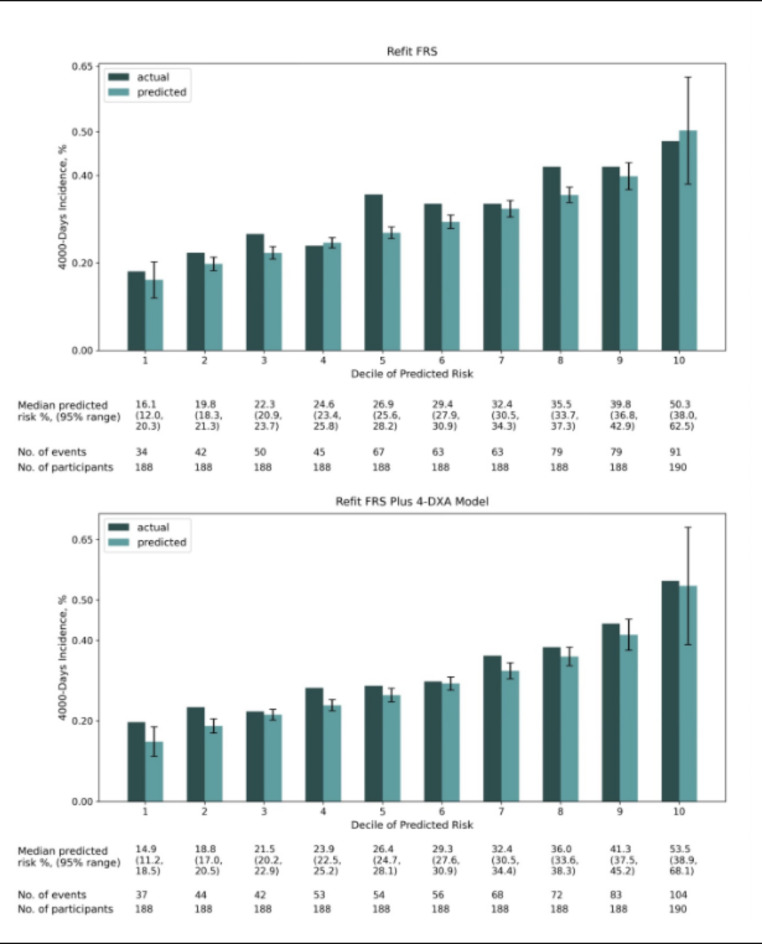
Cardiovascular disease (CVD) is a major chronic disease worldwide and its risk factors have long been investigating in epidemiological studies. Our study aims to develop a body composition-based risk score and integrate it into the Framingham Risk Score (FRS) to improve CVD prediction among well-functioning older adults. We included 1882 older adults from the Health, Aging and Body Composition (Health ABC) study to screen body composition variables obtained from the Dual-energy X-ray absorptiometry (DXA). Three models were developed and compared: the 4-DXA model, the refit FRS, and the refit FRS plus 4-DXA model. C-statistics were 0.62 (95% CI: 0.59, 0.65) for the refit FRS, 0.58 (95% CI: 0.55, 0.61) for the 4-DXA model, and 0.63 (95% CI: 0.60, 0.66) for the refit FRS plus 4-DXA model. Compared to the refit FRS, the refit FRS plus 4-DXA model slightly improved CVD outcome prediction as the discrimination slope, net reclassification index, and the integrated discrimination index were 0.053 (95% CI: 0.041, 0.066), 0.098 (95% CI = - 0.0033, 0.20) and 0.013 (95% CI: 0.0069-0.019). This study provides a model for more accurate risk stratification and draws more attention on DXA-based indices in the clinical setting. It also encourages further research in validating the developed risk score in more diverse population and in investigating a broader range of CVD risk factors.
心血管疾病 (CVD) 是全球范围内的主要慢性疾病,其危险因素在流行病学研究中早已得到广泛研究。本研究旨在开发一种基于人体成分的风险评分,并将其整合到 Framingham 风险评分 (FRS) 中,以提高功能良好的老年人的 CVD 预测能力。我们纳入了来自健康、衰老和身体成分研究 (Health ABC) 的 1882 名老年人,以筛选双能 X 射线吸收法 (DXA) 获得的人体成分变量。我们开发并比较了三种模型:4-DXA 模型、重新拟合的 FRS 和重新拟合的 FRS 加 4-DXA 模型。重新拟合的 FRS 的 C 统计量为 0.62(95%CI:0.59,0.65),4-DXA 模型为 0.58(95%CI:0.55,0.61),重新拟合的 FRS 加 4-DXA 模型为 0.63(95%CI:0.60,0.66)。与重新拟合的 FRS 相比,重新拟合的 FRS 加 4-DXA 模型略微提高了 CVD 结局预测的准确性,其区分斜率、净重新分类指数和综合区分指数分别为 0.053(95%CI:0.041,0.066)、0.098(95%CI=-0.0033,0.20)和 0.013(95%CI:0.0069-0.019)。本研究提供了一种更准确的风险分层模型,并引起了人们对临床实践中基于 DXA 的指标的更多关注。它还鼓励在更多样化的人群中进一步验证所开发的风险评分,并研究更广泛的 CVD 风险因素。