Department of Nephrology, Nagasaki University Graduate School of Biomedical Sciences, Nagasaki, Japan.
Nagasaki Renal Center, Nagasaki, Japan.
Ren Fail. 2024 Dec;46(2):2410375. doi: 10.1080/0886022X.2024.2410375. Epub 2024 Oct 8.
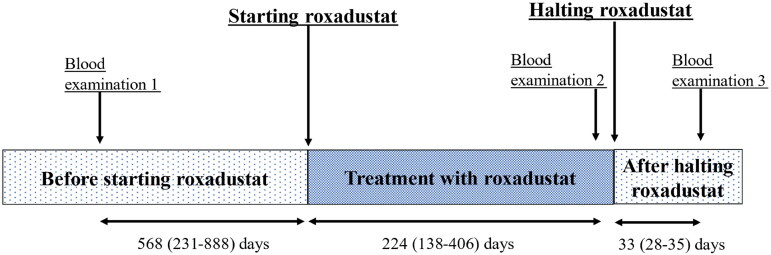
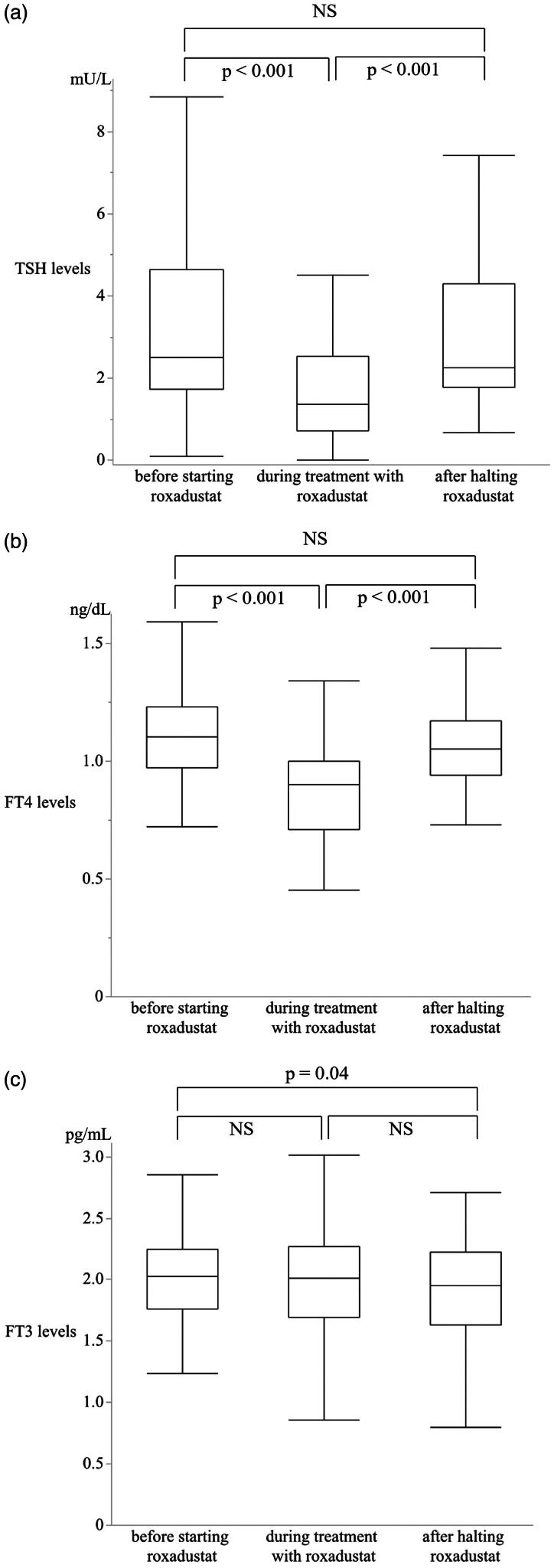
Roxadustat, a hypoxia-inducible factor-prolyl hydroxylase inhibitor, has proven efficacy in the treatment of renal anemia; however, evidence indicates that it may cause central hypothyroidism. The prevalence and reversibility of roxadustat-induced central hypothyroidism in patients undergoing hemodialysis remain unclear. Here, we retrospectively analyzed thyroid-stimulating hormone (TSH), free thyroxine (FT4), and free triiodothyronine (FT3) levels in 51 patients (mean age: 72.3 ± 10.7 years; 58.8% male) undergoing hemodialysis before, during, and after halting roxadustat treatment. TSH levels were significantly decreased from a median of 2.46 (interquartile range:1.60-4.51) mU/L before roxadustat treatment to 1.36 (0.72-2.41) mU/L during treatment ( < 0.001), and improved to 2.56 (1.78-4.63) mU/L after halting roxadustat ( < 0.001). Similarly, FT4 levels decreased from 1.11 (0.97-1.24) ng/dL before roxadustat treatment to 0.92 (0.71-1.03) ng/dL during treatment ( < 0.001) and improved to 1.05 (0.93-1.17) ng/dL after halting roxadustat ( < 0.001). FT3 levels were 2.04 (1.78-2.31) pg/mL before starting roxadustat, 1.97 (1.69-2.27) pg/mL during treatment, and 1.90 (1.63-2.18) pg/mL after halting roxadustat, with no significant difference between each group. Moreover, 2.0% of patients exhibited extremely low TSH levels (≤0.1 mU/L) and low TSH levels (>0.1 mU/L to <0.4 mU/L) before starting roxadustat and that percentage increased to 5.9% and 7.8%, respectively, during treatment. After roxadustat cessation, extremely low or low TSH levels recovered in all patients. Taken together, the results indicate that roxadustat can cause reversible central hypothyroidism in patients undergoing hemodialysis.
罗沙司他是一种低氧诱导因子脯氨酰羟化酶抑制剂,已被证明在治疗肾性贫血方面有效;然而,有证据表明它可能导致中枢性甲状腺功能减退症。在接受血液透析的患者中,罗沙司他引起的中枢性甲状腺功能减退症的患病率和可逆转性仍不清楚。在这里,我们回顾性分析了 51 例(平均年龄:72.3±10.7 岁;58.8%为男性)接受血液透析的患者在开始罗沙司他治疗前、治疗期间和停止治疗后的促甲状腺激素(TSH)、游离甲状腺素(FT4)和游离三碘甲状腺原氨酸(FT3)水平。TSH 水平从开始罗沙司他治疗前的中位数 2.46(四分位距:1.60-4.51)mU/L 显著降低至治疗期间的 1.36(0.72-2.41)mU/L( < 0.001),并在停止罗沙司他治疗后改善至 2.56(1.78-4.63)mU/L( < 0.001)。同样,FT4 水平从开始罗沙司他治疗前的 1.11(0.97-1.24)ng/dL 降低至治疗期间的 0.92(0.71-1.03)ng/dL( < 0.001),并在停止罗沙司他治疗后改善至 1.05(0.93-1.17)ng/dL( < 0.001)。FT3 水平在开始罗沙司他治疗前为 2.04(1.78-2.31)pg/mL,治疗期间为 1.97(1.69-2.27)pg/mL,停止治疗后为 1.90(1.63-2.18)pg/mL,各组间无显著差异。此外,在开始罗沙司他治疗前,有 2.0%的患者出现极低 TSH 水平(≤0.1 mU/L)和低 TSH 水平(>0.1 mU/L 至<0.4 mU/L),而在治疗期间,这一比例分别增加到 5.9%和 7.8%。停止罗沙司他治疗后,所有患者的极低或低 TSH 水平均恢复正常。综上所述,结果表明罗沙司他可导致接受血液透析的患者发生可逆性中枢性甲状腺功能减退症。