
遗传性弥漫性胃癌(HDGC)管理的当前进展与挑战:一项叙述性综述
Current advances and challenges in Managing Hereditary Diffuse Gastric Cancer (HDGC): a narrative review.
作者信息
van der Sluis L, van Dieren J M, van der Post R S, Bisseling T M
机构信息
Department of Gastroenterology, Radboud university medical centre, Nijmegen, The Netherlands.
Department of Gastrointestinal Oncology, The Netherlands Cancer Institute, Amsterdam, The Netherlands.
出版信息
Hered Cancer Clin Pract. 2024 Oct 8;22(1):21. doi: 10.1186/s13053-024-00293-5.
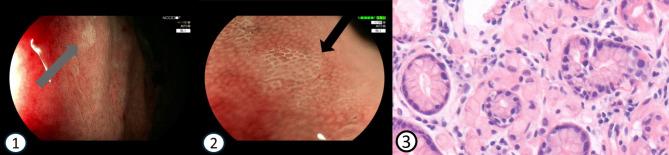
More than 25 years ago, CDH1 pathogenic variants (PVs) were identified as the primary cause of hereditary diffuse gastric cancer (HDGC), an inherited cancer syndrome that increases the lifetime risk of developing diffuse gastric cancer (DGC) and lobular breast cancer (LBC). Since DGC is associated with a poor prognosis, a prophylactic total gastrectomy (PTG) is currently the gold standard for reducing the risk of DGC in CDH1 PV carriers. However, as germline genetic testing becomes more widespread, many CDH1 PV carriers have been identified, including in families with lower penetrance levels or without a history of gastric cancer (GC). When including these families, recent findings suggest that the cumulative lifetime risk of developing advanced DGC is much lower than previously thought and is now estimated to be 13-19%. This lower risk, combined with the fact that around one third of the CDH1 PV carriers decline PTG due to potential lifelong physical and psychological consequences, raises critical questions about the current uniformity in recommending PTG to all CDH1 PV carriers. As a result, there is a growing need to consider alternative strategies, such as endoscopic surveillance. However, despite the currently lower estimated risk of infiltrative (advanced) DGC, almost every PTG specimen shows the presence of small low-stage (pT1a) signet ring cell (SRC) lesions of which the behaviour is unpredictable but often are considered indolent or premalignant stages of DGC. Therefore, the primary goal of surveillance should be to identify atypical, deeper infiltrating lesions rather than every SRC lesion. Understanding the progression from indolent to more infiltrative lesions, and recognizing their endoscopic and histological features, is crucial in deciding the most suitable management option for each individual.
25年多前,CDH1致病变异(PVs)被确定为遗传性弥漫性胃癌(HDGC)的主要病因,HDGC是一种遗传性癌症综合征,会增加患弥漫性胃癌(DGC)和小叶乳腺癌(LBC)的终生风险。由于DGC预后较差,预防性全胃切除术(PTG)目前是降低CDH1 PV携带者患DGC风险的金标准。然而,随着种系基因检测越来越普遍,已发现许多CDH1 PV携带者,包括那些外显率较低或无胃癌(GC)病史的家庭中的携带者。纳入这些家庭后,最近的研究结果表明,发生晚期DGC的累积终生风险远低于此前的认知,目前估计为13%-19%。这一较低的风险,再加上约三分之一的CDH1 PV携带者因潜在的终身身心影响而拒绝PTG,引发了对于目前向所有CDH1 PV携带者推荐PTG的一致性的关键问题。因此,越来越需要考虑替代策略,如内镜监测。然而,尽管目前估计浸润性(晚期)DGC的风险较低,但几乎每个PTG标本都显示存在小的低分期(pT1a)印戒细胞(SRC)病变,其行为不可预测,但通常被认为是DGC的惰性或癌前阶段。因此,监测的主要目标应该是识别非典型的、浸润更深的病变,而不是每个SRC病变。了解从惰性病变到更具浸润性病变的进展,并认识其内镜和组织学特征,对于为每个个体确定最合适的管理方案至关重要。
 Zotero 插件