Kinney Rebecca L, Copeland Laurel A, Tsai Jack, Abbott Alice A, Wallace Kate, Walker Lorrie A, Weber Jillian, Katsos Shara, McInnes Donald K
VA National Center on Homelessness Among Veterans, U.S. Department of Veterans Affairs, Washington, DC, USA.
VA Central Western Massachusetts Healthcare System, Leeds, MA, USA.
Digit Health. 2024 Oct 7;10:20552076241282629. doi: 10.1177/20552076241282629. eCollection 2024 Jan-Dec.
Prior to the coronavirus disease-2019 (COVID-19) pandemic the U.S. Department of Veterans Affairs (VA) had the largest telehealth program in the United States. The pandemic motivated providers within the VA to expand telehealth in effort to reduce disrupted care while mitigating risks. The pandemic provides a rare opportunity to examine how to better engage veterans experiencing housing instability (HI) in telehealth diabetes care.
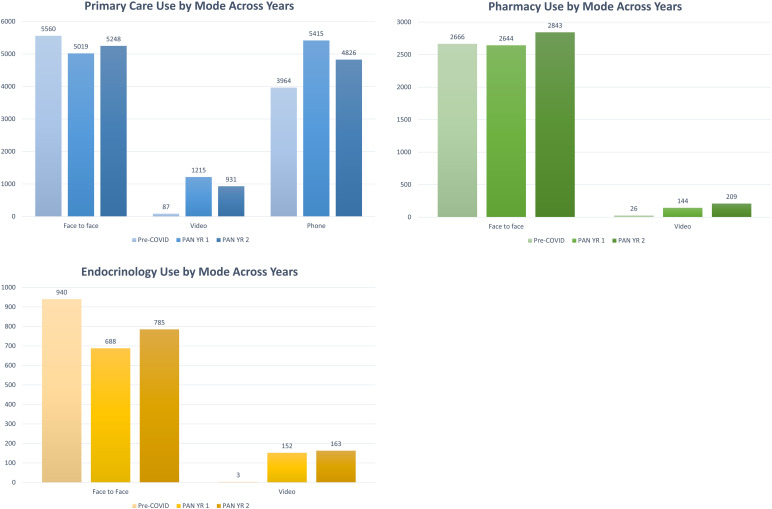
Mixed methods design to examine VA video connect (VVC) diabetes care utilization among veterans experiencing HI from March 1, 2019, to March 1, 2022, combining multivariable regression analyses of VA administrative data with semi-structured interviews. Study aims included: (a) examine changes in diabetes care delivery mode over the peri-pandemic timeframe; (b) identify sociodemographic and clinical characteristics associated with VVC care among veterans with HI; and (c) understand the facilitators and barriers of VVC utilization.
Totally, 5904 veterans were eligible for study analysis. Veterans who are female (OR: 1.63; 95% CI: 1.3, 2.0; < 0.0001), self-identify as Hispanic (OR: 1.44; 95% CI: 1.1, 1.9; = 0.02), are married (OR: 1.39; 95% CI: 1.2, 1.6; < 0.0001), and are in VA priority group 1 (OR: 1.21; 95% CI 1.1, 1.4; = 0.004) were more likely to use VVC the pandemic. Veterans of older age (OR: 0.97; 95% CI: 0.97, 0.98; < .0001) and rural dwelling (OR: 0.85; 95% CI: 0.7, 1.2; = 0.04), were less likely to use VVC. Thirteen VA providers and 15 veterans were interviewed. Veterans reported that decisions about using VVC were driven by limitations in in-person care availability, safety, and convenience.
Telehealth played an important role in providing veterans with HI access to diabetes care during the pandemic. Future interventions should seek to increase education and technology in effort to increase VVC uptake into routine diabetes care to ensure veterans' optimal and equitable access.
在2019冠状病毒病(COVID-19)大流行之前,美国退伍军人事务部(VA)拥有美国最大的远程医疗项目。这场大流行促使VA内部的医疗服务提供者扩大远程医疗,以减少中断的护理,同时降低风险。这场大流行提供了一个难得的机会,来研究如何更好地让经历住房不稳定(HI)的退伍军人参与远程医疗糖尿病护理。
采用混合方法设计,研究2019年3月1日至2022年3月1日期间经历HI的退伍军人对VA视频连接(VVC)糖尿病护理的利用情况,将VA行政数据的多变量回归分析与半结构化访谈相结合。研究目标包括:(a)检查大流行期间糖尿病护理提供模式的变化;(b)确定HI退伍军人中与VVC护理相关的社会人口学和临床特征;(c)了解VVC使用的促进因素和障碍。
共有5904名退伍军人符合研究分析条件。女性退伍军人(比值比:1.63;95%置信区间:1.3,2.0;P<0.0001)、自我认定为西班牙裔的退伍军人(比值比:1.44;95%置信区间:1.1,1.9;P = 0.02)、已婚退伍军人(比值比:1.39;95%置信区间:1.2,1.6;P<0.0001)以及属于VA优先组1的退伍军人(比值比:1.21;95%置信区间1.1,1.4;P = 0.004)在大流行期间更有可能使用VVC。年龄较大的退伍军人(比值比:0.97;95%置信区间:0.97,0.98;P<0.0001)和居住在农村的退伍军人(比值比:0.85;95%置信区间:0.7,1.2;P = 0.04)使用VVC的可能性较小。对13名VA医疗服务提供者和15名退伍军人进行了访谈。退伍军人报告说,使用VVC的决定是由面对面护理的可及性、安全性和便利性方面的限制驱动的。
在大流行期间,远程医疗在为经历HI的退伍军人提供糖尿病护理方面发挥了重要作用。未来的干预措施应寻求增加教育和技术,以努力提高VVC在常规糖尿病护理中的采用率,确保退伍军人获得最佳和公平的医疗服务。