Holida Myrl, Linhart Aleš, Pisani Antonio, Longo Nicola, Eyskens François, Goker-Alpan Ozlem, Wallace Eric, Deegan Patrick, Tøndel Camilla, Feldt-Rasmussen Ulla, Hughes Derralynn, Sakov Anat, Rocco Rossana, Almon Einat Brill, Alon Sari, Chertkoff Raul, Warnock David G, Waldek Stephen, Wilcox William R, Bernat John A
Division of Medical Genetics and Genomics, Stead Family Department of Pediatrics, University of Iowa, Iowa City, Iowa, USA.
Charles University, General University Hospital, Prague, Czech Republic.
J Inherit Metab Dis. 2025 Jan;48(1):e12795. doi: 10.1002/jimd.12795. Epub 2024 Oct 9.
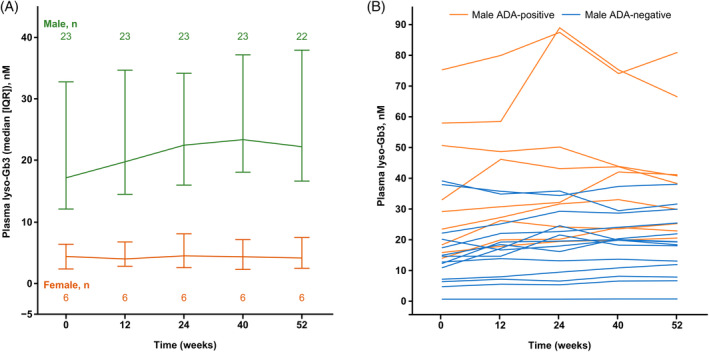
Pegunigalsidase alfa, a PEGylated α-galactosidase A enzyme replacement therapy (ERT) for Fabry disease, has a longer plasma half-life than other ERTs administered intravenously every 2 weeks (E2W). BRIGHT (NCT03180840) was a phase III, open-label study in adults with Fabry disease, previously treated with agalsidase alfa or beta E2W for ≥3 years, who switched to 2 mg/kg pegunigalsidase alfa every 4 weeks (E4W) for 52 weeks. Primary objective assessed safety, including number of treatment-emergent adverse events (TEAEs). Thirty patients were enrolled (24 males); 23 previously received agalsidase beta. Pegunigalsidase alfa plasma concentrations remained above the lower limit of quantification throughout the 4-week dosing interval. Thirty-three of 182 TEAEs (in 9 patients) were considered treatment-related; all were mild/moderate. No patients developed de novo anti-drug antibodies (ADAs). In the efficacy analysis (n = 29), median (inter-quartile range) eGFR change from baseline over 52 weeks was -1.9 (-5.9; 1.8) mL/min/1.73 m (n = 28; males [n = 22]: -2.4 [-5.2; 3.2]; females [n = 6]: -0.7 [-9.2; 2.0]). Overall, median eGFR slope was -1.9 (-8.3; 1.9) mL/min/1.73 m/year (ADA-negative [n = 20]: -1.2 [-6.4; 2.6]; ADA-positive [n = 9]: -8.4 [-11.6; -1.0]). Lyso-Gb3 concentrations were low and stable in females, with a slight increase in males (9/24 ADA-positive). The BRIGHT study results suggest that 2 mg/kg pegunigalsidase alfa E4W is tolerated well in stable adult patients with Fabry disease. Due to the low number of patients in this study, more research is needed to demonstrate the effects of pegunigalsidase alfa given E4W. Further evidence, outside of this clinical trial, should be factored in for physicians to prolong the biweekly ERT intervals to E4W. TAKE-HOME MESSAGE: Treatment with 2 mg/kg pegunigalsidase alfa every 4 weeks could offer a new treatment option for patients with Fabry disease.
聚乙二醇化α-半乳糖苷酶α是一种用于法布里病的聚乙二醇化α-半乳糖苷酶A酶替代疗法(ERT),其血浆半衰期比每2周静脉注射一次(E2W)的其他ERT更长。BRIGHT(NCT03180840)是一项针对成年法布里病患者的III期开放标签研究,这些患者此前接受阿加糖酶α或β每2周一次的治疗≥3年,改为每4周(E4W)接受2mg/kg聚乙二醇化α-半乳糖苷酶α治疗52周。主要目标评估安全性,包括治疗中出现的不良事件(TEAE)数量。共纳入30例患者(24例男性);23例此前接受过阿加糖酶β治疗。在整个4周给药间隔期间,聚乙二醇化α-半乳糖苷酶α的血浆浓度保持在定量下限以上。182例TEAE中的33例(9例患者)被认为与治疗相关;均为轻度/中度。无患者产生新的抗药抗体(ADA)。在疗效分析中(n = 29),52周内估算肾小球滤过率(eGFR)较基线的变化中位数(四分位间距)为-1.9(-5.9;1.8)mL/min/1.73m²(n = 28;男性[n = 22]:-2.4[-5.2;3.2];女性[n = 6]:-0.7[-9.2;2.0])。总体而言,eGFR斜率中位数为-1.9(-8.3;1.9)mL/min/1.73m²/年(ADA阴性[n = 20]:-1.2[-6.4;2.6];ADA阳性[n = 9]:-8.4[-11.6;-1.0])。女性溶酶体Gb3浓度低且稳定,男性略有升高(9/24例ADA阳性)。BRIGHT研究结果表明,每4周一次给予2mg/kg聚乙二醇化α-半乳糖苷酶α在病情稳定的成年法布里病患者中耐受性良好。由于本研究患者数量较少,需要更多研究来证明每4周一次给予聚乙二醇化α-半乳糖苷酶α的效果。在这项临床试验之外,还应考虑更多证据,以便医生将每两周一次的ERT间隔延长至每4周一次。重要信息:每4周用2mg/kg聚乙二醇化α-半乳糖苷酶α治疗可为法布里病患者提供一种新的治疗选择。