Institute for Bioengineering of Catalonia (IBEC), The Barcelona Institute for Science and Technology, Barcelona 08028, Spain.
Networking Biomedical Center in Bioengineering, Biomaterials, and Nanomedicine (CIBER-BBN), ISCIII, Barcelona 08028, Spain.
J Am Chem Soc. 2024 Oct 23;146(42):28822-28831. doi: 10.1021/jacs.4c08446. Epub 2024 Oct 9.
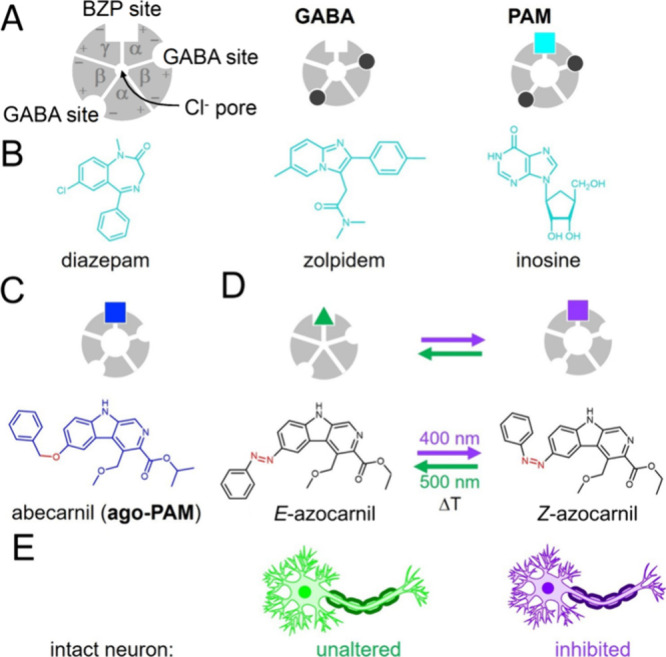
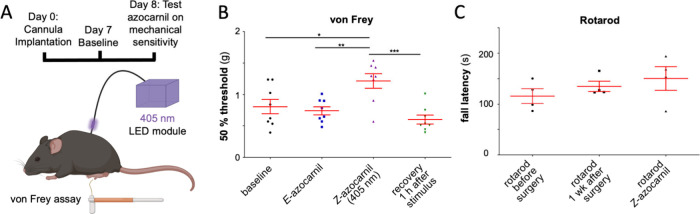
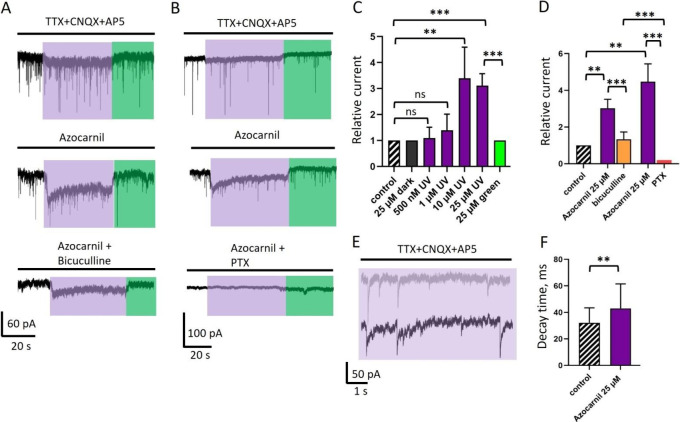
Gamma aminobutyric acid type A receptors (GABARs) play a key role in the mammalian central nervous system (CNS) as drivers of neuroinhibitory circuits, which are commonly targeted for therapeutic purposes with potentiator drugs. However, due to their widespread expression and strong inhibitory action, systemic pharmaceutical potentiation of GABARs inevitably causes adverse effects regardless of the drug selectivity. Therefore, therapeutic guidelines must often limit or exclude clinically available GABAR potentiators, despite their high efficacy, good biodistribution, and favorable molecular properties. One solution to this problem is to use drugs with light-dependent activity (photopharmacology) in combination with on-demand, localized illumination. However, a suitable light-activated potentiator of GABARs has been elusive so far for use in wildtype mammals. We have met this need by developing azocarnil, a diffusible GABAergic agonist-potentiator based on the anxiolytic drug abecarnil that is inactive in the dark and activated by visible violet light. Azocarnil can be rapidly deactivated with green light and by thermal relaxation in the dark. We demonstrate that it selectively inhibits neuronal currents in hippocampal neurons and in the dorsal horns of the spinal cord of mice, decreasing the mechanical sensitivity as a function of illumination without displaying systemic adverse effects. Azocarnil expands the photopharmacological toolkit with a novel chemical scaffold and achieves a milestone toward future phototherapeutic applications to safely treat muscle spasms, pain, anxiety, sleep disorders, and epilepsy.
γ-氨基丁酸 A 型受体 (GABARs) 在哺乳动物中枢神经系统 (CNS) 中发挥着关键作用,是神经抑制回路的驱动因素,这些回路通常是通过增效药物来靶向治疗的。然而,由于它们广泛的表达和强大的抑制作用,全身性药物增效作用不可避免地会引起不良反应,而与药物选择性无关。因此,尽管增效剂具有高效、良好的生物分布和有利的分子特性,治疗指南仍经常限制或排除临床可用的 GABAR 增效剂。解决这个问题的一个方法是使用具有光依赖性活性(光药理学)的药物与按需、局部照明相结合。然而,迄今为止,尚未找到适合在野生型哺乳动物中使用的光激活 GABAR 增效剂。我们通过开发氮杂卡尼(azocarnil)来满足这一需求,氮杂卡尼是一种基于抗焦虑药物 abecarnil 的可扩散 GABA 能激动剂增效剂,在黑暗中不活跃,而在可见的紫光下被激活。氮杂卡尼可以用绿光和在黑暗中通过热弛豫快速失活。我们证明它选择性地抑制海马神经元和小鼠脊髓背角的神经元电流,根据光照抑制机械敏感性,而不会显示出全身不良反应。氮杂卡尼以一种新的化学支架扩展了光药理学工具包,并朝着未来的光疗应用迈出了重要一步,以安全地治疗肌肉痉挛、疼痛、焦虑、睡眠障碍和癫痫。