Department of Anesthesiology and Pain Medicine, College of Medicine, Kosin University, Busan 49267, South Korea.
Department of New Biology, Daegu Gyeongbuk Institute of Science and Technology (DGIST), Daegu 42988, South Korea.
Neurotherapeutics. 2024 Oct;21(6):e00458. doi: 10.1016/j.neurot.2024.e00458. Epub 2024 Oct 8.
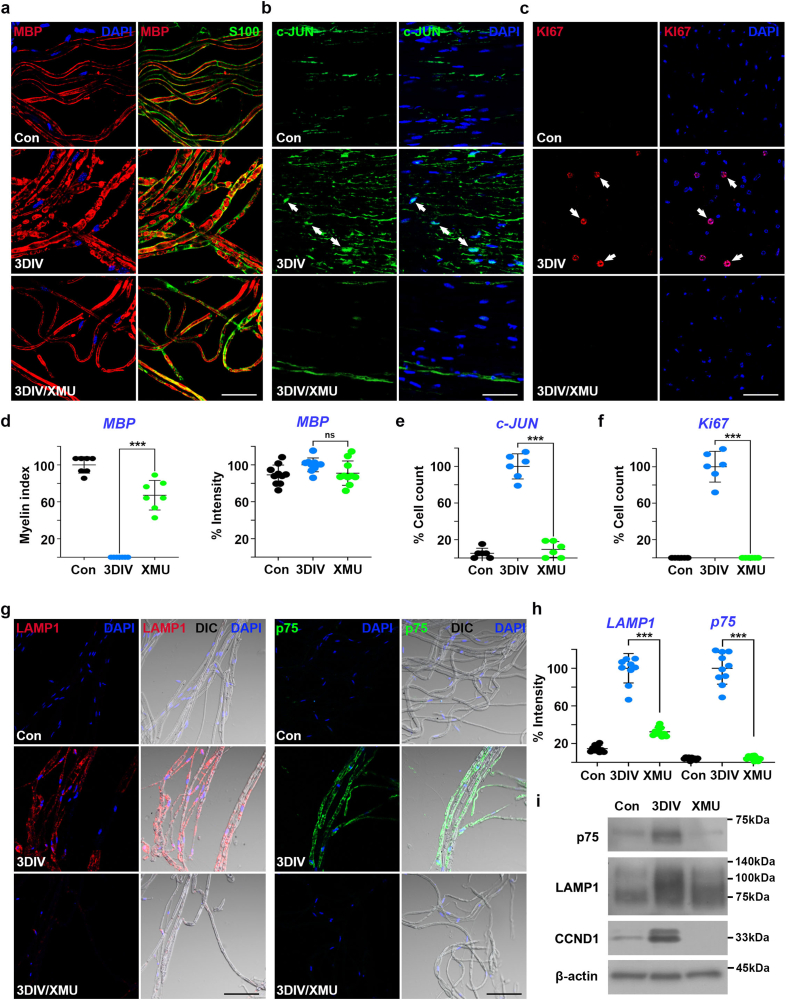
Peripheral neuropathies (PNs) are common diseases in elderly individuals characterized by Schwann cell (SC) dysfunction and irreversible Wallerian degeneration (WD). Although the molecular mechanisms of PN onset and progression have been widely studied, therapeutic opportunities remain limited. In this study, we investigated the pharmacological inhibition of Mammalian Ste20-like kinase 1/2 (MST1/2) by using its chemical inhibitor, XMU-MP-1 (XMU), against WD. XMU treatment suppressed the proliferation, dedifferentiation, and demyelination of SCs in models of WD in vitro, in vivo, and ex vivo. As a downstream mediator of canonical and noncanonical Hippo/MST1 pathway activation, the mature microRNA (miRNA) let-7b and its binding partners quaking homolog (QKI)/nucleolin (NCL) modulated miRNA-mediated silencing of genes involved in protein transport. Hence, direct phosphorylation of QKI and NCL by MST1 might be critical for WD onset and pathogenesis. Moreover, p38α/mitogen-activated protein kinase 14 (p38α) showed a strong affinity for XMU, and therefore, it may be an alternative XMU target for controlling WD in SCs. Taken together, our findings provide new insights into the Hippo/MST pathway function in PNs and suggest that XMU is a novel multitargeted therapeutic for elderly individuals with PNs.
周围神经病变(PNs)是老年人常见的疾病,其特征为雪旺细胞(SC)功能障碍和不可逆转的瓦勒变性(WD)。尽管 PN 发病和进展的分子机制已被广泛研究,但治疗机会仍然有限。在这项研究中,我们研究了通过其化学抑制剂 XMU-MP-1(XMU)抑制哺乳动物 Ste20 样激酶 1/2(MST1/2)对 WD 的药理学抑制作用。XMU 处理抑制了 WD 体外、体内和离体模型中 SC 的增殖、去分化和脱髓鞘。作为经典和非经典 Hippo/MST1 途径激活的下游介质,成熟 microRNA(miRNA)let-7b 及其结合伴侣 quaking 同源物(QKI)/核仁素(NCL)调节 miRNA 介导的与蛋白质转运相关基因的沉默。因此,MST1 对 QKI 和 NCL 的直接磷酸化可能对 WD 的发病机制至关重要。此外,p38α/丝裂原活化蛋白激酶 14(p38α)与 XMU 具有很强的亲和力,因此,它可能是控制 SC 中 WD 的另一种 XMU 靶标。综上所述,我们的研究结果为 PN 中的 Hippo/MST 途径功能提供了新的见解,并表明 XMU 是治疗老年人 PNs 的一种新型多靶点治疗方法。