University of Bordeaux, Inserm, CNRS, ARNA Laboratory, U1212, UMR 5320, Institut Européen de Chimie et Biologie, F-33600, Pessac, France.
School of Chemical Sciences, University of Auckland, Auckland, New Zealand.
Nat Commun. 2024 Oct 10;15(1):8766. doi: 10.1038/s41467-024-53136-1.
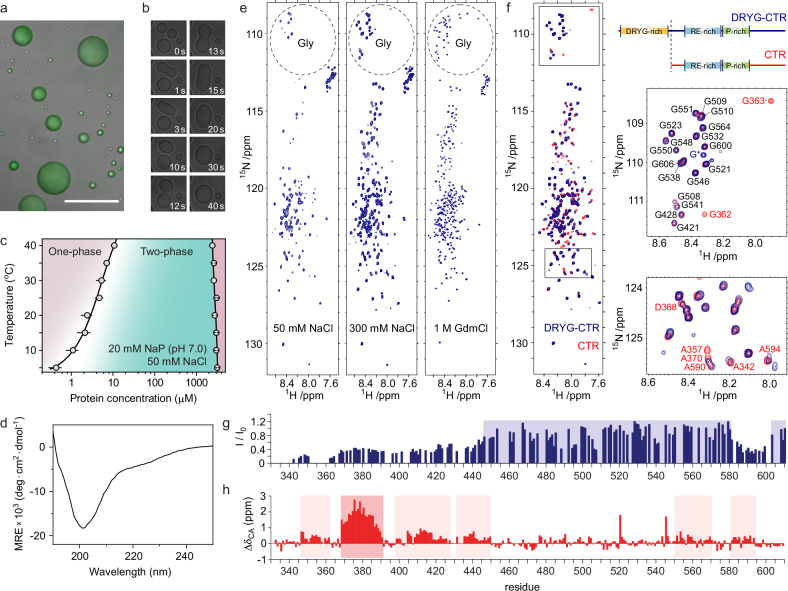
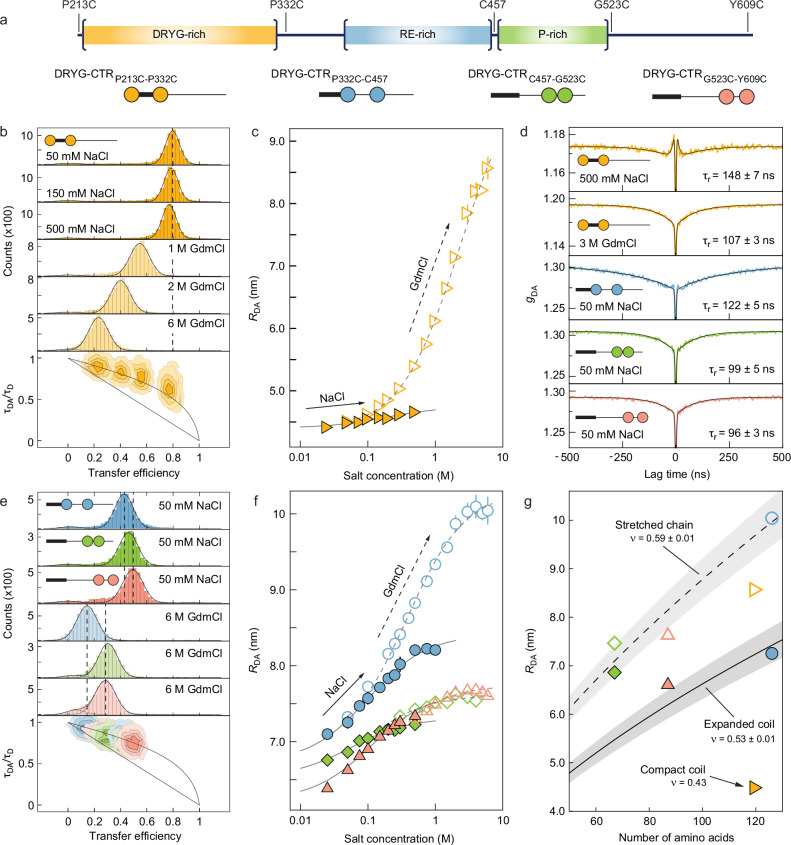
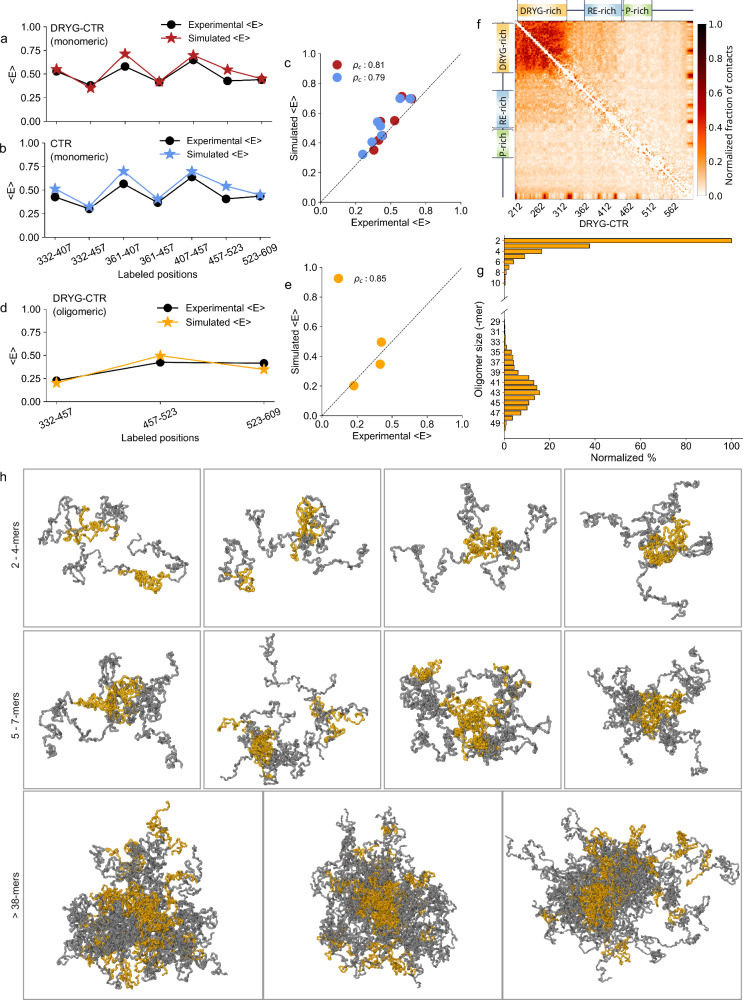
Eukaryotic translation initiation factor eIF4B is required for efficient cap-dependent translation, it is overexpressed in cancer cells, and may influence stress granule formation. Due to the high degree of intrinsic disorder, eIF4B is rarely observed in cryo-EM structures of translation complexes and only ever by its single structured RNA recognition motif domain, leaving the molecular details of its large intrinsically disordered region (IDR) unknown. By integrating experiments and simulations we demonstrate that eIF4B IDR orchestrates and fine-tunes an intricate transition from monomers to a condensed phase, in which large-size dynamic oligomers form before mesoscopic phase separation. Single-molecule spectroscopy combined with molecular simulations enabled us to characterize the conformational ensembles and underlying intra- and intermolecular dynamics across the oligomerization transition. The observed sensitivity to ionic strength and molecular crowding in the self-association landscape suggests potential regulation of eIF4B nanoscopic and mesoscopic behaviors such as driven by protein modifications, binding partners or changes to the cellular environment.
真核翻译起始因子 eIF4B 是高效帽依赖翻译所必需的,它在癌细胞中过度表达,可能影响应激颗粒的形成。由于高度的固有无序性,eIF4B 在翻译复合物的 cryo-EM 结构中很少被观察到,而且只通过其单一的结构 RNA 识别基序结构域被观察到,这使得其较大的固有无序区 (IDR) 的分子细节未知。通过整合实验和模拟,我们证明 eIF4B IDR 协调并微调了从单体到凝聚相的复杂转变,其中在介观相分离之前形成了大尺寸的动态寡聚体。单分子光谱学结合分子模拟使我们能够描述寡聚化转变过程中构象集合体和潜在的分子内和分子间动力学。在自组装景观中观察到对离子强度和分子拥挤的敏感性表明,eIF4B 的纳米级和介观级行为可能受到蛋白质修饰、结合伴侣或细胞环境变化的调节。