Banse Paul, Elena Santiago F, Beslon Guillaume
INSA Lyon, INRIA, CNRS, Universite Claude Bernard Lyon 1, Ecole Centrale de Lyon, Université Lumière Lyon 2, LIRIS, UMR5205, Villeurbanne 69621, France.
Instituto de Biología Integrativa de Sistemas (I2SysBio), CSIC-Universitat de València, Catedrático Agustín Escardino 9, Paterna, Valencia 46980, Spain.
Virus Evol. 2024 Sep 20;10(1):veae078. doi: 10.1093/ve/veae078. eCollection 2024.
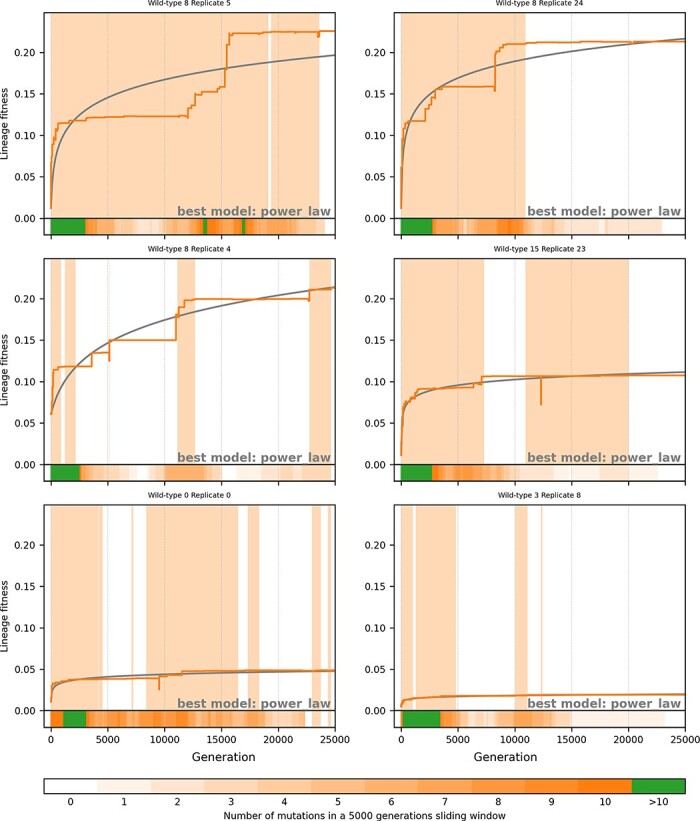
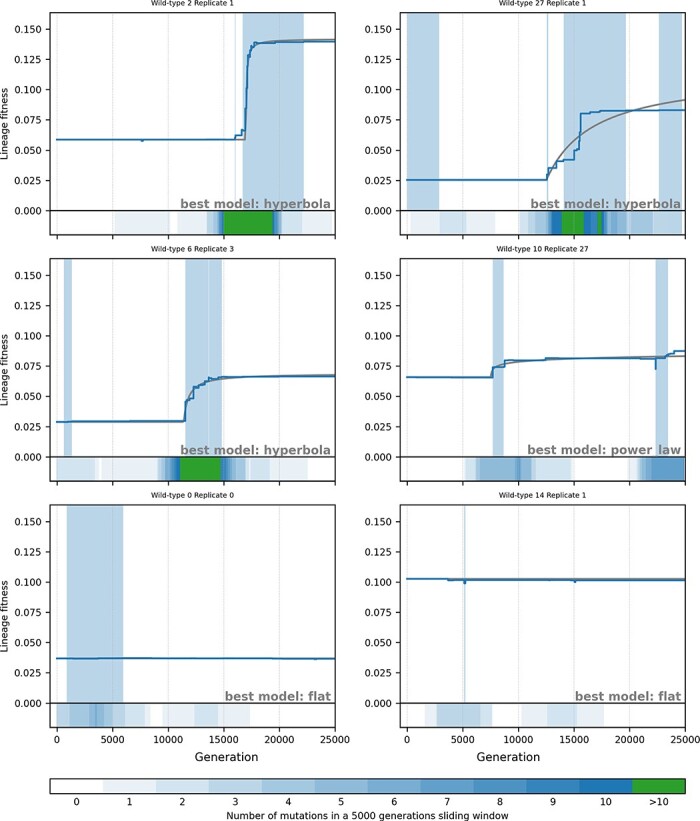
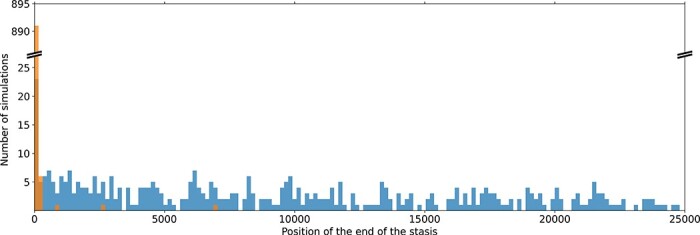
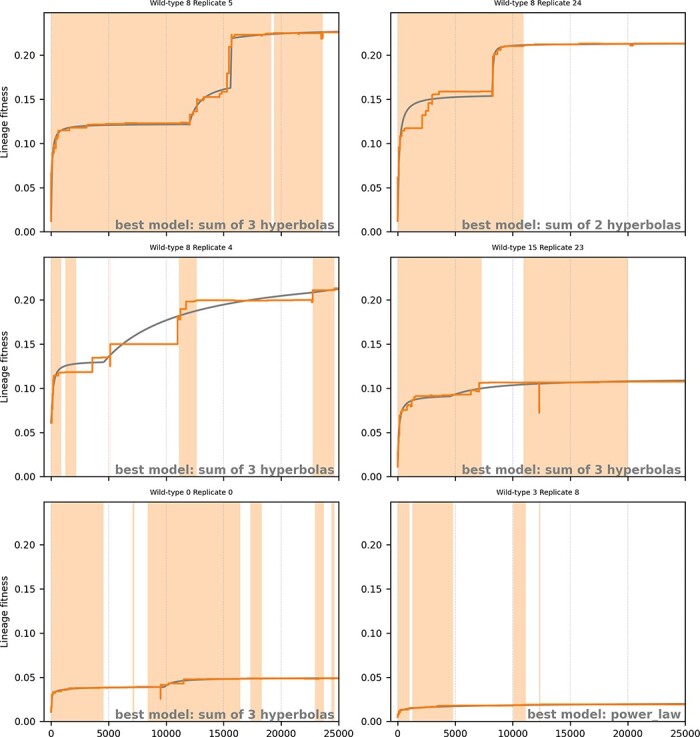
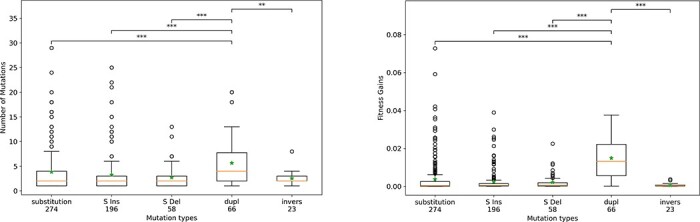
Viruses evolve by periods of relative stasis interleaved with sudden, rapid series of mutation fixations, known as evolutionary bursts. These bursts can be triggered by external factors, such as environmental changes, antiviral therapies, or spill-overs from reservoirs into novel host species. However, it has also been suggested that bursts may result from the intrinsic evolutionary dynamics of viruses. Indeed, bursts could be caused by fitness valley crossing, or a neutral exploration of a fitness plateau until an escape mutant is found. In order to investigate the importance of these intrinsic causes of evolutionary bursts, we used a simulation software package to perform massive evolution experiments of viral-like genomes. We tested two conditions: (i) after an external change and (ii) in a constant environment, with the latter condition guaranteeing the absence of an external triggering factor. As expected, an external change was almost systematically followed by an evolutionary burst. However, we also observed bursts in the constant environment as well, albeit much less frequently. We analyzed how many of these bursts are triggered by deleterious, quasi-neutral, or beneficial mutations and show that, while bursts can occasionally be triggered by valley crossing or traveling along neutral ridges, many of them were triggered by chromosomal rearrangements and, in particular, segmental duplications. Our results suggest that combinatorial differences between the different mutation types lead to punctuated evolutionary dynamics, with long periods of stasis occasionally interrupted by short periods of rapid evolution, akin to what is observed in virus evolution.
病毒通过相对静止期与突然、快速的一系列突变固定(即进化爆发)交替进行而进化。这些爆发可由外部因素触发,如环境变化、抗病毒疗法或从宿主库溢出到新宿主物种。然而,也有人提出爆发可能源于病毒的内在进化动力学。事实上,爆发可能是由适应性谷底跨越引起的,或者是对适应性高原的中性探索,直到找到逃逸突变体。为了研究这些进化爆发内在原因的重要性,我们使用了一个模拟软件包对类病毒基因组进行大规模进化实验。我们测试了两种条件:(i)外部变化后和(ii)在恒定环境中,后一种条件确保不存在外部触发因素。正如预期的那样,外部变化几乎总是紧接着进化爆发。然而,我们也在恒定环境中观察到了爆发,尽管频率要低得多。我们分析了这些爆发中有多少是由有害、准中性或有益突变触发的,并表明,虽然爆发偶尔可能由谷底跨越或沿着中性脊移动触发,但其中许多是由染色体重排,特别是片段重复触发的。我们的结果表明,不同突变类型之间的组合差异导致了间断的进化动力学,长时间的静止偶尔被短时间的快速进化打断,这与在病毒进化中观察到的情况类似。