Van Hout Marie Claire, Klankwarth Ulla-Britt, Fleißner Simon, Stöver Heino
South East Technological University, Ireland.
Institute for Addiction Research, Faculty of Health and Social Work, Frankfurt University of Applied Sciences, Germany.
Public Health Pract (Oxf). 2024 Aug 23;8:100544. doi: 10.1016/j.puhip.2024.100544. eCollection 2024 Dec.
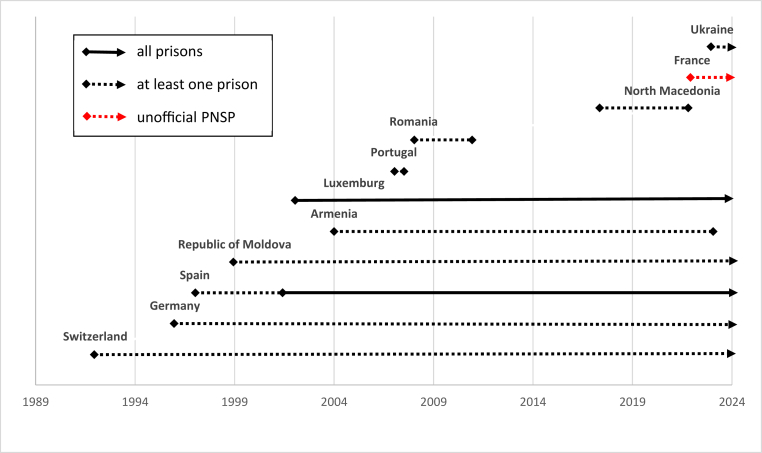
Prisons in Europe remain high-risk environments and conducive for infectious disease transmission, often related to injection drug use. Many infected people living in prison unaware of their infection status (HIV, hepatitis C). Despite all Council of Europe (CoE) member states providing community needle and syringe programmes (NSP), prison NSP are limited to seven countries. The study aim was to scrutinise the Committee for the Prevention of Torture and Inhuman or Degrading Treatment (CPT) reporting of periodic and ad hoc country mission visits to prisons, with an explicit focus on the extent to which member states are/were fulfilling obligations to protect prisoners from HIV/hepatitis C; and implementing prison NSP under the non-discriminatory equivalence of care principle.
Socio-legal review.
A systematic search of the CPT database was conducted in 2024 with no date restriction. All CPT reports were screened in chronological order with the terms; " and . Relevant narrative content on prison NSP operations, including repeat CPT reminders and any official/publicly expressed reasons for not implementing is presented.
CPT reporting reveals limited prison NSP provision in selected prisons visited on mission, with little change in status over time, despite documented evidence of prior observations around absent/insufficient harm reduction measures and explicit (often longstanding) recommendations to address deficits. Reasons for not implementing prison NSP include; existing availability of opioid substitute treatment, lack of evidence for injecting drug use, for security and maintenance of order, and contradiction with prison protocols sanctioning drug use.
Prison health is public health. Regular research and evaluations of prison NSP in Europe are warranted. Future CPT visits should also continue to assess availability and standards of provision; recommend where appropriate including when opioid substitute treatment is already provided, and in line with broad availability of community NSP in Europe.
欧洲的监狱仍然是高风险环境,有利于传染病传播,这通常与注射吸毒有关。许多在押感染者不知道自己的感染状况(艾滋病毒、丙型肝炎)。尽管欧洲委员会(CoE)的所有成员国都提供社区针头和注射器项目(NSP),但监狱NSP仅在七个国家实施。本研究的目的是仔细审查预防酷刑和不人道或有辱人格待遇委员会(CPT)关于定期和临时国家监狱访问任务的报告,特别关注成员国在履行保护囚犯免受艾滋病毒/丙型肝炎感染义务方面的程度;以及在非歧视性同等护理原则下实施监狱NSP的情况。
社会法律审查。
2024年对CPT数据库进行了无日期限制的系统检索。所有CPT报告均按时间顺序进行筛选,关键词为“和”。呈现了关于监狱NSP运作的相关叙述内容,包括CPT的重复提醒以及任何未实施的官方/公开说明的原因。
CPT报告显示,在访问的部分监狱中,监狱NSP的提供有限,而且随着时间推移情况变化不大,尽管有记录表明之前曾观察到减少伤害措施缺失/不足,并且有明确(通常是长期的)建议来解决这些缺陷。不实施监狱NSP的原因包括:现有的阿片类药物替代治疗可用性、缺乏注射吸毒的证据、出于安全和维持秩序的考虑,以及与制裁吸毒的监狱规程相矛盾。
监狱健康即公共健康。有必要对欧洲监狱NSP进行定期研究和评估。未来CPT的访问还应继续评估其可用性和提供标准;在适当情况下提出建议,包括在已经提供阿片类药物替代治疗时,并且要与欧洲社区NSP的广泛可用性保持一致。