Castaño-Díez Sandra, López-Guerra Mònica, Zugasti Inés, Calvo Xavier, Schulz Felicitas Isabel, Avendaño Alejandro, Mora Elvira, Falantes José, Azaceta Gemma, Ibáñez Mariam, Chen Tzu, Notario Cristina, Amer Neus, Palomo Laura, Pomares Helena, Vila Jordi, Bernal Del Castillo Teresa, Jiménez-Vicente Carlos, Esteban Daniel, Guijarro Francesca, Álamo José, Cortés-Bullich Albert, Torrecillas-Mayayo Víctor, Triguero Ana, Mont-de Torres Lucía, Carcelero Ester, Cardús Aina, Germing Ulrich, Betz Beate, Rozman Maria, Arenillas Leonor, Zamora Lurdes, Díez-Campelo María, Xicoy Blanca, Esteve Jordi, Díaz-Beyá Marina
Department of Hematopathology, Hospital Clínic de Barcelona, Institut d'Investigacions Biomèdiques August Pi i Sunyer, Barcelona, Spain.
Grupo Español de Síndromes Mielodisplásicos, Madrid, Spain.
Blood Adv. 2025 Jan 14;9(1):39-53. doi: 10.1182/bloodadvances.2024013648.
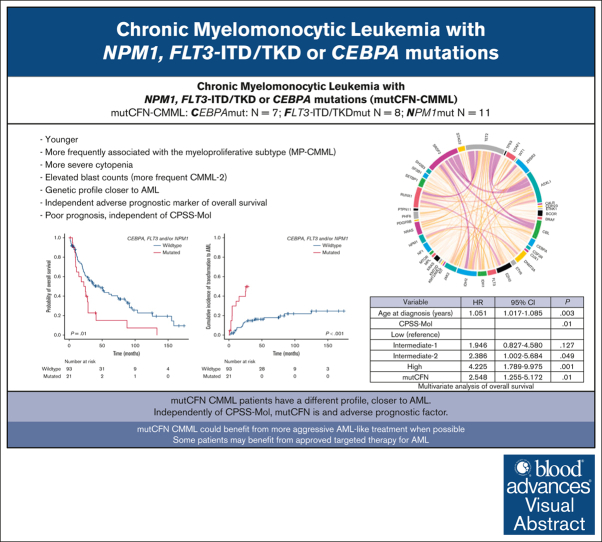
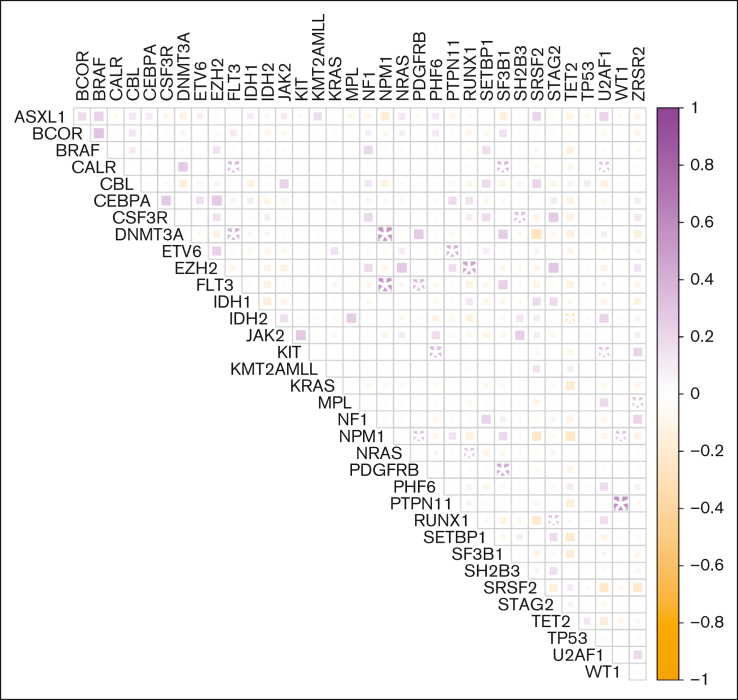
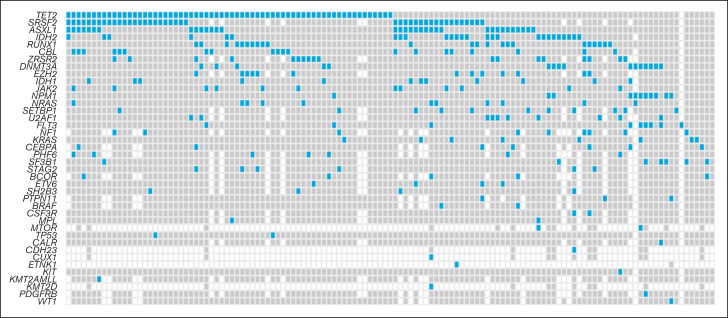
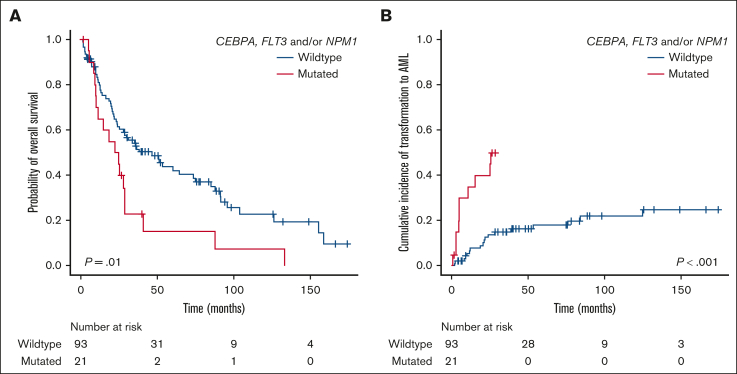
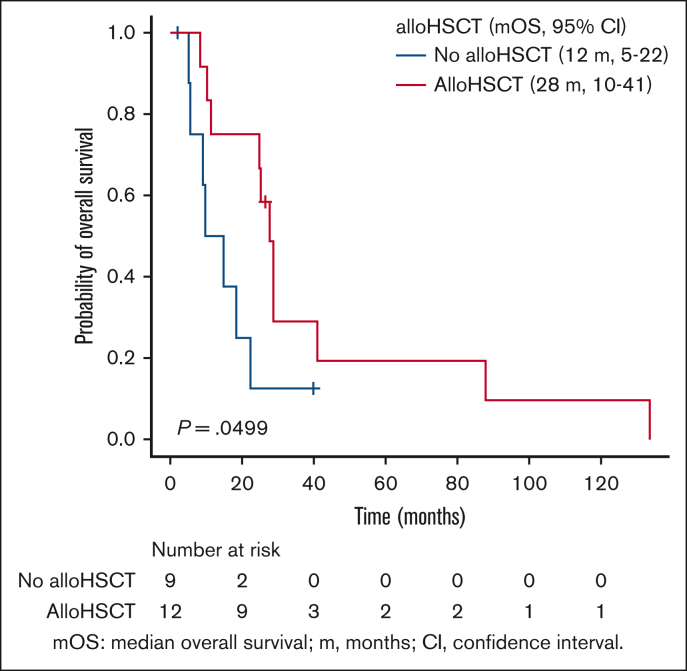
Mutations commonly associated with acute myeloid leukemia (AML), such as CEBPA, FLT3, IDH1/2, and NPM1, are rarely found in chronic myelomonocytic leukemia (CMML), and their prognostic significance in CMML has not been clearly identified. In 127 patients with CMML, we have retrospectively analyzed next-generation sequencing and polymerase chain reaction data from bone marrow samples collected at the time of CMML diagnosis. Seven patients harbored CEBPA mutations, 8 FLT3 mutations, 12 IDH1 mutations, 26 IDH2 mutations, and 11 NPM1 mutations. Patients with CMML harboring CEBPA, FLT3, and/or NPM1 mutations (mutCFN) more frequently had the myeloproliferative subtype, a high prevalence of severe cytopenia, and elevated blast counts. Regardless of their CMML Prognostic Scoring System molecular classification, mutCFN patients with CMML had a poor prognosis, and the multivariate analysis identified mutCFN as an independent marker of overall survival. The genetic profile of these mutCFN patients with CMML closely resembled that of patients with AML, with higher-risk clinical characteristics. Our findings lead us to suggest including the assessment of these mutations in CMML prognostic models and treating these patients with AML-type therapies, including intensive chemotherapy and allogeneic stem cell transplantation, whenever feasible. Furthermore, certain targeted therapies approved for use in AML should be considered.
常见于急性髓系白血病(AML)的突变,如CEBPA、FLT3、IDH1/2和NPM1,在慢性粒单核细胞白血病(CMML)中很少发现,其在CMML中的预后意义尚未明确。在127例CMML患者中,我们回顾性分析了CMML诊断时采集的骨髓样本的二代测序和聚合酶链反应数据。7例患者存在CEBPA突变,8例存在FLT3突变,12例存在IDH1突变,26例存在IDH2突变,11例存在NPM1突变。携带CEBPA、FLT3和/或NPM1突变(mutCFN)的CMML患者更常具有骨髓增殖性亚型、严重血细胞减少的高患病率和原始细胞计数升高。无论其CMML预后评分系统分子分类如何,mutCFN的CMML患者预后较差,多变量分析确定mutCFN是总生存的独立标志物。这些mutCFN的CMML患者的基因谱与AML患者非常相似,具有更高风险的临床特征。我们的研究结果促使我们建议在CMML预后模型中纳入这些突变的评估,并在可行时采用AML型治疗方法治疗这些患者,包括强化化疗和异基因干细胞移植。此外,应考虑某些批准用于AML的靶向治疗。