Wan Qianyi, Liu Xingzhu, Xu Jinghao, Zhao Rui, Yang Shiqin, Feng Jianrong, Cao Zhan, Li Jingru, He Xiaopeng, Chen Haiou, Ye Jinbao, Chen Haiyang, Chen Yi
Department of General Surgery, Division of Gastrointestinal Surgery, West China Hospital, Sichuan University, Chengdu, China.
West China School of Medicine, Sichuan University, Chengdu, China.
J Cachexia Sarcopenia Muscle. 2024 Dec;15(6):2608-2617. doi: 10.1002/jcsm.13605. Epub 2024 Oct 10.
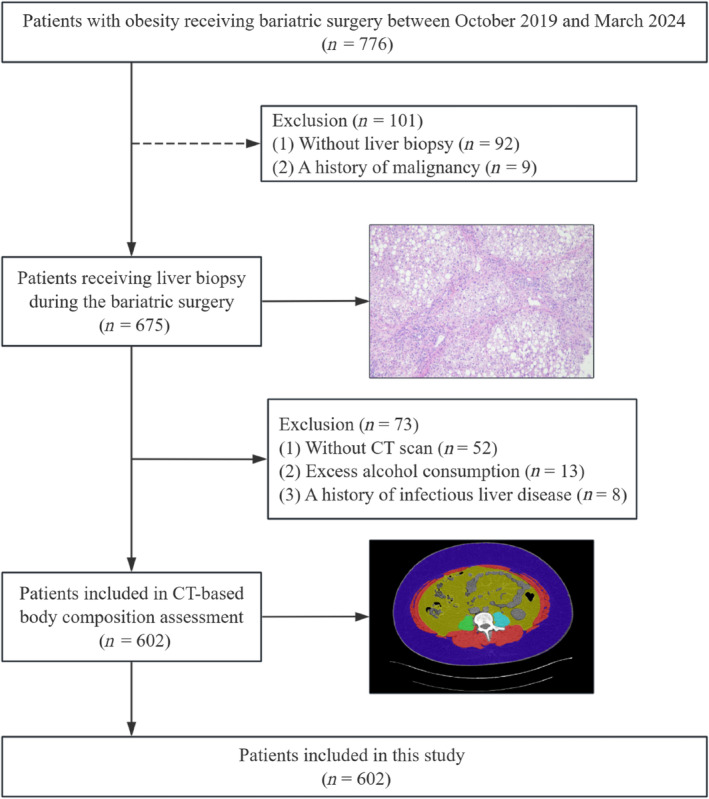
Obesity is a significant risk factor for the progression of non-alcoholic fatty liver disease (NAFLD). However, a convenient and efficacious non-invasive test for monitoring NAFLD progression in patients with obesity is currently lacking. This study aims to investigate the associations between CT-based body composition and the progression of biopsy-proven NAFLD in patients with obesity.
Liver biopsy was conducted in patients with obesity, and the progression of NAFLD was evaluated by the NAFLD activity score (NAS). Body composition was assessed through abdominal computed tomography (CT) scans.
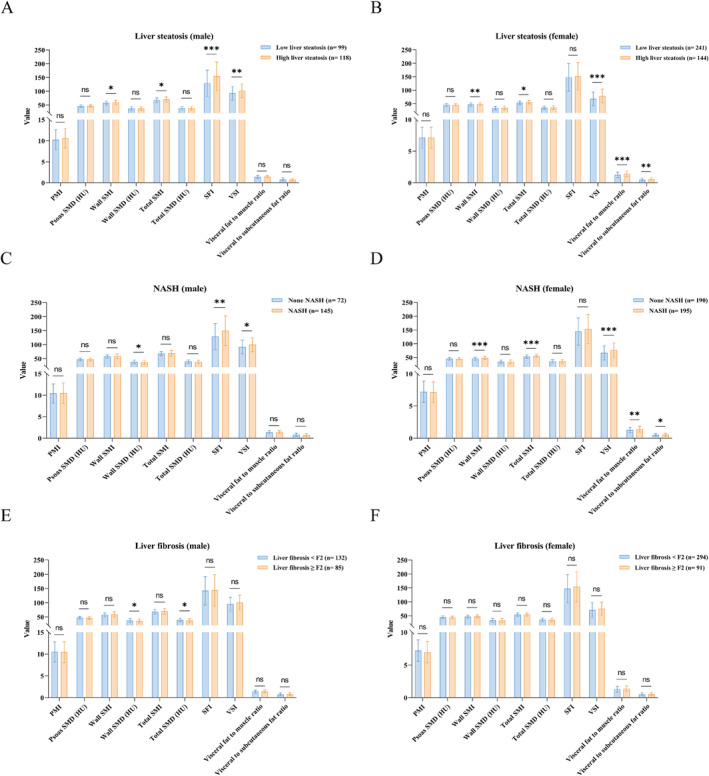
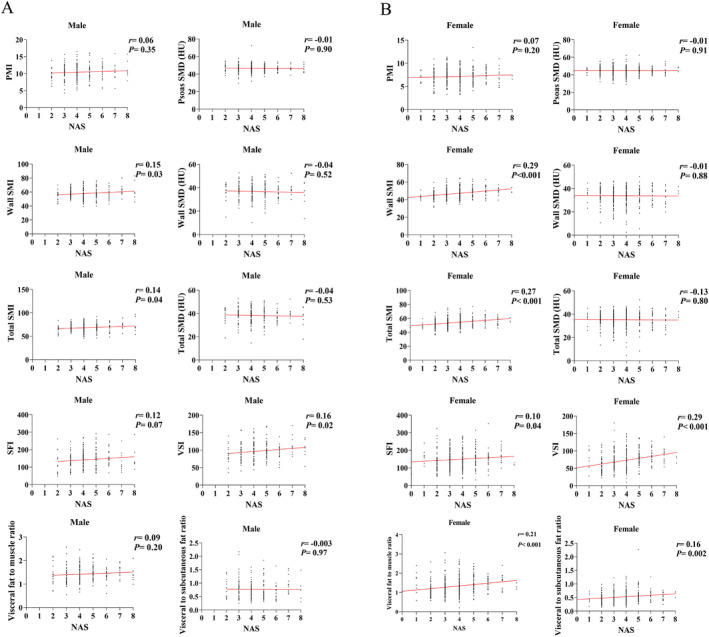
A total of 602 patients with an average age of 31.65 (±9.33) years old were included, comprising 217 male patients and 385 female patients. The wall skeletal muscle index (SMI), total SMI, and visceral fat index (VFI) were positively correlated with NAS in both male and female patients. Multivariate regression analysis demonstrated significant associations between high liver steatosis and wall SMI (HR: 1.60, 95% CI: 1.12 to 2.30), total SMI (HR: 1.50, 95% CI: 1.02 to 2.08), VSI (HR: 2.16, 95% CI: 1.48 to 3.14), visceral fat to muscle ratio (HR: 1.51, 95% CI: 1.05 to 2.18), and visceral to subcutaneous fat ratio (HR: 1.51, 95% CI: 1.07 to 2.12). Non-alcoholic steatohepatitis (NASH) was significantly associated with wall SMI (HR: 1.52, 95% CI: 1.06 to 2.19) and VSI (HR: 1.50, 95% CI: 1.03 to 2.17). Liver fibrosis ≥ F2 was significantly associated with psoas muscle index (HR: 0.64, 95% CI: 0.44 to 0.93) and psoas skeletal muscle density (HR: 0.61, 95% CI: 0.41 to 0.89).
Our study suggested that certain CT-based body composition indicators, notably high VFI, were significantly associated with the progression of NAFLD in patients with obesity. Great attentions and timely managements should be given to these patients with body composition characteristics associated with the risk of NAFLD progression.
肥胖是非酒精性脂肪性肝病(NAFLD)进展的重要危险因素。然而,目前缺乏一种方便有效的非侵入性检测方法来监测肥胖患者NAFLD的进展。本研究旨在探讨基于CT的身体成分与肥胖患者经活检证实的NAFLD进展之间的关联。
对肥胖患者进行肝活检,并通过NAFLD活动评分(NAS)评估NAFLD的进展。通过腹部计算机断层扫描(CT)评估身体成分。
共纳入602例患者,平均年龄31.65(±9.33)岁,其中男性217例,女性385例。男性和女性患者的壁骨骼肌指数(SMI)、总SMI和内脏脂肪指数(VFI)均与NAS呈正相关。多因素回归分析显示,高肝脂肪变性与壁SMI(HR:1.60,95%CI:1.12至2.30)、总SMI(HR:1.50,95%CI:1.02至2.08)、VSI(HR:2.16,95%CI:1.48至3.14)、内脏脂肪与肌肉比值(HR:1.51,95%CI:1.05至2.18)以及内脏与皮下脂肪比值(HR:1.51,95%CI:1.07至2.12)之间存在显著关联。非酒精性脂肪性肝炎(NASH)与壁SMI(HR:1.52,95%CI:1.06至2.19)和VSI(HR:1.50,95%CI:1.03至2.17)显著相关。肝纤维化≥F2与腰大肌指数(HR:0.64,95%CI:0.44至0.93)和腰大肌骨骼肌密度(HR:0.61,95%CI:0.41至0.89)显著相关。
我们的研究表明,某些基于CT的身体成分指标,特别是高VFI,与肥胖患者NAFLD的进展显著相关。对于具有与NAFLD进展风险相关的身体成分特征的患者,应给予高度关注并及时管理。