Balakirski Galina, Assaf Chalid, Dippel Edgar, Fröhlich Anne, Kofler Lukas, Kreuter Alexander, Kunte Christian, Hartmann Daniela, Hofmann Silke C, Horn Thomas, Neubert Thorsten, Pumnea Teodora, Schmitt Laurenz, Yazdi Amir S, Löser Christoph R
Zentrum für Dermatologie, Allergologie und Dermatochirurgie, Helios Universitätsklinikum Wuppertal, Universität Witten/Herdecke, Heusnerstr. 40, 42283, Wuppertal, Deutschland.
Klinik für Dermatologie und Venerologie, Helios Klinikum Krefeld, Krefeld, Deutschland.
Dermatologie (Heidelb). 2024 Nov;75(11):864-877. doi: 10.1007/s00105-024-05417-5. Epub 2024 Oct 10.
Currently, only little data is available on the impact of the COVID-19 pandemic on inpatient dermatosurgical care in German dermatological clinics.
A retrospective analysis of all dermatosurgical cases that were treated in inpatient setting in nine German dermatological clinics in four federal states in 2019, 2020 and 2021 was performed. The diagnoses were recorded using the ICD-10 codes. In addition, demographic data such as age, gender and the length of inpatient stay were analysed.
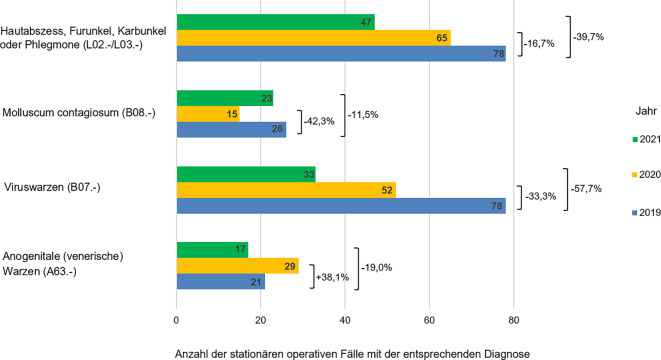
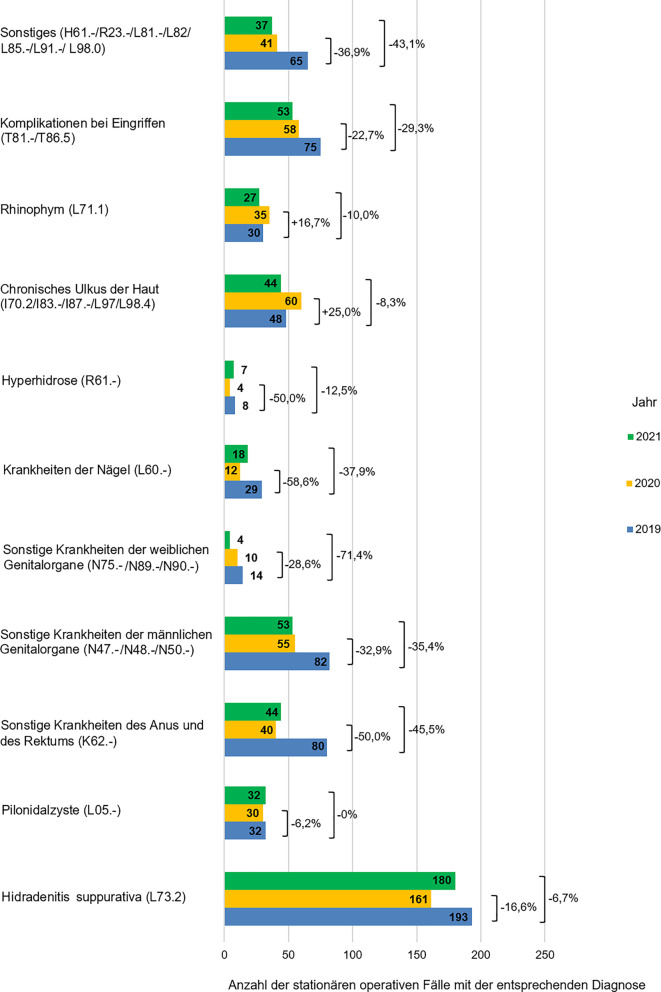
In 2019, 2020 and 2021, a total of 10,739, 9185 and 9828 dermatosurgical inpatients were treated respectively. Thus, the reduction of inpatient dermatosurgical cases was 14.5% in 2020 and 8.5% in 2021 compared to 2019. Inpatient surgical treatment of melanoma decreased by 10.1% of cases in 2020. This decrease was only 1.4% in 2021 compared to 2019. The number of inpatient surgeries performed for benign lesions such as melanocytic nevi or viral warts reduced sharply in both pandemic years.
Our data show for the first time how inpatient care for the entire spectrum of dermatosurgical diseases developed during the COVID-19 pandemic in Germany. After the initial marked decline in inpatient dermatosurgical cases in 2020, there was less difference in 2021 compared to 2019. This trend can be interpreted as an indication that there is still a strong need for inpatient dermatosurgical care that cannot yet be met on an outpatient basis.
目前,关于新冠疫情对德国皮肤科诊所住院皮肤外科护理的影响,可用数据很少。
对2019年、2020年和2021年在德国四个联邦州的九家皮肤科诊所接受住院治疗的所有皮肤外科病例进行回顾性分析。使用国际疾病分类第十版(ICD - 10)编码记录诊断结果。此外,还分析了年龄、性别和住院时间等人口统计学数据。
2019年、2020年和2021年分别共治疗了10739例、9185例和9828例住院皮肤外科患者。因此,与2019年相比,2020年住院皮肤外科病例减少了14.5%,2021年减少了8.5%。2020年黑色素瘤的住院手术治疗病例减少了10.1%。与2019年相比,2021年这一降幅仅为1.4%。在这两个疫情年份,针对良性病变(如黑素细胞痣或病毒疣)进行的住院手术数量大幅减少。
我们的数据首次展示了德国在新冠疫情期间各类皮肤外科疾病的住院护理情况。2020年住院皮肤外科病例最初显著下降后,2021年与2019年相比差异较小。这种趋势可以解释为表明对住院皮肤外科护理仍有强烈需求,而门诊治疗尚无法满足。