Uhlmann Sven Sebastian, Savina Esther, Karlsen Junita, Ampe Bart
Fisheries and Aquatic Production, Animal Sciences Unit Flanders Research Institute for Agriculture, Fisheries and Food (ILVO), Jacobsenstraat 1, 8400 Ostend, Belgium.
Marine Institute, Rinville West, Rinville, Co, Galway, H91 R673, Ireland.
Conserv Physiol. 2024 Oct 9;12(1):coae070. doi: 10.1093/conphys/coae070. eCollection 2024.
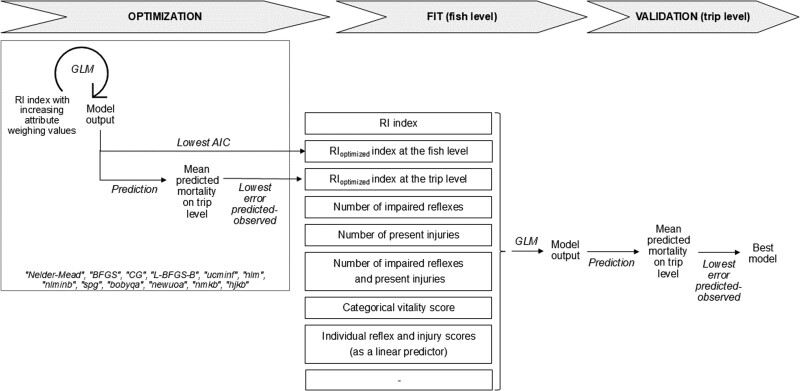
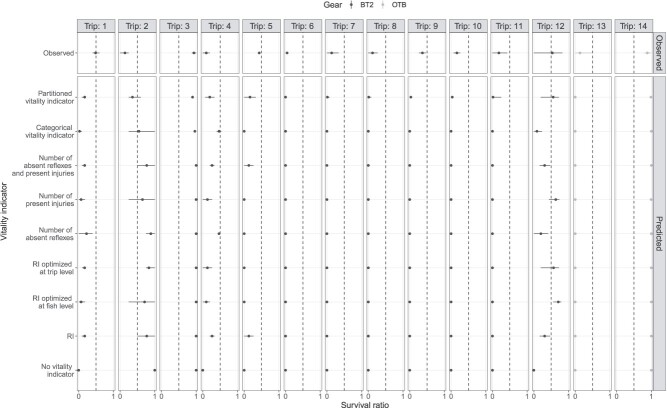
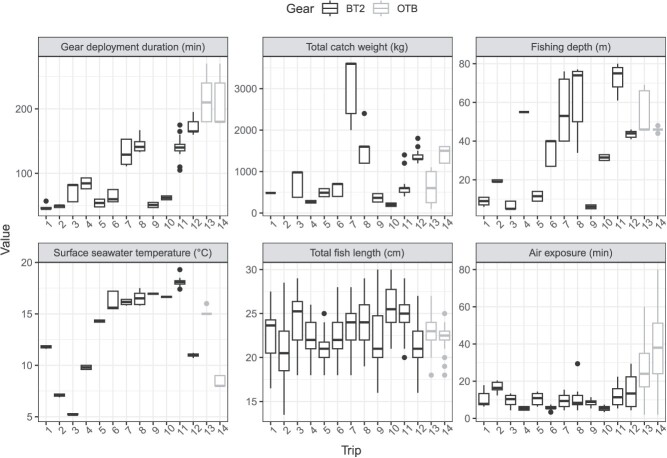
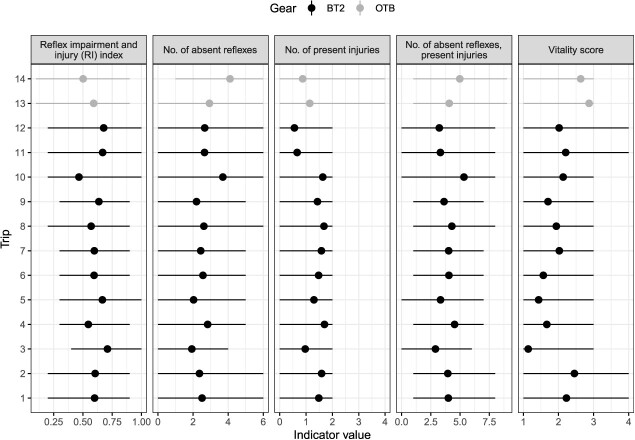
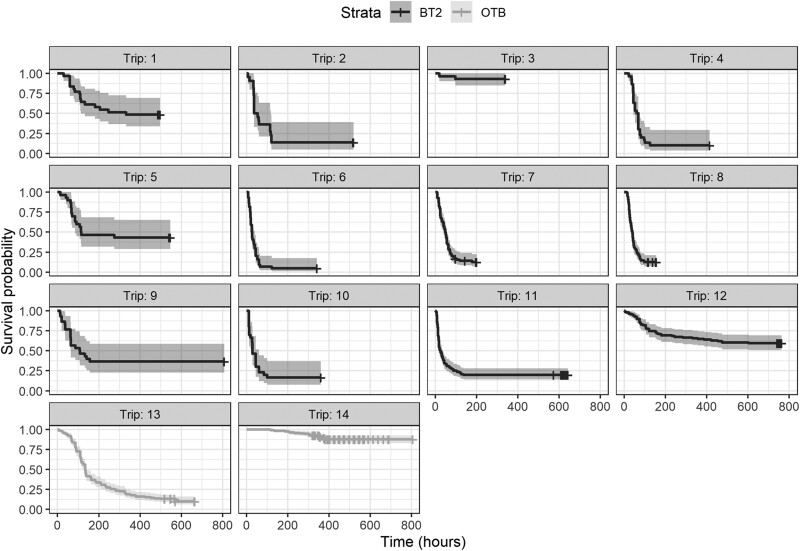
Predicting the discard survival of aquatic animals after fisheries capture using vitality indicators (i.e. individual scores or indices of physical condition) is a resource-efficient approach compared to estimating discard survival from captive observation. But such indicators do not always lead to accurate and robust predictions. Individual scores of reflex impairments and injuries are typically given the same weight when being aggregated into an index, while some reflexes or injuries may contribute to mortality more than others. This study established an analytical methodology and created an index based on differential contributions of individual reflexes and injuries to optimize the prediction of discard survival of bottom-trawled European plaice (). The optimization procedures were applied to a dataset from vitality assessment of 1122 undersized plaice caught during 16 commercial fishing trips and 58 gear deployments in Belgium and Denmark. As welfare indicators, we considered and evaluated against post-capture survival of plaice: original vs. optimized reflex impairment and injury (R&I) index, number of absent reflexes, number of present injuries, number of absent reflexes and present injuries, categorical vitality score and individual reflex and injury scores. These were used in eight candidate generalized linear models (one without any vitality indicator) as explanatory variables to predict survival, with or without biological, environmental, technical and operational covariates, either at the individual fish or trip level. Bruising to the head and body were the most relevant predictors. The optimized R&I index did not perform better than any other vitality indicator, and all the indicators performed poorly in predicting survival probability both at the fish and trip levels without information on air exposure and seawater temperature. This means that they cannot be considered to be independent measures. The categorical vitality score provided a viable alternative to the more labour-intensive, scoring method of reflex responsiveness. Use of reflexes as proxies may not be accurate when they are not independent of environmental, biological or technical variables.
与通过圈养观察来估计丢弃物存活率相比,使用活力指标(即个体评分或身体状况指数)预测渔业捕捞后水生动物的丢弃物存活率是一种资源高效的方法。但此类指标并不总能得出准确且可靠的预测结果。在汇总成一个指数时,反射损伤和伤害的个体评分通常被赋予相同的权重,而某些反射或伤害对死亡率的影响可能比其他的更大。本研究建立了一种分析方法,并基于个体反射和伤害的不同贡献创建了一个指数,以优化对底拖网捕捞的欧洲鲽鱼丢弃物存活率的预测。优化程序应用于来自比利时和丹麦16次商业捕鱼航行及58次渔具部署期间捕获的1122条未达尺寸鲽鱼活力评估的数据集。作为福利指标,我们考虑并根据鲽鱼捕获后的存活率评估了:原始与优化后的反射损伤和伤害(R&I)指数、缺失反射的数量、存在的伤害数量、缺失反射和存在伤害的数量、分类活力评分以及个体反射和伤害评分。这些指标在八个候选广义线性模型(一个不使用任何活力指标)中作为解释变量用于预测存活率,无论有无生物、环境、技术和操作协变量,在个体鱼或航行层面均可使用。头部和身体的瘀伤是最相关的预测因素。优化后的R&I指数并不比任何其他活力指标表现更好,并且在没有空气暴露和海水温度信息的情况下,所有指标在预测鱼和航行层面的存活概率时表现都很差。这意味着它们不能被视为独立的度量标准。分类活力评分为更耗费人力的反射反应评分方法提供了一个可行的替代方案。当反射与环境、生物或技术变量不独立时,将其用作代理可能并不准确。