El-Haj Madi, Beyth Shaul, Korach Amit, Wald Ori, Eliav Tal, Kalish Yosef, Vorobeitchik Sofia A, Bloom Allan I
From the Department of Orthopedics, Faculty of Medicine, Hadassah Medical Center, Hebrew University of Jerusalem, Jerusalem, Israel.
Department of Cardiothoracic Surgery, Faculty of Medicine, Hadassah Medical Center, Hebrew University of Jerusalem, Jerusalem, Israel.
Plast Reconstr Surg Glob Open. 2024 Oct 10;12(10):e6248. doi: 10.1097/GOX.0000000000006248. eCollection 2024 Oct.
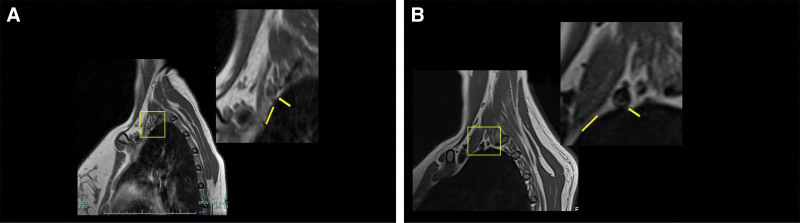
Neurogenic thoracic outlet syndrome (NTOS) is a dynamic compression of the brachial plexus. This study aimed to evaluate the correlation between the concave deformity of the posterior edge of the anterior scalene muscle (CDAS) on sagittal T1 with intraoperative findings of vascular compression. The second aim was to define the NTOS vascular subtypes and establish possible treatments.
We retrospectively reviewed patients who met the Consortium for Research and Education on Thoracic Outlet Syndrome criteria for NTOS and were operated on after a failed rehabilitation program.
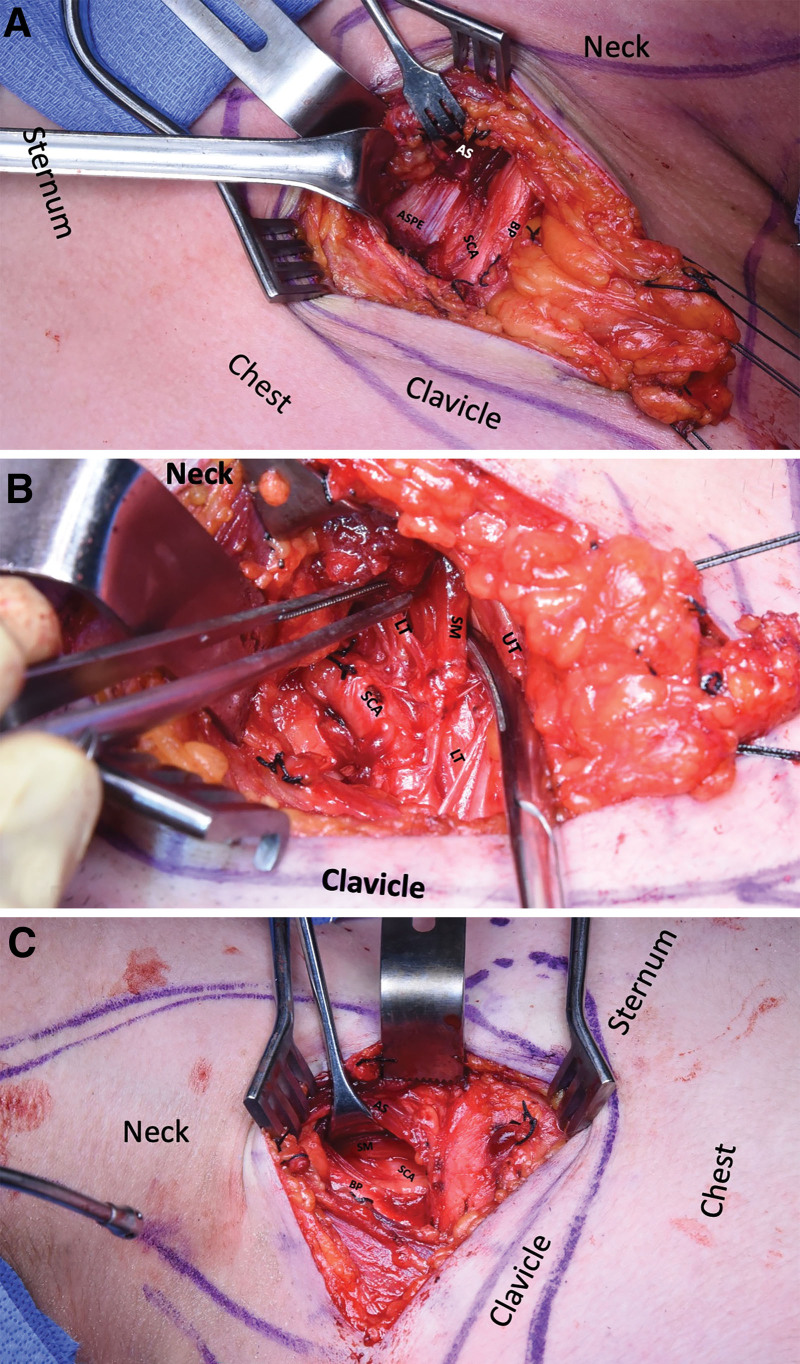
Forty-four patients were included; mean age was 29.51 years (range: 13-55 years), and 24 (54.5%) were women. CDAS on sagittal T1 magnetic resonance imaging (MRI) was identified in 20 of 44. Patients were divided into two categories: type A (pure NTOS) (20 of 44); and type B (mixed neurogenic-vascular variants) (24 of 44). Type B was divided into B1, B2, and B3, corresponding to subclavian artery (SCA) compression (seven of 44), subclavian vein compression (SCV) (five of 44), and both SCA and SCV compression (12 of 44), respectively. All patients with B1 had CDAS on MRI T1 sagittal, whereas CDAS was found on 5%, 60%, and 58.3% in types A, B2, and B3, respectively. Intraoperatively, all patients had at least one structural anomaly. Preoperative symptoms of lower or middle-lower brachial plexus trunk compressions were more prominent in patients with the vascular variant (B1: 85%, B2: 83%, and B3: 83%) than the pure NTOS (type A) (40%).
NTOS presents as four subtypes: pure neurogenic (A) and vascular (B1, B2, and B3). Preoperative middle/lower trunk symptoms combined with positive upper limb duplex ultrasound of the SCA, SCV, and sagittal MRI show that a CDAS is correlated with the vascular form of NTOS and predicts failure of preoperative rehabilitation program.
神经源性胸廓出口综合征(NTOS)是臂丛神经的动态压迫。本研究旨在评估矢状面T1加权像上前斜角肌后缘凹陷畸形(CDAS)与术中血管压迫发现之间的相关性。第二个目的是确定NTOS的血管亚型并建立可能的治疗方法。
我们回顾性分析了符合胸廓出口综合征研究与教育联盟NTOS标准且在康复计划失败后接受手术的患者。
纳入44例患者;平均年龄29.51岁(范围:13 - 55岁),24例(54.5%)为女性。44例中有20例在矢状面T1磁共振成像(MRI)上发现CDAS。患者分为两类:A型(单纯NTOS)(44例中的20例);和B型(神经源性 - 血管混合型)(44例中的24例)。B型又分为B1、B2和B3型,分别对应锁骨下动脉(SCA)压迫(44例中的7例)、锁骨下静脉压迫(SCV)(44例中的5例)以及SCA和SCV均受压(44例中的12例)。所有B1型患者在MRI T1矢状面上均有CDAS,而在A型、B2型和B3型中,CDAS的发现率分别为5%、60%和58.3%。术中,所有患者至少有一处结构异常。血管变异型患者(B1型:85%,B2型:83%,B3型:83%)术前臂丛神经中下干压迫症状比单纯NTOS(A型)患者(40%)更突出。
NTOS表现为四种亚型:单纯神经源性(A型)和血管性(B1型、B2型和B3型)。术前中下干症状结合上肢SCA、SCV双功超声检查阳性及矢状面MRI显示,CDAS与NTOS的血管型相关,并预示术前康复计划失败。