Sexton Dan, Faucette Ryan, Rivera-Hernandez Melody, Kenniston Jon A, Papaioannou Nikolaos, Cosic Janja, Kopacz Kris, Salmon Gary, Beauchemin Chantal, Juethner Salomé, Yeung Dave
Takeda Development Center Americas Inc., Cambridge, MA, United States.
Charles River Laboratories, Harlow, United Kingdom.
Front Allergy. 2024 Sep 17;5:1436855. doi: 10.3389/falgy.2024.1436855. eCollection 2024.
Cleaved high-molecular-weight kininogen (HKa) is a disease state biomarker of kallikrein-kinin system (KKS) activation in patients with hereditary angioedema due to C1 inhibitor deficiency (HAE-C1INH), the endogenous inhibitor of plasma kallikrein (PKa).
Develop an HKa-specific enzyme-linked immunosorbent assay (ELISA) to monitor KKS activation in the plasma of HAE-C1INH patients.
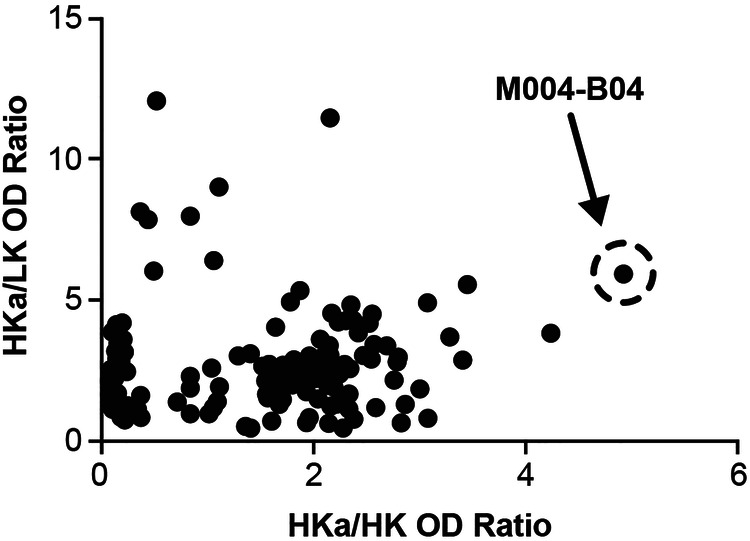
A novel HKa-specific antibody was discovered by antibody phage display and used as a capture reagent to develop an HKa-specific ELISA.
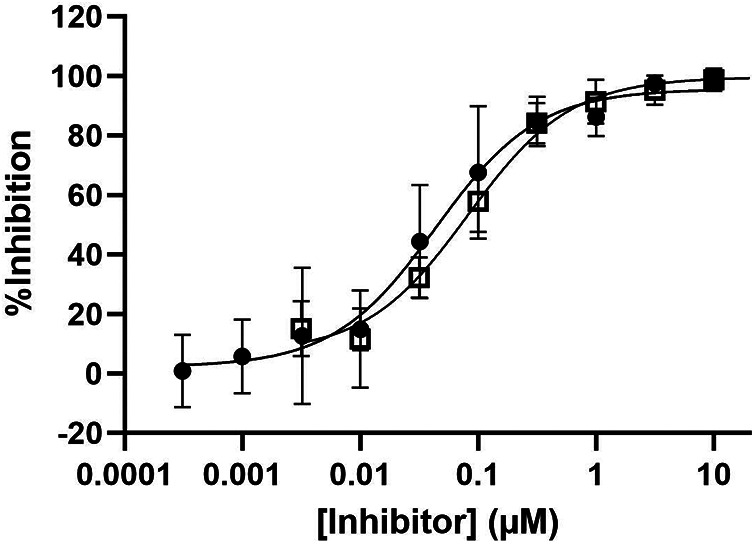
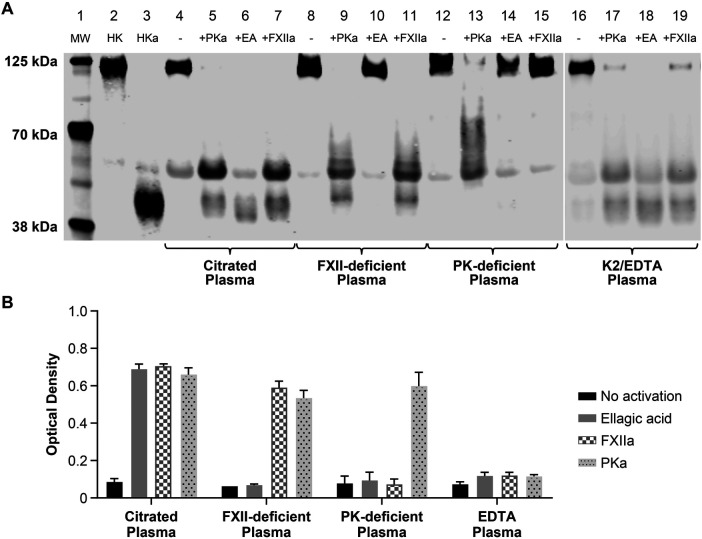
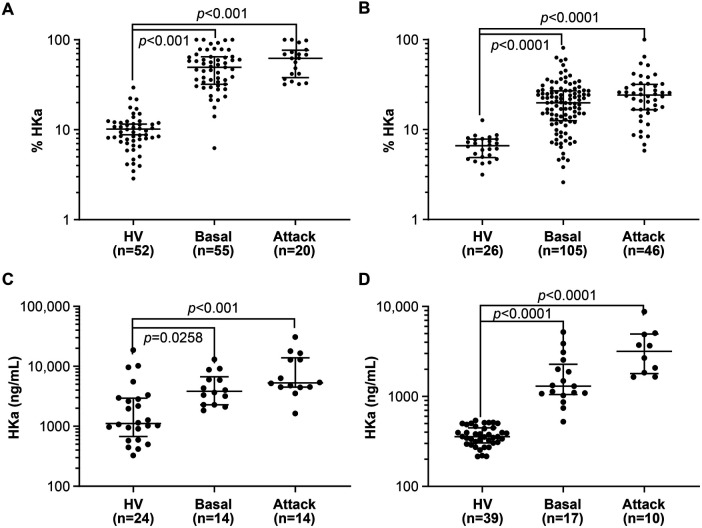
Specific HKa detection following KKS activation was observed in plasma from healthy controls but not in prekallikrein-, high-molecular-weight kininogen-, or coagulation factor XII (FXII)-deficient plasma. HKa levels in plasma collected from HAE-C1INH patients in a disease quiescent state were higher than in plasma from healthy controls and increased further in HAE-C1INH plasma collected during an angioedema attack. The specificity of the assay for PKa-mediated HKa generation in minimally diluted plasma activated with exogenous FXIIa was demonstrated using a specific monoclonal antibody inhibitor (lanadelumab, IC = 0.044 µM).
An ELISA was developed for the specific and quantitative detection of HKa in human plasma to support HAE-C1INH drug development. Improved quantification of the HKa biomarker may facilitate further pathophysiologic insight into HAE-C1INH and other diseases mediated by a dysregulated KKS and may enable the design of highly potent inhibitors targeting this pathway.
裂解的高分子量激肽原(HKa)是因C1抑制剂缺乏(HAE-C1INH)导致的遗传性血管性水肿患者中激肽释放酶-激肽系统(KKS)激活的疾病状态生物标志物,C1抑制剂是血浆激肽释放酶(PKa)的内源性抑制剂。
开发一种HKa特异性酶联免疫吸附测定(ELISA),以监测HAE-C1INH患者血浆中的KKS激活情况。
通过抗体噬菌体展示发现一种新型HKa特异性抗体,并将其用作捕获试剂来开发HKa特异性ELISA。
在健康对照者的血浆中观察到KKS激活后可特异性检测到HKa,但在缺乏前激肽释放酶、高分子量激肽原或凝血因子XII(FXII)的血浆中未检测到。处于疾病静止状态的HAE-C1INH患者采集的血浆中HKa水平高于健康对照者的血浆,并且在血管性水肿发作期间采集的HAE-C1INH血浆中进一步升高。使用特异性单克隆抗体抑制剂(lanadelumab,IC = 0.044 μM)证明了该测定法对外源性FXIIa激活的最低稀释血浆中PKa介导的HKa生成的特异性。
开发了一种ELISA用于特异性和定量检测人血浆中的HKa,以支持HAE-C1INH药物研发。HKa生物标志物定量的改进可能有助于进一步深入了解HAE-C1INH和其他由失调的KKS介导的疾病的病理生理学,并可能有助于设计针对该途径的高效抑制剂。