Lambrechts Agata A, Cavallaro Marco, Lepori Benedetto
Università della Svizzera italiana, Institute of Communication and Public Policy, Lugano, Switzerland.
High Educ (Dordr). 2024;88(4):1227-1247. doi: 10.1007/s10734-023-01167-w. Epub 2024 Jan 5.
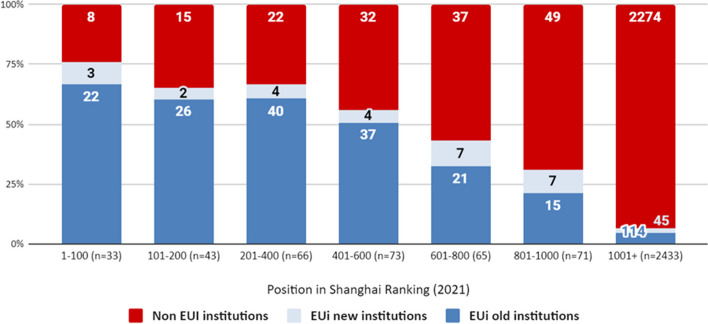
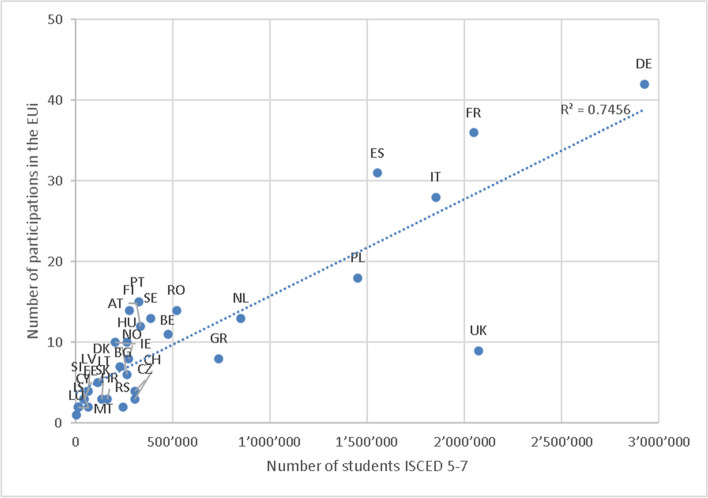
Using a dataset of higher education institutional alliances within the framework of the European University initiative (EUi), we test empirically whether the policy-defined goal of a relative balance between and within the scheme has been achieved. Specifically, we provide a descriptive and analytical account of the diversity of the higher education institutions (HEIs) participating in the EUi, the composition of-as well as the mechanisms behind-the formation of individual alliances. We observe that alliance formation activated the deep sociological mechanisms of hierarchisation, with the alliances largely reproducing the existing . Specifically, we argue that the global-level stratification hierarchy cast by rankings influences the participation of individual institutions and-although to a more limited extent-the formation/structure of the alliances. Further, we demonstrate that the EUi has strengthened existing ties since most alliances thus far have built on existing forms of collaboration. However, we also show empirically that some of the distinctive policy design measures, namely the requirement for broad geographical coverage and generically framed rules for participation, as well as opening the initiative to new alliances and encouraging enlargement of the existing ones, have generated opportunities for involvement of the lower-status institutions. This broadened the scope of the EUi beyond the core of top-ranked research universities located in the knowledge production centres of Europe. We suggest that these observations may have important implications for how the intended extension of the EUi may be implemented in the future.
The online version contains supplementary material available at 10.1007/s10734-023-01167-w.
利用欧洲大学计划(EUi)框架内的高等教育机构联盟数据集,我们通过实证检验该计划中政策所定义的[此处原文缺失部分内容]之间相对平衡的目标是否已实现。具体而言,我们对参与EUi的高等教育机构(HEIs)的多样性、各个联盟的组成以及联盟形成背后的机制进行了描述性和分析性阐述。我们观察到联盟的形成激活了分层的深层社会学机制,联盟在很大程度上重现了现有的[此处原文缺失部分内容]。具体来说,我们认为排名所塑造的全球层面分层等级制度影响了各个机构的参与,并且——尽管程度较为有限——也影响了联盟的形成/结构。此外,我们证明EUi加强了现有联系,因为迄今为止大多数联盟都是建立在现有合作形式之上的。然而,我们也通过实证表明,一些独特的政策设计措施,即对广泛地理覆盖范围的要求、一般性的参与规则框架,以及向新联盟开放该计划并鼓励扩大现有联盟,为地位较低的机构创造了参与机会。这将EUi的范围扩展到了位于欧洲知识生产中心的顶尖研究型大学核心之外。我们认为这些观察结果可能对未来如何实施EUi的预期扩展具有重要意义。
在线版本包含可在10.1007/s10734 - 023 - 01167 - w获取的补充材料。