British Heart Foundation Glasgow Cardiovascular Research Centre, School of Cardiovascular and Metabolic Sciences, University of Glasgow, Glasgow, United Kingdom.
Clin Sci (Lond). 2024 Oct 16;138(20):1305-1323. doi: 10.1042/CS20241021.
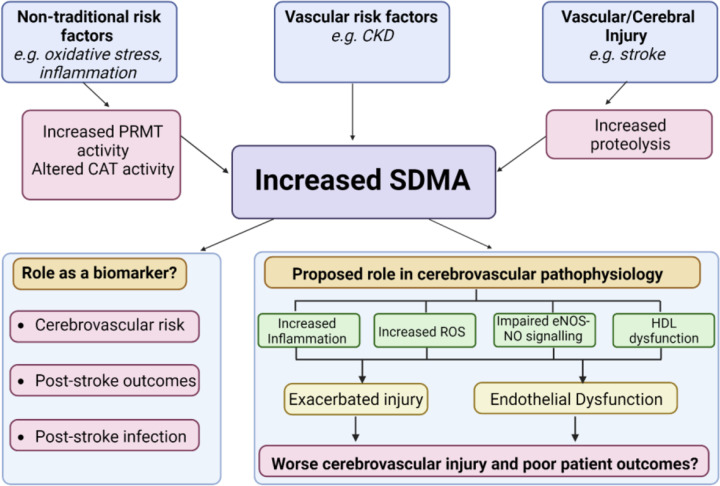
Symmetric dimethylarginine (SDMA) is a methylated derivative of arginine, generated by all cells as a by-product of cellular metabolism and eliminated via the kidney. For many years SDMA has been considered inert and of little biological significance. However, a growing body of evidence now suggests this view is outdated and that circulating SDMA levels may, in fact, be intricately linked to endothelial dysfunction and vascular risk. In this review, we specifically examine SDMA within the context of cerebrovascular disease, with a particular focus on ischaemic stroke. We first discuss pre-clinical evidence supporting the notion that SDMA has effects on nitric oxide signalling, inflammation, oxidative stress, and HDL function. We then appraise the most recent clinical studies that explore the relationship between circulating SDMA and cerebrovascular risk factors, such as chronic kidney disease, hypertension, atrial fibrillation, and atherosclerosis, exploring whether any associations may arise due to the existence of shared risk factors. Finally, we consider the evidence that elevated circulating SDMA is linked to poor outcomes following ischaemic and haemorrhagic stroke. We draw upon pre-clinical insights into SDMA function to speculate how SDMA may not only be a marker of cerebrovascular disease but could also directly influence cerebrovascular pathology, and we highlight the pressing need for more mechanistic pre-clinical studies alongside adequately powered, longitudinal clinical studies to fully evaluate SDMA as a marker/mediator of disease.
对称二甲基精氨酸(SDMA)是精氨酸的甲基化衍生物,由所有细胞作为细胞代谢的副产物产生,并通过肾脏排出体外。多年来,SDMA 一直被认为是惰性的,生物学意义不大。然而,越来越多的证据表明,这种观点已经过时,循环 SDMA 水平实际上可能与内皮功能障碍和血管风险密切相关。在这篇综述中,我们特别研究了 SDMA 在脑血管疾病中的作用,特别是在缺血性中风方面。我们首先讨论了支持 SDMA 对一氧化氮信号、炎症、氧化应激和高密度脂蛋白功能有影响的临床前证据。然后,我们评估了最近探索循环 SDMA 与脑血管危险因素(如慢性肾脏病、高血压、心房颤动和动脉粥样硬化)之间关系的临床研究,探讨是否由于存在共同的危险因素而产生任何关联。最后,我们考虑了循环 SDMA 升高与缺血性和出血性中风后不良结局之间关联的证据。我们借鉴了关于 SDMA 功能的临床前研究,推测 SDMA 不仅可能是脑血管疾病的标志物,还可能直接影响脑血管病理学,并强调迫切需要更多的机制性临床前研究和充分有力的纵向临床研究,以充分评估 SDMA 作为疾病的标志物/介导物。