Department of Epidemiology, University of Michigan School of Public Health, Ann Arbor, MI, United States of America.
Institute for Social Research, Research Center for Group Dynamics, University of Michigan, Ann Arbor, MI, United States of America.
PLoS One. 2024 Oct 11;19(10):e0312027. doi: 10.1371/journal.pone.0312027. eCollection 2024.
To describe and explore variation in 'pandemic-related circumstances' among suicide decedents during the first year of the COVID-19 pandemic.
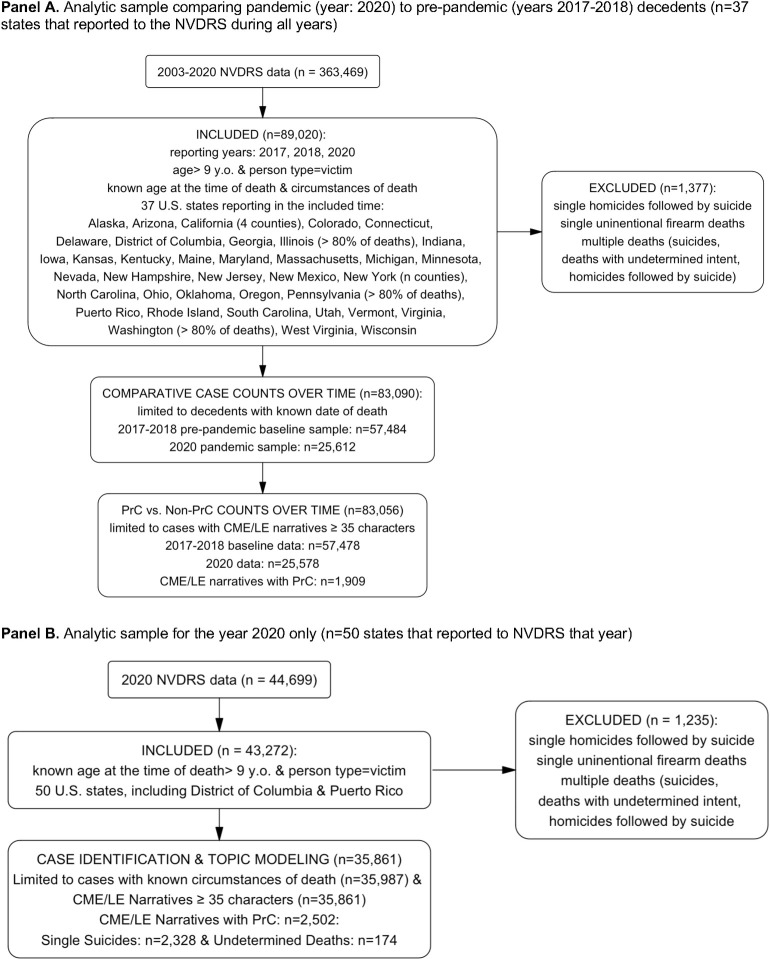
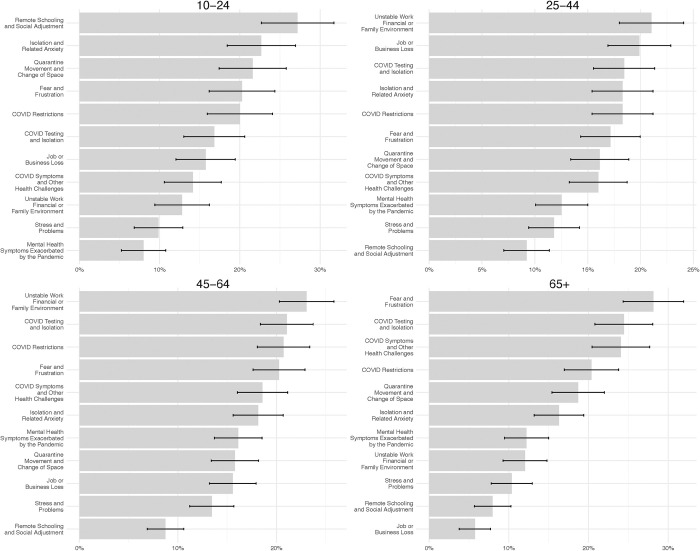
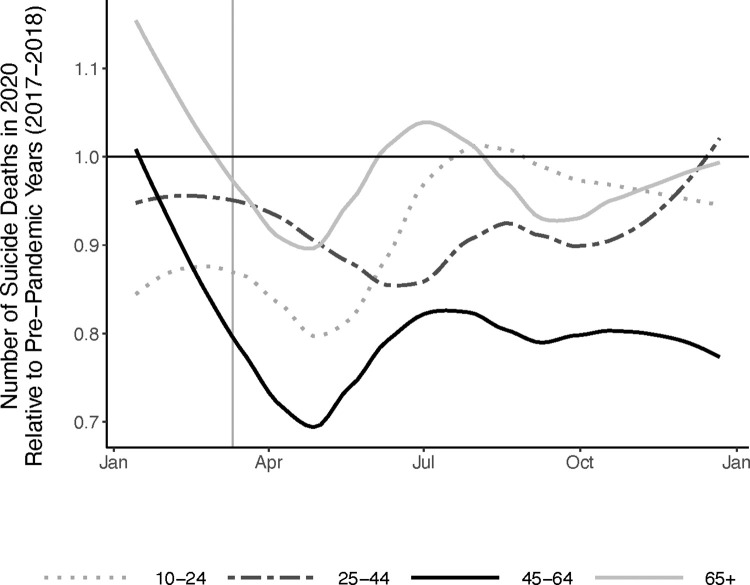
We identified pandemic-related circumstances using decedents' text narratives in the 2020 National Violent Death Reporting System. We use time-series analysis to compare other psychosocial characteristics (e.g., mental health history, interpersonal difficulties, financial strain) of decedents pre-pandemic (2017/2018: n = 56,968 suicide and n = 7,551 undetermined deaths) to those in 2020 (n = 31,887 suicide and n = 4,100 undetermined). We characterize common themes in the narratives with pandemic-related circumstances using topic modeling, and explore variation in topics by age and other psychosocial circumstances.
In 2020, n = 2,502 (6.98%) narratives described pandemic-related circumstances. Compared to other deaths in 2020 and to the pre-pandemic period, decedents with pandemic-related circumstances were older and more highly educated. Common themes of pandemic-related circumstances narratives included: concerns about shutdown restrictions, financial losses, and infection risk. Relative to decedents of the same age that did not have pandemic-related circumstances in 2020, those with pandemic-related circumstances were more likely to also have financial (e.g., for 25-44 years, 43% vs. 12%) and mental health (76% vs. 66%) psychosocial circumstances, but had similar or lower prevalence of substance abuse (47% vs. 49%) and interpersonal (40% vs. 42%) circumstances.
While descriptive, these findings help contextualize suicide mortality during the acute phase of the COVID-19 pandemic and can inform mental health promotion efforts during similar public health emergencies.
描述并探讨 COVID-19 大流行第一年自杀死亡者中与大流行相关的情况的变化。
我们使用 2020 年国家暴力死亡报告系统中死者的文字叙述来识别与大流行相关的情况。我们使用时间序列分析来比较 2017/2018 年(自杀死亡者 n=56968 人,死因不明者 n=7551 人)和 2020 年(自杀死亡者 n=31887 人,死因不明者 n=4100 人)之前与大流行相关的心理社会特征(例如,心理健康史、人际关系困难、经济压力)的其他特征。我们使用主题建模来描述与大流行相关的叙述中的常见主题,并根据年龄和其他心理社会情况探索主题的变化。
2020 年,有 n=2502(6.98%)的叙述描述了与大流行相关的情况。与 2020 年的其他死亡病例和大流行前时期相比,有与大流行相关情况的死者年龄更大,教育程度更高。与大流行相关情况叙述的常见主题包括:对关闭限制、经济损失和感染风险的担忧。与 2020 年没有与大流行相关情况的同年龄死者相比,有与大流行相关情况的死者更有可能同时存在财务(例如,25-44 岁,43%对 12%)和心理健康(76%对 66%)心理社会情况,但滥用药物(47%对 49%)和人际关系(40%对 42%)情况的患病率相似或更低。
虽然这些发现是描述性的,但它们有助于了解 COVID-19 大流行急性阶段的自杀死亡率,并为类似公共卫生紧急情况下的心理健康促进工作提供信息。