Ethiopian Field Epidemiology and Laboratory Training Program (EFELTP), Jimma University, Jimma, Ethiopia.
Public Health Institute, Southwest Ethiopia People Regional Health Bureau, Tarcha, Ethiopia.
BMC Pediatr. 2024 Oct 11;24(1):653. doi: 10.1186/s12887-024-05117-y.
Opportunistic infections (OIs) pose a significant threat to children infected with HIV. Despite advancements in antiretroviral therapy (ART), these infections continue to be a public health concern. However, there is limited evidence regarding the incidence and predictors of OIs among HIV-infected children in Ethiopia, particularly in the study area. Therefore, the objective of this study was to assess the incidence and predictors of OIs among HIV-infected children on ART at public health facilities of Southwest Ethiopia People Regional State.
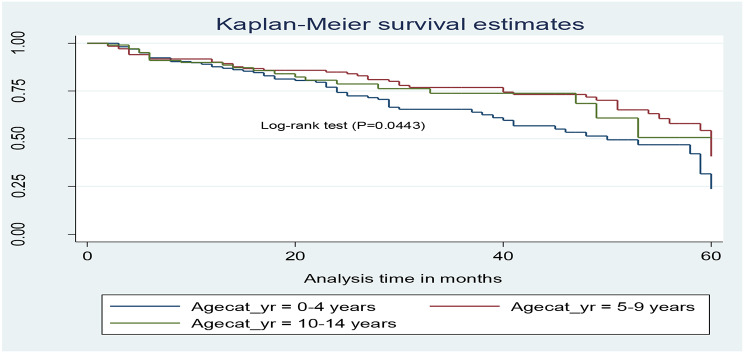
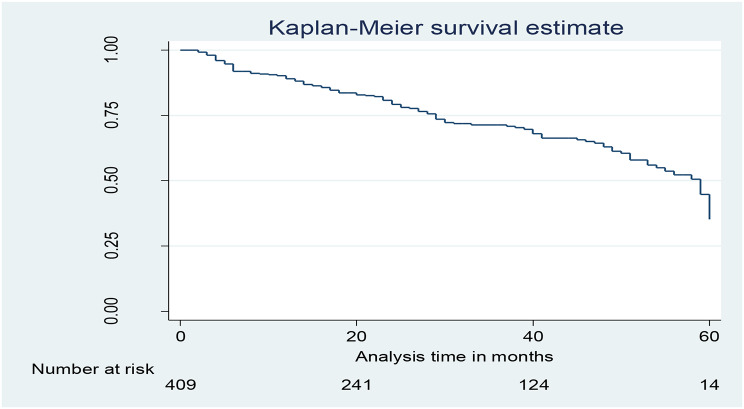
The study employed an institution-based retrospective cohort design, conducted from July 1, 2018 to July 31, 2023, among HIV-infected children aged less than 15 years. Data were extracted using the national ART intake and follow-up forms. KoboCollect version 2023.2.4 and STATA version 14.0 were used for data collection and analysis, respectively. The Kaplan-Meier survival curve was used to estimate the probability of OI-free survival time. Variables with P-value < 0.25 in the bivariable Cox proportional hazard model were selected as candidates. In multivariable analysis, P-value < 0.05 and adjusted hazard ratio (AHR) with 95% confidence interval (CI) were used to declare statistically significant predictors.
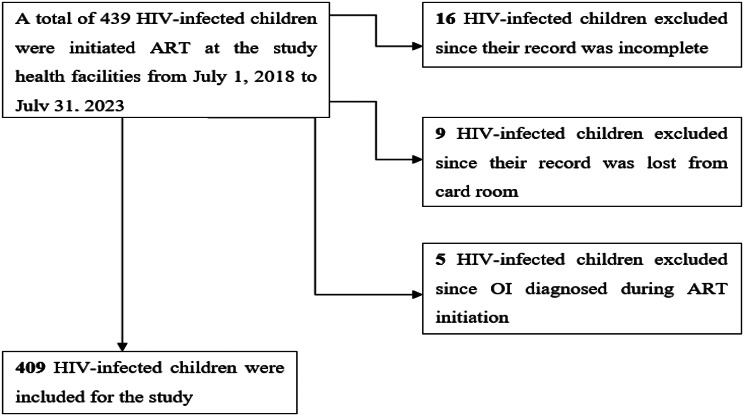
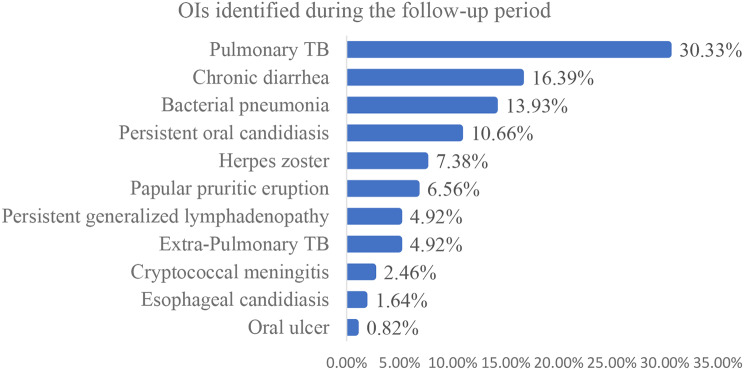
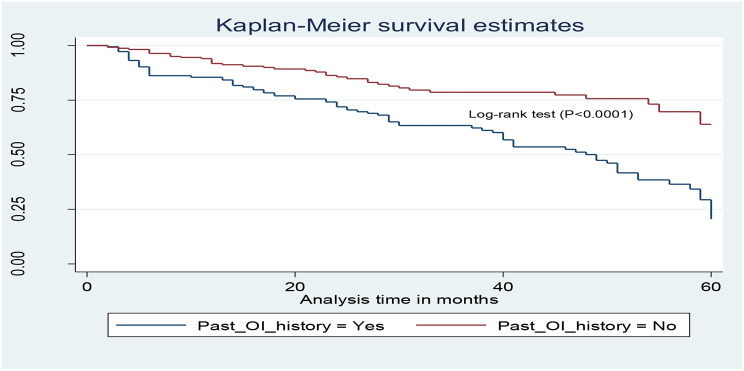
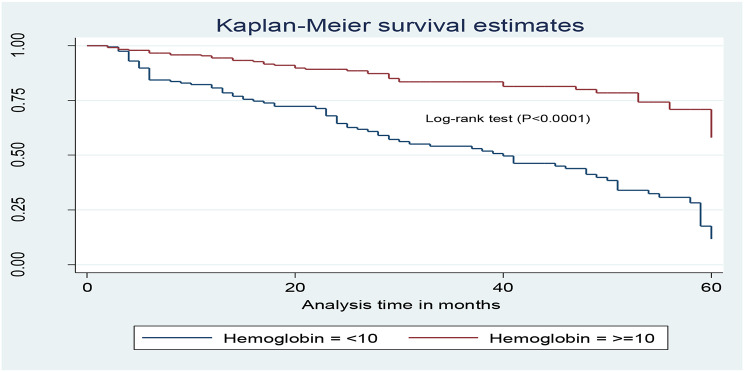
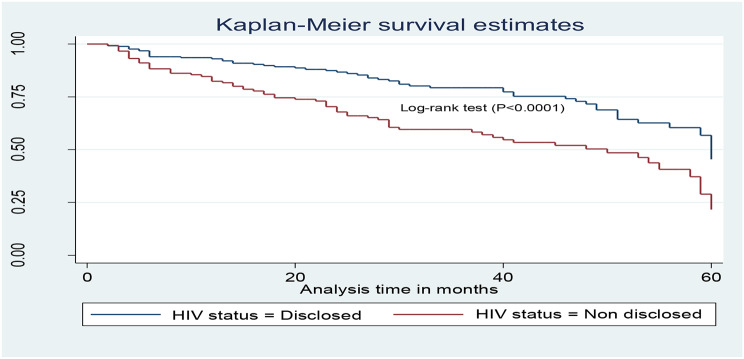
Of the total 409 HIV infected children, 122(29.8%) developed at least one OI, contributing to 954.95 person-years of risk. The overall incidence rate was 12.8 (95% CI: 10.7, 15.2) per 100 person-years. The OI-free survival probability at the end of the follow-up period was 0.277(95% CI: 0.139, 0.434). The commonest OI was pulmonary tuberculosis, 30.33% (95% CI: 22.7, 39.2). Non-disclosing HIV status (AHR: 2.56, 95% CI: 1.42, 4.63), children aged 10-14 years (AHR: 2.34, 95% CI: 1.10, 4.95), no history of prevention of mother-to-child transmission of HIV (AHR: 2.33, 95% CI: 1.48, 3.66), hemoglobin level < 10 mg/dL (AHR: 2.26, 95% CI: 1.37, 3.75), fair or poor adherence to ART (AHR: 1.74, 95% CI: 1.09, 2.79), and having past history of OIs (AHR: 1.61, 95% CI: 1.03, 2.55) were statistically significant predictors of OIs.
The incidence of OIs was high in the study area. Hence, health facilities need to regularly monitor hemoglobin, enhance ART adherence, provide OI prophylaxis for at-risk children, reinforce PMTCT programs for early OI detection and management, and encourage timely and age-appropriate HIV status disclosure. Caregivers of HIV-infected children are also required to oversee and assist their children in adhering to the ART.
机会性感染(OIs)对感染 HIV 的儿童构成重大威胁。尽管抗逆转录病毒疗法(ART)取得了进展,但这些感染仍然是一个公共卫生问题。然而,关于埃塞俄比亚,特别是在研究区域内,感染 HIV 的儿童发生机会性感染的发生率和预测因素的证据有限。因此,本研究旨在评估在埃塞俄比亚西南部人民地区州公立卫生机构接受 ART 的感染 HIV 的儿童发生机会性感染的发生率和预测因素。
本研究采用基于机构的回顾性队列设计,于 2018 年 7 月 1 日至 2023 年 7 月 31 日期间进行,研究对象为年龄小于 15 岁的感染 HIV 的儿童。使用国家 ART 摄入和随访表格提取数据。使用 KoboCollect 版本 2023.2.4 和 STATA 版本 14.0 分别进行数据收集和分析。使用 Kaplan-Meier 生存曲线估计 OI 无生存时间的概率。在单变量 Cox 比例风险模型中 P 值<0.25 的变量被选为候选变量。在多变量分析中,P 值<0.05 和调整后的风险比(AHR)及其 95%置信区间(CI)用于宣布具有统计学意义的预测因素。
在总共 409 名感染 HIV 的儿童中,有 122 名(29.8%)至少发生了一次 OI,导致 954.95 人年的风险。总的发病率为 12.8(95%CI:10.7,15.2)每 100 人年。在随访期末,OI 无生存概率为 0.277(95%CI:0.139,0.434)。最常见的 OI 是肺结核,占 30.33%(95%CI:22.7,39.2)。未公开 HIV 感染状态(AHR:2.56,95%CI:1.42,4.63)、年龄在 10-14 岁的儿童(AHR:2.34,95%CI:1.10,4.95)、无母婴传播预防 HIV 感染史(AHR:2.33,95%CI:1.48,3.66)、血红蛋白水平<10mg/dL(AHR:2.26,95%CI:1.37,3.75)、ART 依从性差或差(AHR:1.74,95%CI:1.09,2.79)和有既往 OI 病史(AHR:1.61,95%CI:1.03,2.55)是 OI 的统计学显著预测因素。
该地区 OI 的发病率很高。因此,卫生机构需要定期监测血红蛋白,加强 ART 依从性,为高危儿童提供 OI 预防措施,加强 PMTCT 计划以早期发现和管理 OI,并鼓励及时和适当的 HIV 状态披露。感染 HIV 的儿童的照顾者还需要监督和帮助他们的孩子遵守 ART。