Department of Pharmacology Laboratory of Therapeutic Chemistry and Analysis of Natural Substances Faculty of Pharmaceutical Sciences, University of Lubumbashi (UNILU), 27, Av. Kato, Commune Kampemba, Lubumbashi - DR, Congo.
Department of Pharmacology- Laboratory of Pharmacognosy - Faculty of Pharmaceutical Sciences - , University of Lubumbashi (UNILU), 27, Av Kato, Commune Kampemba, Lubumbashi - DR, Congo.
BMC Complement Med Ther. 2024 Oct 11;24(1):365. doi: 10.1186/s12906-024-04646-4.
A variety of medicinal plants are used in traditional medicine in Lubumbashi for the management of hemorrhoidal diseases. However, no investigation has been conducted to gather the knowledge required for this type of management in the region. The present study was conducted to inventory the plants used in Lubumbashi to treat hemorrhoidal diseases and to relate their ethnomedical characteristics.
This study was conducted between March 2022 and February 2023 by interviews using semi-structured questionnaire with households (n = 1520), herbalists (n = 25), and traditional healers: THs (n = 59).
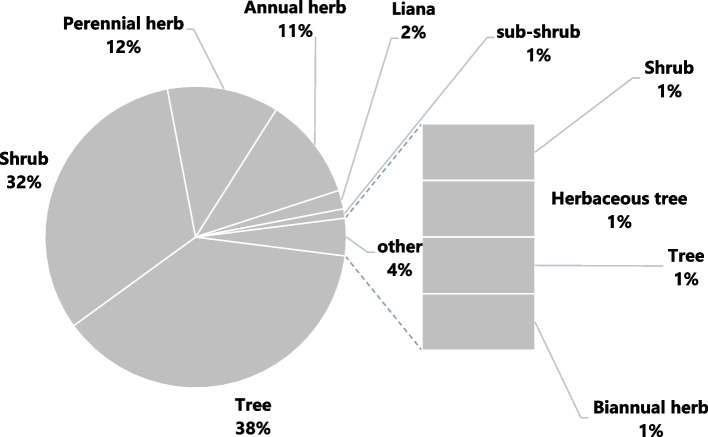
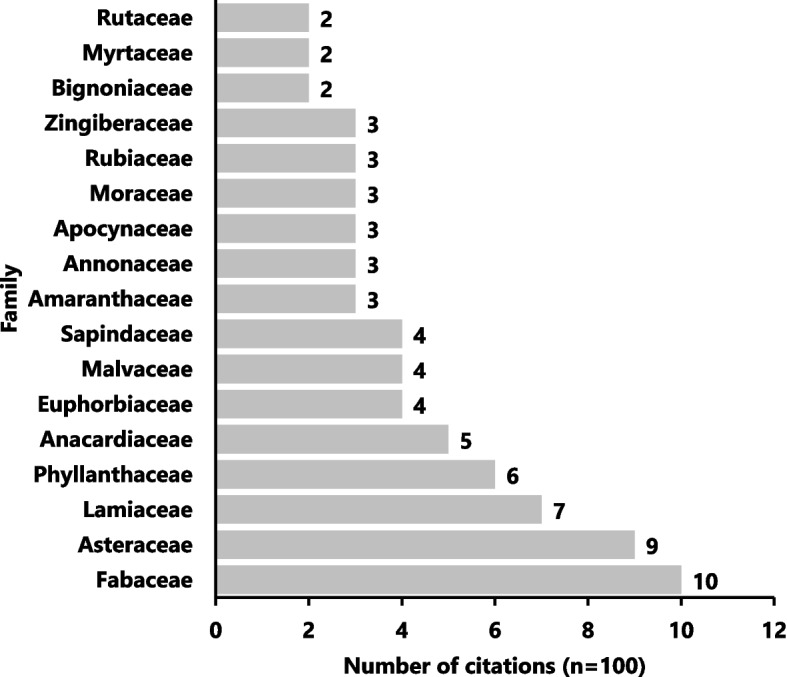
The 1,604 respondents (sex ratio M/F = 0.9; mean age: 56 ± 3 years; experience: 12 ± 3 years) provided information on 100 taxa, 84 of which are used against internal hemorrhoids, Phyllanthus amarus being the most cited (Citation Index, CI: 0.76). Most of them are trees (38%) or shrubs (32%), belonging to 90 genera and 45 families dominated by the Fabaceae (10%) and Asteraceae (9%). They are indicated in 76 other pathologies, dominated by gastrointestinal disorders (GID), wounds and sexually transmitted infections (CI > 0.57). From these 100 taxa, 117 anti-hemorrhoidal formulations were derived, 11 of which combined more than one plant. In all these recipes, the leaf is the most commonly used part (> 60%) and the liniment (> 45%) is the most popular form of application. For the first time, this study reports 14 taxa as plants used in the treatment of hemorrhoids. Among these taxa, Ficus stuhlmannii, Ficus laurifolia, and Ocimum centraliafricanum are listed as medicinal plants for the first time. Khaya nyasica, and Syzygium cordatum, each with 11 uses, have the highest traditional medicinal value.
The findings of this study indicate that a significant number of medicinal plants are used in traditional medicine in Lubumbashi for the treatment of hemorrhoidal diseases. Some of these plants are endemic to the biodiversity area, while others are shared with other cultures and regions. A series of pharmacological studies is currently underway with the objective of validating the anti-hemorrhoidal properties of these plants and in order to identify phytochemical compounds responsible of this activity.
在卢本巴希,多种药用植物被用于传统医学中,以治疗痔疮疾病。然而,该地区尚未进行任何调查以收集此类管理所需的知识。本研究旨在盘点卢本巴希用于治疗痔疮疾病的植物,并阐述其民族医学特征。
本研究于 2022 年 3 月至 2023 年 2 月期间进行,采用半结构式问卷对 1520 户家庭、25 名草药医生和 59 名传统治疗师进行访谈。
1604 名受访者(男女比例 0.9;平均年龄 56±3 岁;经验 12±3 年)提供了 100 种分类群的信息,其中 84 种用于治疗内痔,叶下珠(Citation Index,CI:0.76)的引用率最高。它们大多为乔木(38%)或灌木(32%),隶属于 90 个属和 45 个科,其中以豆科(10%)和菊科(9%)为主。它们还用于 76 种其他疾病,以胃肠道疾病(GID)、创伤和性传播感染为主(CI>0.57)。从这 100 种分类群中,衍生出 117 种抗痔配方,其中 11 种配方结合了一种以上植物。在所有这些配方中,叶是最常用的部分(>60%),软膏剂(>45%)是最常用的应用形式。本研究首次报道了 14 种被用于治疗痔疮的植物。在这些分类群中,榕属的榕叶榕、榕属的厚叶榕和罗勒属的中央非洲罗勒首次被列为药用植物。Khaya nyasica 和 Syzygium cordatum 每种植物都有 11 种用途,具有最高的传统药用价值。
本研究结果表明,卢本巴希传统医学中使用了大量药用植物来治疗痔疮疾病。其中一些植物是生物多样性区域的特有种,而其他植物则与其他文化和地区共享。目前正在进行一系列药理学研究,旨在验证这些植物的抗痔特性,并确定负责这种活性的植物化学化合物。