Saunders Harmony I, Holloran Sean M, Trinca Gloria M, Artigues Antonio, Villar Maite, Tinoco Julio C, Dias Wagner Barbosa, Werner Lauryn R, Chowanec Eilidh I, Heard Amanda, Chalise Prabhakar, Slawson Chad, Hagan Christy R
Department of Cancer Biology, University of Kansas Medical Center, Kansas City, Kansas, USA.
Department of Biochemistry and Molecular Biology, University of Kansas Medical Center, Kansas City, Kansas, USA.
J Biol Chem. 2024 Nov;300(11):107886. doi: 10.1016/j.jbc.2024.107886. Epub 2024 Oct 11.
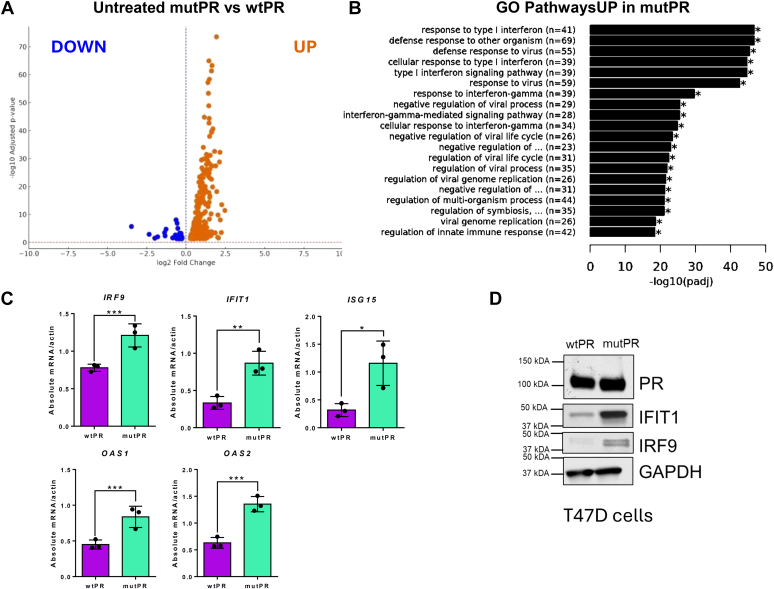
Hormone receptor positive (HR+) breast cancer, defined by expression of estrogen receptor (ER) and/or progesterone receptor (PR), is the most commonly diagnosed type of breast cancer. PR alters the transcriptional landscape to support tumor growth in concert with, or independent of, ER. Understanding the mechanisms regulating PR function is critical to developing new strategies to treat HR+ breast cancer. O-linked β-N-acetylglucosamine (O-GlcNAc) is a posttranslational modification responsible for nutrient sensing that modulates protein function. Although PR is heavily posttranslationally modified, through both phosphorylation and O-GlcNAcylation, specific sites of O-GlcNAcylation on PR and how they regulate PR action have not been investigated. Using established PR-expressing breast cancer cell lines, we mapped several sites of O-GlcNAcylation on PR. RNA-sequencing after PR O-GlcNAc site mutagenesis revealed site-specific O-GlcNAcylation of PR is critical for ligand-independent suppression of interferon signaling, a regulatory function of PR in breast cancer. Furthermore, O-GlcNAcylation of PR enhances PR-driven tumor growth in vivo. Herein, we have delineated one contributing mechanism to PR function in breast cancer that impacts tumor growth and provided additional insight into the mechanism through which PR attenuates interferon signaling.
激素受体阳性(HR+)乳腺癌由雌激素受体(ER)和/或孕激素受体(PR)的表达所定义,是最常见的乳腺癌诊断类型。PR改变转录格局,与ER协同或独立支持肿瘤生长。了解调节PR功能的机制对于开发治疗HR+乳腺癌的新策略至关重要。O-连接的β-N-乙酰葡糖胺(O-GlcNAc)是一种负责营养感知的翻译后修饰,可调节蛋白质功能。尽管PR经过大量翻译后修饰,包括磷酸化和O-GlcNAc化,但PR上O-GlcNAc化的特定位点及其调节PR作用的方式尚未得到研究。利用已建立的表达PR的乳腺癌细胞系,我们绘制了PR上几个O-GlcNAc化位点。PR O-GlcNAc位点诱变后的RNA测序显示,PR的位点特异性O-GlcNAc化对于干扰素信号的非配体依赖性抑制至关重要,这是PR在乳腺癌中的一种调节功能。此外,PR的O-GlcNAc化增强了PR在体内驱动的肿瘤生长。在此,我们阐述了PR在乳腺癌中影响肿瘤生长的一种作用机制,并对PR减弱干扰素信号的机制提供了更多见解。