
青少年心理健康的代际转变:一项纵向时间滞后研究。
Generational Shifts in Adolescent Mental Health: A Longitudinal Time-Lag Study.
作者信息
Borg Meghan E, Heffer Taylor, Willoughby Teena
机构信息
Brock University, St. Catharines, ON, Canada.
Ontario Tech University, Oshawa, ON, Canada.
出版信息
J Youth Adolesc. 2025 Apr;54(4):837-848. doi: 10.1007/s10964-024-02095-3. Epub 2024 Oct 12.
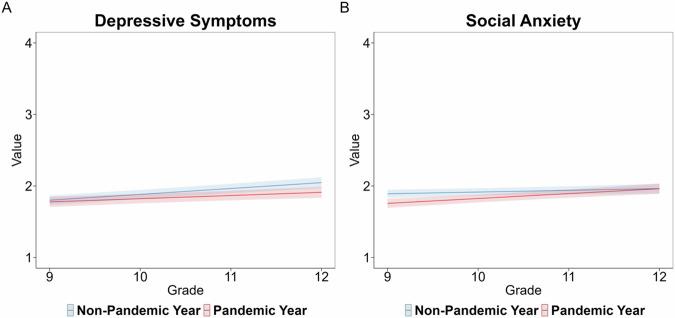
There is concern that adolescents today are experiencing a "mental health crisis" compared to previous generations. Research has lacked a longitudinal time-lag design to directly compare depressive symptoms and social anxiety of adolescents in two generations. The current study surveyed 1081 adolescents in the current generation (Mage = 14.60, SD = 0.31, 49% female) and 1211 adolescents in a previous generation (Mage = 14.40, SD = 0.51, 51% female) across the high school years (grades 9-12), 20 years apart. Mixed-effects analysis revealed that the Current-Sample reported higher and increasing mental health problems over time compared to the Past-Sample. Although most adolescents reported consistently low mental health problems, the Current-Sample had a higher proportion of adolescents who were consistently at risk across the high school years compared to the Past-Sample. These findings highlight while most adolescents in both generations do not report elevated mental health problems, there may be a small, yet growing, group of adolescents today at risk for experiencing a "mental health crisis".
有人担心,与前几代人相比,如今的青少年正经历一场“心理健康危机”。此前的研究缺乏纵向时滞设计,无法直接比较两代青少年的抑郁症状和社交焦虑情况。本研究对相隔20年的两代高中生(9至12年级)进行了调查,其中当代有1081名青少年(平均年龄14.60岁,标准差0.31,49%为女性),上一代有1211名青少年(平均年龄14.40岁,标准差0.51,51%为女性)。混合效应分析显示,与上一代样本相比,当代样本报告的心理健康问题随着时间推移更高且呈上升趋势。尽管大多数青少年报告的心理健康问题一直较低,但与上一代样本相比,当代样本中在高中各年级持续处于风险中的青少年比例更高。这些发现凸显出,虽然两代人中的大多数青少年并未报告心理健康问题加剧,但如今可能有一小部分且数量在不断增加的青少年面临经历“心理健康危机”的风险。


 Zotero 插件