Department of Neurology, Vestfold Hospital, Tønsberg, Norway.
J Headache Pain. 2014 Jun 13;15(1):38. doi: 10.1186/1129-2377-15-38.
It is well documented that both anxiety and depression are associated with headache, but there is limited knowledge regarding the relation between recurrent primary headaches and symptoms of anxiety and depression as well as behavioral problems among adolescents. Assessment of co-morbid disorders is important in order to improve the management of adolescents with recurrent headaches. Thus the main purpose of the present study was to assess the relationship of recurrent headache with anxiety and depressive symptoms and behavioral problems in a large population based cross-sectional survey among adolescents in Norway.
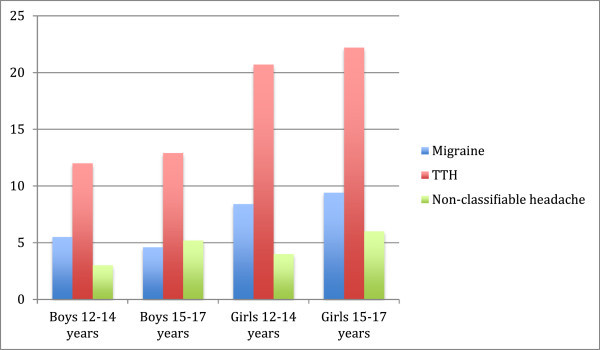
A cross-sectional, population-based study was conducted in Norway from 1995 to 1997 (Young-HUNT1). In Young-HUNT1, 4872 adolescents aged 12 to 17 years were interviewed about their headache complaints and completed a comprehensive questionnaire that included assessment of symptoms of anxiety and depression and behavioral problems, i.e. conduct and attention difficulties.
In adjusted multivariate analyses among adolescents aged 12-14 years, recurrent headache was associated with symptoms of anxiety and depression (OR: 2.05, 95% CI: 1.61-2.61, p < 0.001), but not with behavioral problems. A significant association with anxiety and depressive symptoms was evident for all headache categories; i.e. migraine, tension-type headache and non-classifiable headache. Among adolescents aged 15-17 years there was a significant association between recurrent headache and symptoms of anxiety and depression (OR: 1.64, 95% CI: 1.39-1.93, p < 0,001) and attention difficulties (OR: 1.25, 95% CI: 1.09-1.44, p =0.001). For migraine there was a significant association with both anxiety and depressive symptoms and attention difficulties, while tension-type headache was significantly associated only with symptoms of anxiety and depression. Non-classifiable headache was associated with attention difficulties and conduct difficulties, but not with anxiety and depressive symptoms. Headache frequency was significantly associated with increasing symptoms scores for anxiety and depressive symptoms as well as attention difficulties, evident for both age groups.
The results from the present study indicate that both anxiety and depressive symptoms and behavioral problems are associated with recurrent headache, and should accordingly be considered a part of the clinical assessment of children and adolescents with headache. Identification of these associated factors and addressing them in interventions may improve headache management.
焦虑和抑郁与头痛密切相关,这已得到充分证实,但关于复发性原发性头痛与青少年焦虑和抑郁症状以及行为问题之间的关系,以及相关知识还很有限。评估共病障碍对于改善青少年复发性头痛的管理非常重要。因此,本研究的主要目的是在挪威一项基于人群的青少年横断面研究中评估复发性头痛与焦虑和抑郁症状以及行为问题之间的关系。
1995 年至 1997 年,在挪威进行了一项横断面、基于人群的研究(Young-HUNT1)。在 Young-HUNT1 中,4872 名 12 至 17 岁的青少年接受了头痛症状的访谈,并完成了一份综合问卷,其中包括焦虑和抑郁症状以及行为问题的评估,即行为和注意力困难。
在 12-14 岁的青少年中进行的调整多变量分析中,复发性头痛与焦虑和抑郁症状相关(OR:2.05,95%CI:1.61-2.61,p<0.001),但与行为问题无关。偏头痛、紧张型头痛和无法分类的头痛等所有头痛类别均与焦虑和抑郁症状显著相关。在 15-17 岁的青少年中,复发性头痛与焦虑和抑郁症状(OR:1.64,95%CI:1.39-1.93,p<0.001)和注意力困难(OR:1.25,95%CI:1.09-1.44,p=0.001)之间存在显著关联。偏头痛与焦虑和抑郁症状以及注意力困难均显著相关,而紧张型头痛仅与焦虑和抑郁症状显著相关。无法分类的头痛与注意力困难和行为困难相关,但与焦虑和抑郁症状无关。头痛频率与焦虑和抑郁症状以及注意力困难的症状评分呈显著正相关,在两个年龄组中均如此。
本研究结果表明,焦虑和抑郁症状以及行为问题与复发性头痛相关,因此应将其视为头痛儿童和青少年临床评估的一部分。识别这些相关因素并在干预措施中加以解决,可能会改善头痛管理。