Sekita Tetsuya, Asano Naofumi, Kobayashi Hiroshi, Yonemoto Tsukasa, Kobayashi Eisuke, Ishii Takeshi, Kawai Akira, Nakayama Robert
Department of Orthopedic Surgery, Keio University School of Medicine, Tokyo, Japan.
Division of Musculoskeletal Oncology, National Cancer Center Hospital, Tokyo, Japan.
Bone Jt Open. 2024 Oct 14;5(10):868-878. doi: 10.1302/2633-1462.510.BJO-2024-0114.R1.
Surgical limb sparing for knee-bearing paediatric bone sarcoma is considered to have a clinically significant influence on postoperative function due to complications and leg-length discrepancies. However, researchers have not fully evaluated the long-term postoperative functional outcomes. Therefore, in this study, we aimed to elucidate the risk factors and long-term functional prognosis associated with paediatric limb-sparing surgery.
We reviewed 40 patients aged under 14 years who underwent limb-sparing surgery for knee bone sarcoma (15 cases in the proximal tibia and 25 in the distal femur) between January 2000 and December 2013, and were followed up for a minimum of five years. A total of 35 patients underwent reconstruction using artificial materials, and five underwent biological reconstruction. We evaluated the patients' postoperative complications, survival rate of reconstruction material, and limb, limb function, and leg-length discrepancy at the final follow-up, as well as the risk factors for each.
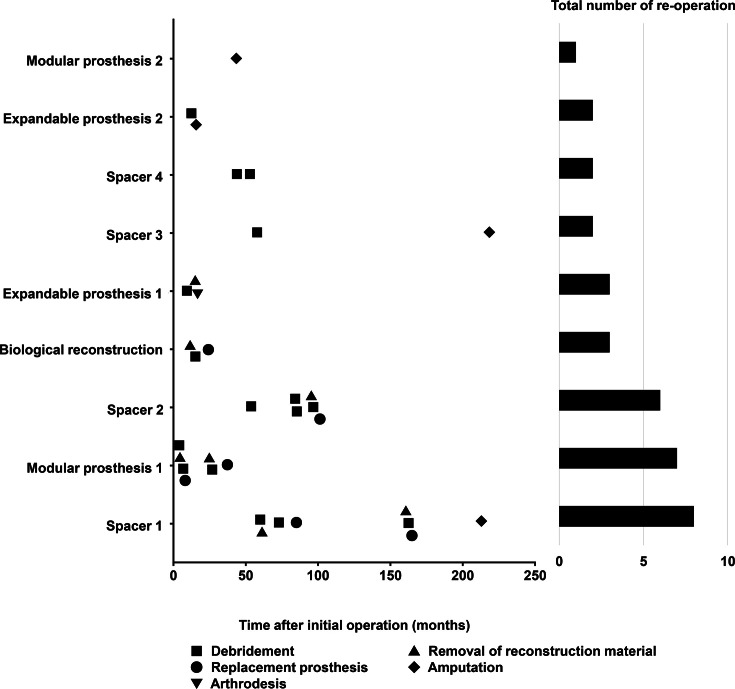
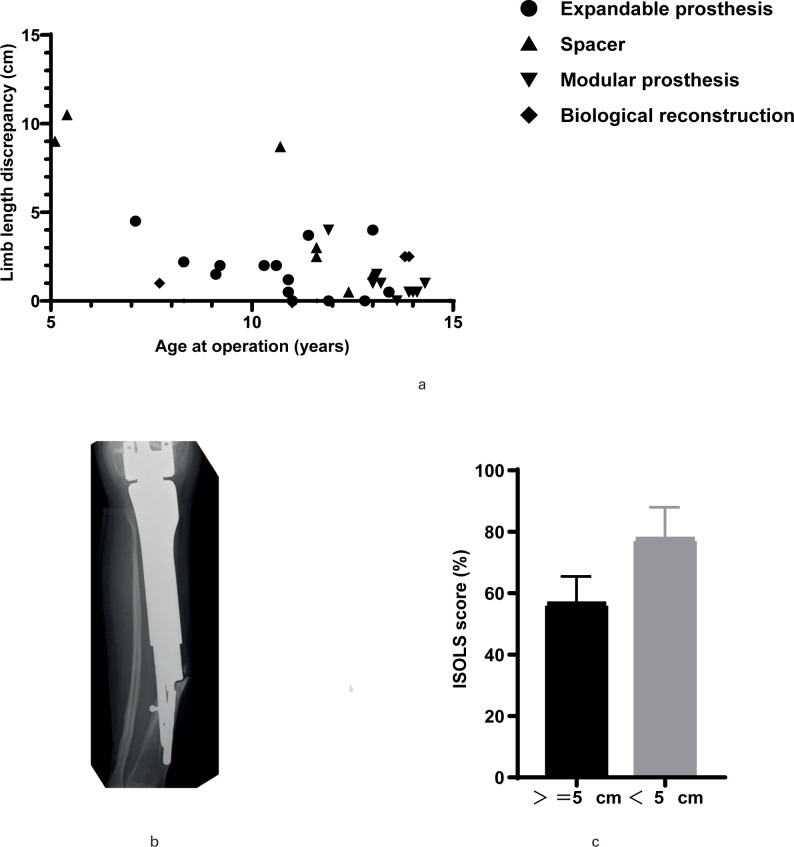
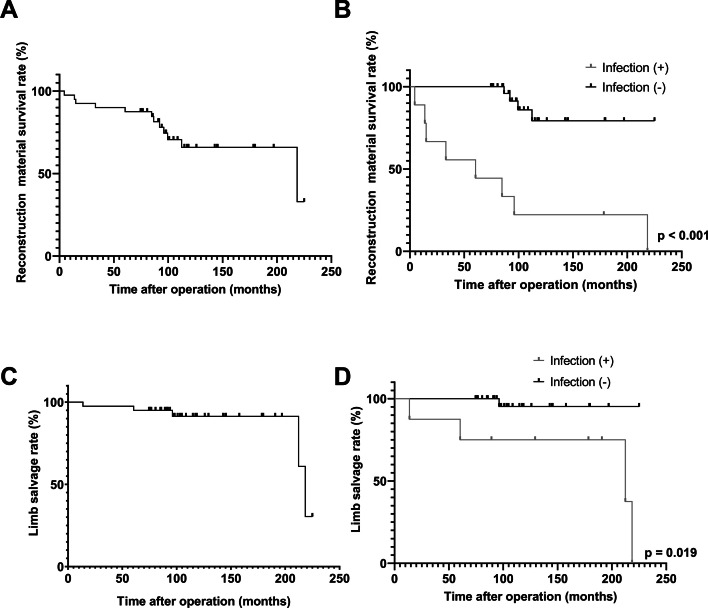
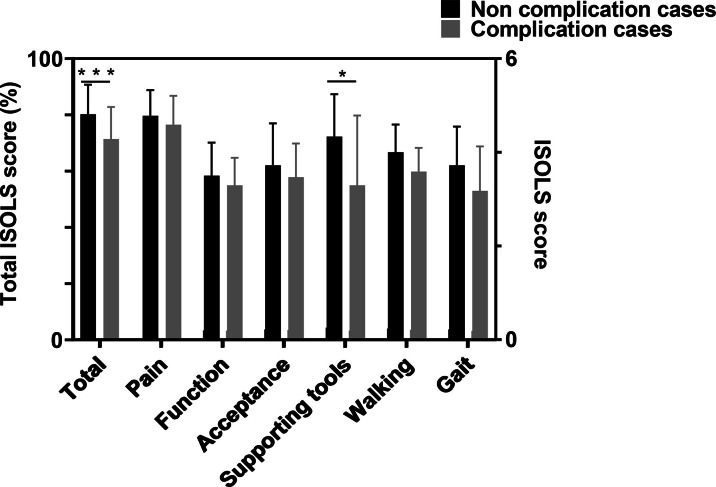
Complications were observed in 55% (22/40) of patients. The limb survival and reconstruction material rates at five and ten years were 95% and 91%, and 88% and 66%, respectively. Infection was the only risk factor in both survivals (p < 0.001, p = 0.019). In the 35 patients with limb preservation, the median International Society of Limb Salvage (ISOLS) score at the final follow-up was 80 (47% to 97%). Younger age (p = 0.027) and complications (p = 0.005) were poor prognostic factors. A negative correlation was found between age and leg-length discrepancy (R = -0.426; p = 0.011). The ISOLS scores were significantly lower in patients with a leg-length discrepancy of more than 5 cm (p = 0.005).
Young age and complications were linked to an unfavourable functional prognosis. Leg-length correction was insufficient, especially in very young children, resulting in decreased function of the affected limb. Limb-sparing surgery for these children remains a considerable challenge.
由于并发症和腿长差异,保肢手术对儿童膝关节骨肉瘤术后功能具有临床显著影响。然而,研究人员尚未充分评估术后长期功能结局。因此,在本研究中,我们旨在阐明与儿童保肢手术相关的危险因素和长期功能预后。
我们回顾了2000年1月至2013年12月期间接受膝关节骨肉瘤保肢手术的40例14岁以下患者(胫骨近端15例,股骨远端25例),并进行了至少五年的随访。共有35例患者使用人工材料进行重建,5例进行生物重建。我们评估了患者的术后并发症、重建材料存活率、肢体、肢体功能、最终随访时的腿长差异以及各自的危险因素。
55%(22/40)的患者出现并发症。五年和十年时的肢体存活率和重建材料率分别为95%和91%,以及88%和66%。感染是两种存活率的唯一危险因素(p < 0.001,p = 0.019)。在35例保肢患者中,最终随访时国际保肢协会(ISOLS)评分中位数为80(47%至97%)。年龄较小(p = 0.027)和并发症(p = 0.005)是不良预后因素。年龄与腿长差异之间存在负相关(R = -0.426;p = 0.011)。腿长差异超过5 cm的患者ISOLS评分显著较低(p = 0.005)。
年龄较小和并发症与不良功能预后相关。腿长矫正不足,尤其是在非常年幼的儿童中,导致患肢功能下降。对这些儿童进行保肢手术仍然是一项巨大挑战。