Department of Pathology and Molecular Pathology, University of Zurich (UZH) and University Hospital Zurich (USZ), Zurich, Switzerland.
Division of Gastroenterology and Hepatology, Lausanne University Hospital and University of Lausanne, Lausanne, Switzerland.
Nat Commun. 2024 Oct 14;15(1):8849. doi: 10.1038/s41467-024-53072-0.
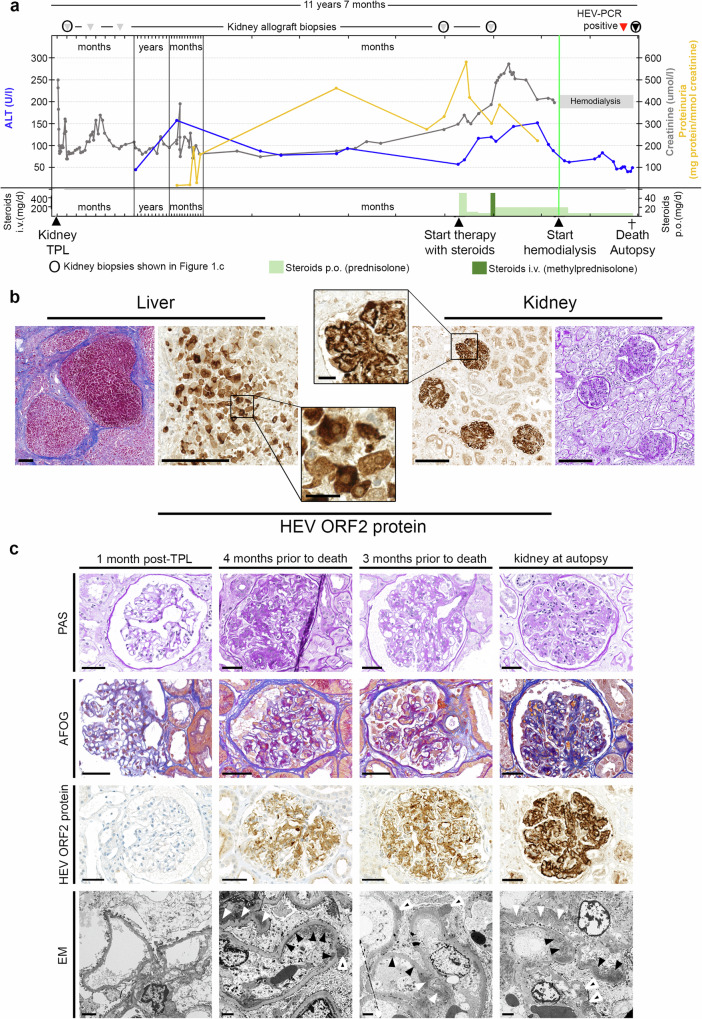
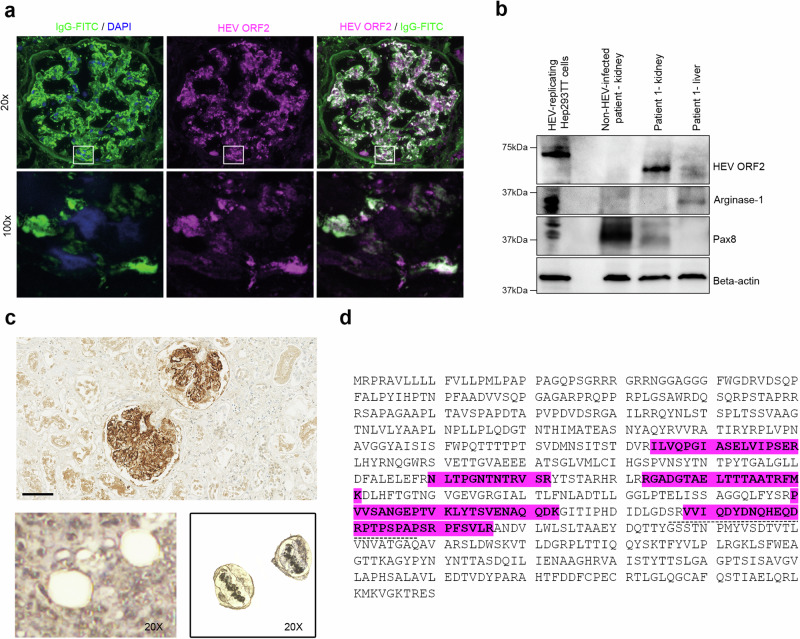
Hepatitis E virus (HEV) infection, one of the most common forms of hepatitis worldwide, is often associated with extrahepatic, particularly renal, manifestations. However, the underlying mechanisms are incompletely understood. Here, we report the development of a de novo immune complex-mediated glomerulonephritis (GN) in a kidney transplant recipient with chronic hepatitis E. Applying immunostaining, electron microscopy, and mass spectrometry after laser-capture microdissection, we show that GN develops in parallel with increasing glomerular deposition of a non-infectious, genome-free and non-glycosylated HEV open reading frame 2 (ORF2) capsid protein. No productive HEV infection of kidney cells is detected. Patients with acute hepatitis E display similar but less pronounced deposits. Our results establish a link between the production of HEV ORF2 protein and the development of hepatitis E-associated GN in the immunocompromised state. The formation of glomerular IgG-HEV ORF2 immune complexes discovered here provides a potential mechanistic explanation of how the hepatotropic HEV can cause variable renal manifestations. These findings directly provide a tool for etiology-based diagnosis of hepatitis E-associated GN as a distinct entity and suggest therapeutic implications.
戊型肝炎病毒(HEV)感染是全球最常见的肝炎形式之一,常伴有肝外,特别是肾脏表现。然而,其潜在机制尚不完全清楚。在这里,我们报告了一名慢性 HEV 感染的肾移植受者新发免疫复合物介导的肾小球肾炎(GN)的发生。通过免疫组化、电镜和激光捕获微切割后的质谱分析,我们发现 GN 的发生与肾小球中不断增加的非感染性、无基因组和非糖基化的 HEV 开放阅读框 2(ORF2)衣壳蛋白沉积平行。未检测到肾细胞的产毒性 HEV 感染。急性 HEV 感染患者显示出类似但不那么明显的沉积物。我们的结果在免疫抑制状态下建立了 HEV ORF2 蛋白的产生与 HEV 相关 GN 发展之间的联系。在此发现的肾小球 IgG-HEV ORF2 免疫复合物的形成提供了一个潜在的机制解释,说明嗜肝性 HEV 如何引起不同的肾脏表现。这些发现直接为基于病因的 HEV 相关性 GN 作为一种独特实体的诊断提供了工具,并提示了治疗意义。