Yaegashi Hiroshi, Izumi Kouji, Makino Tomoyuki, Naito Renato, Iwamoto Hiroaki, Kawaguchi Shohei, Shigehara Kazuyoshi, Nohara Takahiro, Mizokami Atsushi
Department of Integrative Cancer Therapy and Urology, Kanazawa University Graduate School of Medical Science, Kanazawa, JPN.
Cureus. 2024 Sep 13;16(9):e69366. doi: 10.7759/cureus.69366. eCollection 2024 Sep.
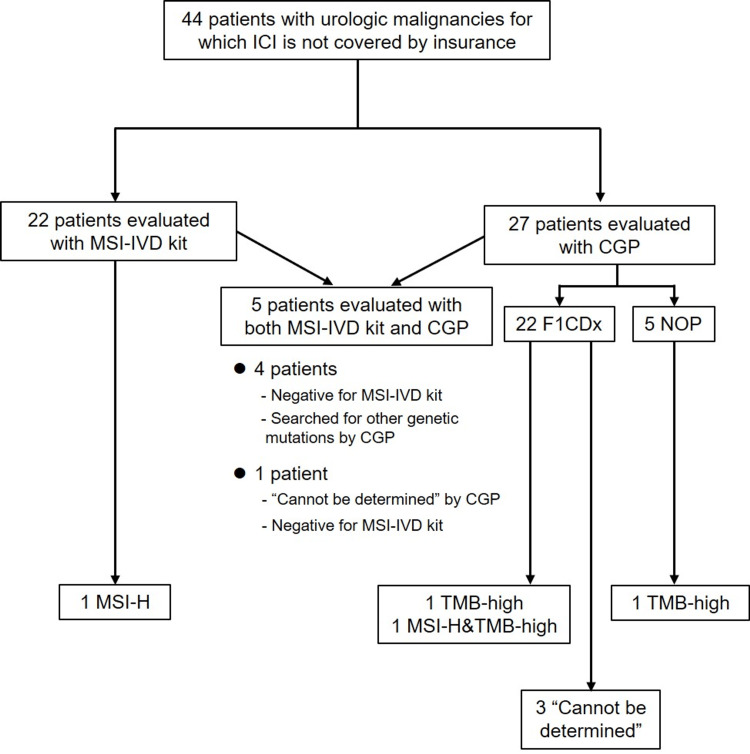
Objectives Microsatellite instability-high (MSI-H) and high tumor mutation burden (TMB-high) frequencies were investigated to determine the efficacy and adverse events of pembrolizumab in patients with urologic malignancies (or their equivalents) for which immune checkpoint inhibitors (ICIs) are not covered by Japanese insurance. Methods Between February 2019 and April 2024, patients with urologic malignancies (or their equivalents) treated in our department for whom ICIs were not approved by Japanese insurance were screened with an MSI companion diagnostic kit or comprehensive genomic profiling (CGP). The efficacy of pembrolizumab therapy, presence of adverse events, and outcomes were evaluated retrospectively in patients with MSI-H or TMB-high. Results In total, 44 patients were tested, and the median age at testing was 70 years. Castration-resistant prostate cancer (CRPC) was the most common (n = 31). Overall, 49 tests were performed, including 22 MSI companion diagnostic kits and 27 CGP tests. Of the 49 tests, 1 detected MSI-H, 2 detected TMB-high, and 1 detected simultaneous MSI-H/TMB-high, with detection rates of 4.1% and 11.1% for MSI-H and TMB-high, respectively. A patient with MSI-H CRPC and neuroendocrine differentiation achieved a complete response and a prolonged duration of response to pembrolizumab without adverse events. The duration of response to pembrolizumab was shorter in a patient with TMB-high, and a CRPC patient with simultaneously detected MSI-H/TMB-high had to discontinue pembrolizumab early due to immune-related adverse events. Conclusions Despite the potential benefit of pembrolizumab, MSI-H or TMB-high was less frequently detected in urologic malignancies for which ICIs are not covered by Japanese insurance.
目的 研究微卫星高度不稳定(MSI-H)和高肿瘤突变负荷(TMB-High)的频率,以确定帕博利珠单抗在日本保险未涵盖免疫检查点抑制剂(ICI)的泌尿生殖系统恶性肿瘤(或其等效物)患者中的疗效和不良事件。方法 在2019年2月至2024年4月期间,对在我科接受治疗且日本保险未批准使用ICI的泌尿生殖系统恶性肿瘤(或其等效物)患者,使用MSI伴随诊断试剂盒或综合基因组分析(CGP)进行筛查。对MSI-H或TMB-High患者的帕博利珠单抗治疗疗效、不良事件的发生情况及结局进行回顾性评估。结果 共检测44例患者,检测时的中位年龄为70岁。去势抵抗性前列腺癌(CRPC)最为常见(n = 31)。总体而言,共进行了49次检测,包括22次MSI伴随诊断试剂盒检测和27次CGP检测。在49次检测中,1次检测到MSI-H,2次检测到TMB-High,1次同时检测到MSI-H/TMB-High,MSI-H和TMB-High的检测率分别为4.1%和11.1%。1例伴有神经内分泌分化的MSI-H CRPC患者对帕博利珠单抗获得完全缓解且缓解持续时间延长,未出现不良事件。1例TMB-High患者对帕博利珠单抗的缓解持续时间较短,1例同时检测到MSI-H/TMB-High的CRPC患者因免疫相关不良事件不得不提前停用帕博利珠单抗。结论 尽管帕博利珠单抗可能有益,但在日本保险未涵盖ICI的泌尿生殖系统恶性肿瘤中,MSI-H或TMB-High的检测频率较低。