Lim Tse Yang, Dong Huiru, Stringfellow Erin, Hasgul Zeynep, Park Ju, Glos Lukas, Kazemi Reza, Jalali Mohammad S
Center for Communicable Disease Dynamics, Harvard T.H. Chan School of Public Health, Boston, MA, USA.
Massachusetts General Hospital Institute for Technology Assessment, Harvard Medical School, Boston, MA, USA.
Lancet Reg Health Am. 2024 Sep 27;39:100898. doi: 10.1016/j.lana.2024.100898. eCollection 2024 Nov.
Fentanyl and its analogs contribute substantially to drug overdose deaths in the United States. There is concern that people using drugs are being unknowingly exposed to fentanyl, increasing their risk of overdose death. This study examines temporal trends and spatial variations in the co-occurrence of fentanyl with other seized drugs.
We identified fentanyl co-occurrence (the proportion of samples of non-fentanyl substances that also contain fentanyl) among 9 substances or substance classes of interest: methamphetamine, cannabis, cocaine, heroin, club drugs, hallucinogens, and prescription opioids, stimulants, and benzodiazepines. We used serial cross-sectional data on drug reports across 50 states and the District of Columbia from the National Forensic Laboratory Information System, the largest available database on the U.S. illicit drug supply, from January 2013 to December 2023.
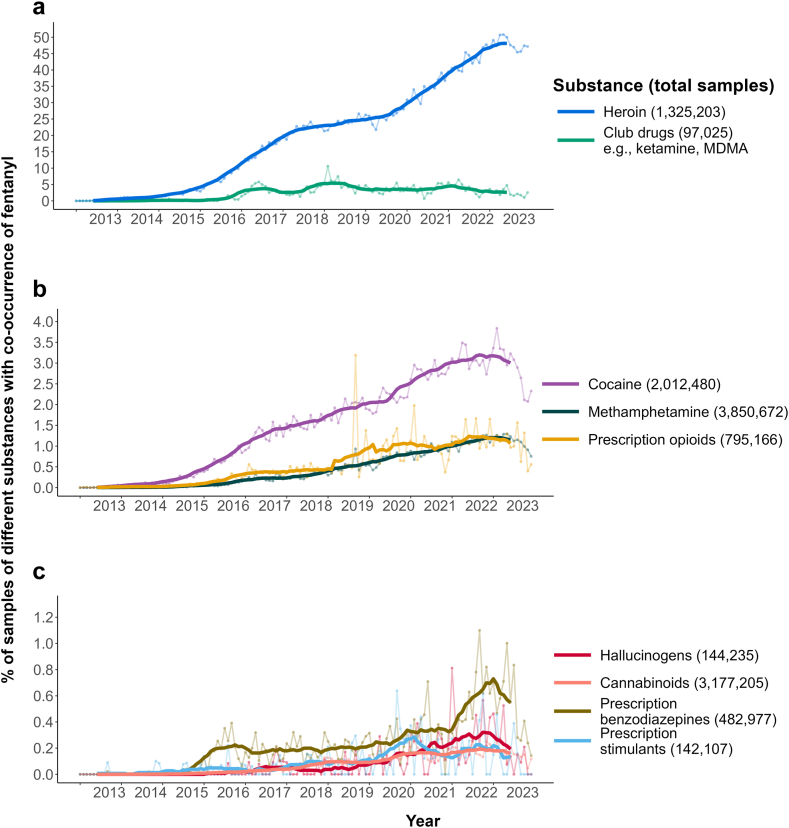
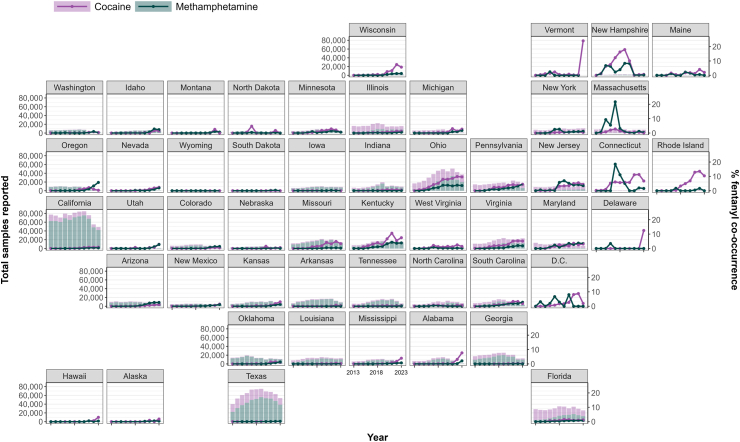
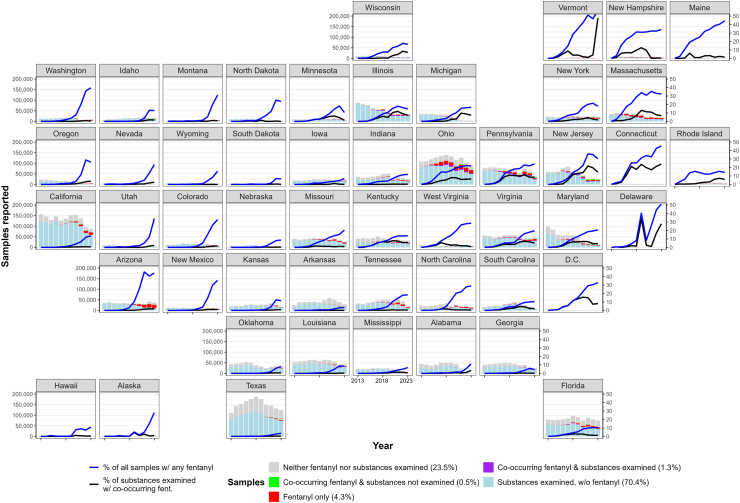
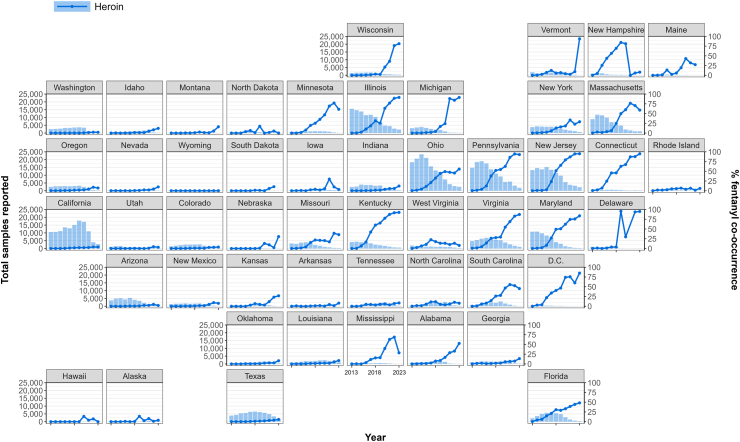
We analyzed data from 11,940,207 samples. Fentanyl co-occurrence with all examined substances increased monotonically over time (Mann-Kendall < 0.0001). Nationally, fentanyl co-occurrence was highest among heroin samples (approx. 50%), but relatively low among methamphetamine (≤1%), cocaine (≤4%), and other drug samples. However, co-occurrence rates have grown to over 10% for cocaine and methamphetamine in several Northeast states in 2017-2023.
Fentanyl co-occurs most commonly with heroin, but its presence in stimulant supplies is increasing in some areas, where it may pose a disproportionately high risk of overdose.
This work was partly supported by FDA grant U01FD00745501. This article reflects the views of the authors and does not represent the views or policies of the FDA or US Department of Health and Human Services.
芬太尼及其类似物在美国药物过量死亡事件中占很大比例。人们担心吸毒者在不知情的情况下接触到芬太尼,从而增加了药物过量死亡的风险。本研究考察了芬太尼与其他查获毒品同时出现的时间趋势和空间差异。
我们确定了芬太尼与9种感兴趣的物质或物质类别同时出现的情况(不含芬太尼的物质样本中也含有芬太尼的比例),这些物质包括甲基苯丙胺、大麻、可卡因、海洛因、俱乐部药物、致幻剂、处方阿片类药物、兴奋剂和苯二氮卓类药物。我们使用了来自国家法医实验室信息系统的50个州和哥伦比亚特区的药物报告的系列横断面数据,该系统是美国最大的非法药物供应数据库,数据时间跨度为2013年1月至2023年12月。
我们分析了11940207个样本的数据。芬太尼与所有检测物质同时出现的情况随时间呈单调增加(曼-肯德尔检验P<0.0001)。在全国范围内,芬太尼在海洛因样本中的同时出现率最高(约50%),但在甲基苯丙胺(≤1%)、可卡因(≤4%)和其他药物样本中的同时出现率相对较低。然而,在2017 - 2023年期间,几个东北部州的可卡因和甲基苯丙胺的同时出现率已增长到超过10%。
芬太尼最常与海洛因同时出现,但在一些地区,它在兴奋剂供应中的存在正在增加,这可能带来不成比例的高药物过量风险。
这项工作部分得到了美国食品药品监督管理局(FDA)授予的U01FD00745501资助。本文仅反映作者的观点,并不代表FDA或美国卫生与公众服务部的观点或政策。