Gustafsson Arvid, Tingstedt Bobby, Olsson Greger
Departments of Research and Development and Surgery, Central Hospital, Region Kronoberg, Strandvägen 8, Växjö SE-351 85, Sweden.
Department of Clinical Sciences Lund, Surgery, Lund University and Skåne University Hospital, Lund, Sweden.
Therap Adv Gastroenterol. 2024 Oct 5;17:17562848241279105. doi: 10.1177/17562848241279105. eCollection 2024.
Periampullary diverticulum (PAD) is commonly encountered in endoscopic retrograde cholangiopancreatography (ERCP) procedures.
We sought to determine whether PADs are associated with a lower success rate of cannulation and an increased risk of adverse events.
A retrospective cohort study was conducted using prospectively gathered nationwide registry data.
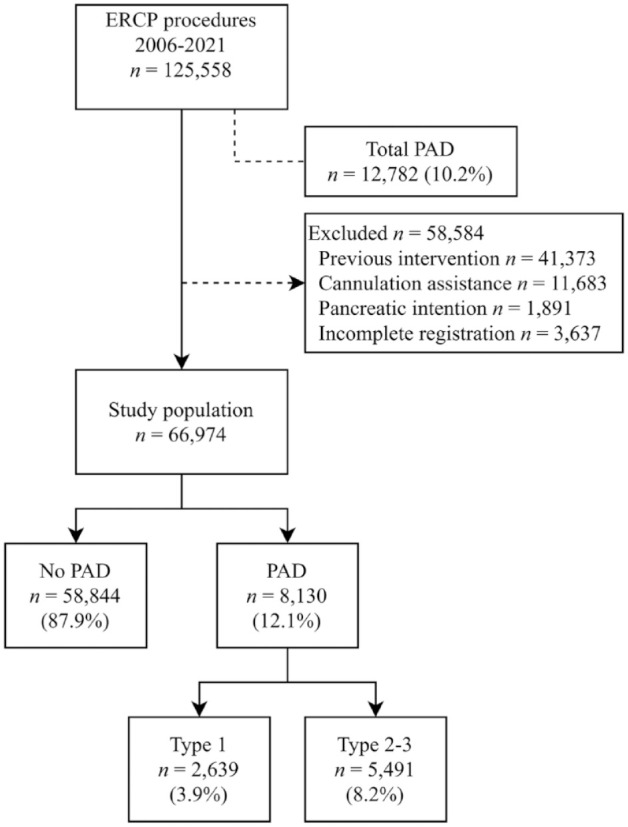
Using the Swedish registry for gallstone surgery and ERCP, we analyzed a cohort of 66,974 prospectively registered ERCP procedures performed in 2006-2021. The presence of PAD was divided into two groups based on the PAD type: Boix type 1 (the papilla located inside the PAD) and Boix types 2-3 (the papilla located either at the edge of the PAD or immediately adjacent to the PAD). The primary outcomes were the success rate of cannulation and overall adverse events within 30 days.
PADs were registered in 8130 (12.1%) of ERCPs included in the study population. In total, 2114 (3.9%) patients had Boix type 1 PAD, while 5035 (8.2%) patients had Boix type 2 or 3 PAD. The chance of successful cannulation was lower in patients with type 1 PAD compared to no PAD (80.1% vs 88.7%; odds ratio: 0.42, 95% confidence interval: 0.38-0.46). No differences were seen in overall adverse events or post-ERCP pancreatitis. Adverse events occurred in 14.6% of patients with PAD type 1 and 16.0% of patients with PAD type 2 or 3, compared to 16.5% of patients without a PAD.
Cannulation appears less successful during ERCP when the papilla is located in the PAD (i.e., type 1). Adverse events seem not to increase with the presence of a PAD, but they could theoretically be influenced by the inability to cannulate.
壶腹周围憩室(PAD)在内镜逆行胰胆管造影(ERCP)操作中较为常见。
我们试图确定PAD是否与插管成功率降低及不良事件风险增加相关。
采用前瞻性收集的全国登记数据进行回顾性队列研究。
利用瑞典胆结石手术和ERCP登记处的数据,我们分析了2006年至2021年期间前瞻性登记的66974例ERCP操作队列。根据PAD类型将PAD的存在分为两组:博伊克斯1型(乳头位于PAD内)和博伊克斯2 - 3型(乳头位于PAD边缘或紧邻PAD)。主要结局是插管成功率和30天内的总体不良事件。
研究人群中纳入的ERCP操作有8130例(12.1%)登记有PAD。总共有2114例(3.9%)患者为博伊克斯1型PAD,而5035例(8.2%)患者为博伊克斯2型或3型PAD。与无PAD的患者相比,1型PAD患者成功插管的几率较低(80.1%对88.7%;优势比:0.42,95%置信区间:0.38 - 0.46)。在总体不良事件或ERCP后胰腺炎方面未观察到差异。1型PAD患者中有14.6%发生不良事件,2型或3型PAD患者中有16.0%发生不良事件,而无PAD的患者中有此情况的为16.5%。
当乳头位于PAD内(即1型)时,ERCP期间插管似乎不太成功。不良事件似乎不会因PAD的存在而增加,但理论上可能会受到无法插管的影响。