Gupta Karnika, Maddison Daniel C, Melo Eduardo P, da Costa Ana Rosa M, Avezov Edward
UK Dementia Research Institute at University of Cambridge, Department of Clinical Neurosciences, Cambridge, UK.
Centre of Marine Sciences (CCMAR/CIMAR LA), Campus de Gambelas, Universidade do Algarve, Faro, Portugal.
Bio Protoc. 2024 Oct 5;14(19):e5080. doi: 10.21769/BioProtoc.5080.
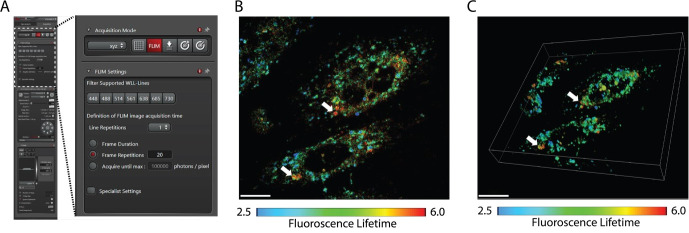
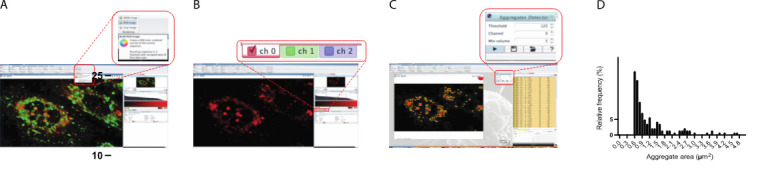
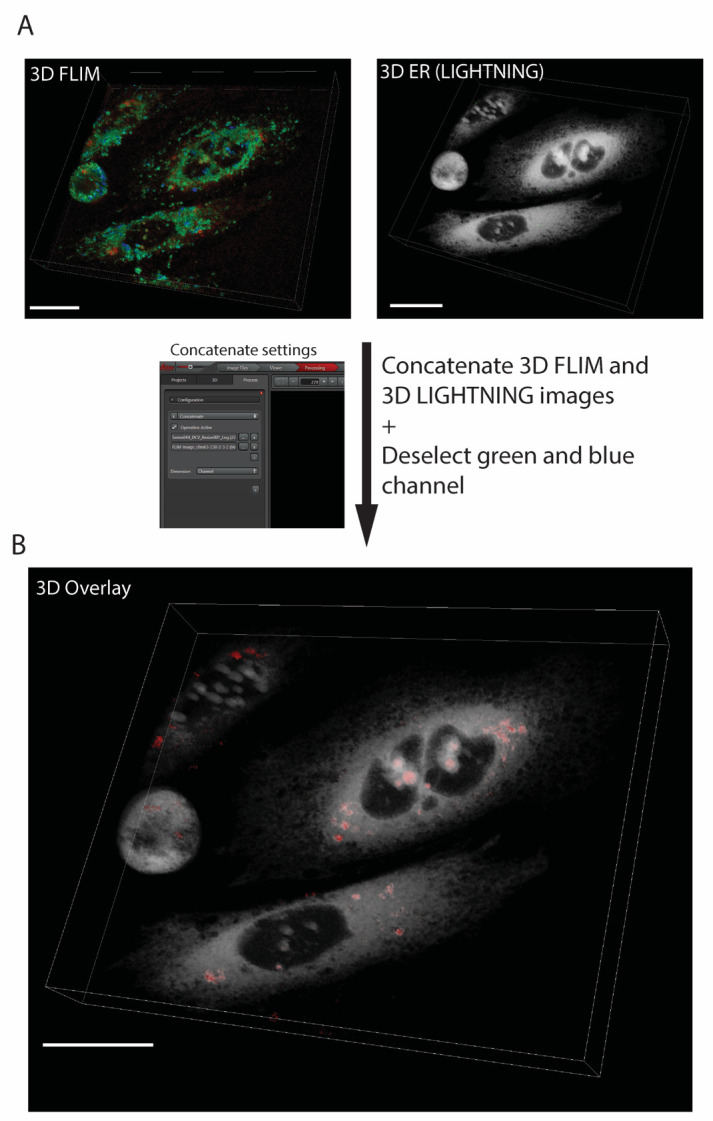
Protein misfolding fuels multiple neurodegenerative diseases, but existing techniques lack the resolution to pinpoint the location and physical properties of aggregates within living cells. Our protocol describes high-resolution confocal and fluorescent lifetime microscopy (Fast 3D FLIM) of an aggregation probing system. This system involves a metastable HaloTag protein (HT-aggr) labeled with P1 solvatochromic fluorophore, which can be targeted to subcellular compartments. This strategy allows to distinguish between aggregated and folded probe species, since P1 fluorophore changes its lifetime depending on the hydrophobicity of its microenvironment. The probe is not fluorescence intensity-dependent, overcoming issues related to intensity-based measurements of labeled proteins, such as control of probe quantity due to differences in expression or photobleaching of a proportion of the fluorophore population. Our approach reports on the performance of the machinery dealing with aggregation-prone substrates and thus opens doors to studying proteostasis and its role in neurodegenerative diseases. Key features • Aggregation state: Tracks aggregate formation and disaggregation with pulse-chase experiments • Sub-organellar resolution: Pinpoints and allows control of aggregate location within the cell, exceeding traditional techniques • Quantitative analysis: Measures aggregate load through image analysis • Methodology: • Metastable HaloTag variant labeling with a solvatochromic small-molecule reporter ligand • High-resolution confocal microscopy coupled with FLIM for aggregate identification and localization • Image analysis for aggregate quantification and distribution within the ER • Pulse-chase experiments to track aggregates.
蛋白质错误折叠引发多种神经退行性疾病,但现有技术缺乏分辨率来精确确定活细胞内聚集体的位置和物理特性。我们的方案描述了一种聚集探测系统的高分辨率共聚焦和荧光寿命显微镜技术(快速3D荧光寿命成像)。该系统涉及一种用P1溶剂化显色荧光团标记的亚稳态卤代标签蛋白(HT-聚集体),它可以靶向亚细胞区室。这种策略能够区分聚集态和折叠态的探针种类,因为P1荧光团会根据其微环境的疏水性改变其寿命。该探针不依赖荧光强度,克服了与基于强度的标记蛋白测量相关的问题, 例如由于表达差异或部分荧光团群体的光漂白而导致的探针数量控制问题。我们的方法报告了处理易聚集底物的机制的性能,从而为研究蛋白质稳态及其在神经退行性疾病中的作用打开了大门。关键特性 • 聚集状态:通过脉冲追踪实验跟踪聚集体的形成和解聚 • 亚细胞器分辨率:精确确定并控制细胞内聚集体的位置,超越传统技术 • 定量分析:通过图像分析测量聚集体负载 • 方法: • 用溶剂化显色小分子报告配体标记亚稳态卤代标签变体 • 高分辨率共聚焦显微镜与荧光寿命成像相结合用于聚集体鉴定和定位 • 图像分析用于聚集体定量和在内质网中的分布 • 脉冲追踪实验跟踪聚集体