Arcelona Christian N, Hallman Taylor G, Qureshi Umer A, Gutowski Kristof S, Donaldson Rachel E, Figueroa Ariel E, Gosain Arun K
From the Division of Plastic Surgery, Ann and Robert H. Lurie Children's Hospital, Chicago, Ill.
Plast Reconstr Surg Glob Open. 2024 Oct 11;12(10):e6233. doi: 10.1097/GOX.0000000000006233. eCollection 2024 Oct.
We evaluate the performance of plastic surgeons in converting National Institutes of Health K grants in early career to R grants intended for established investigators. We also investigate characteristics that may positively predict successful transition from K to R grants.
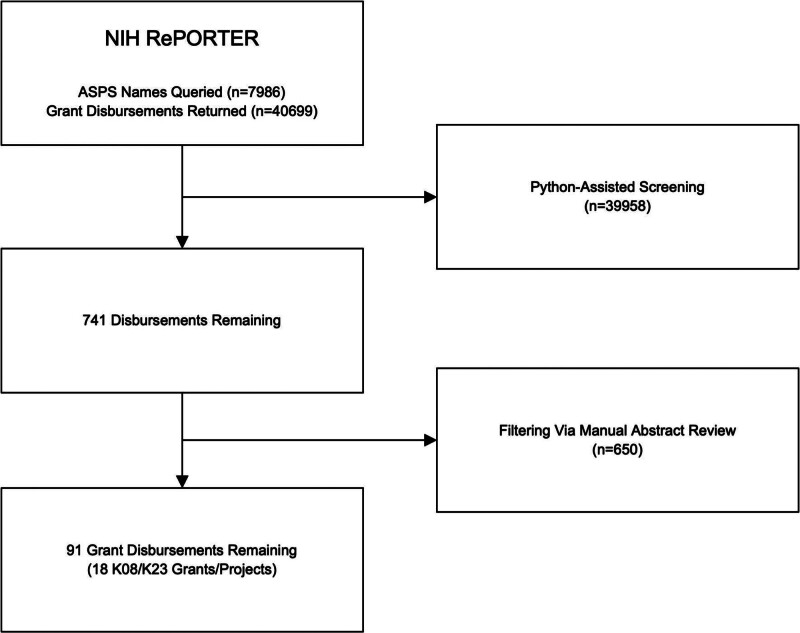
K08, K23, and R01 (or equivalent) grants awarded to plastic surgeons and physicians within the departments of ophthalmology, dermatology, and neurosurgery were collected. Analyses of successful conversion rates from a K to an R grant between plastic surgeons and physicians within the selected departments were performed. Cross-sectional analysis of characteristics among identified plastic surgeons was completed via logistic regression to elucidate possible predictors of successful conversion.
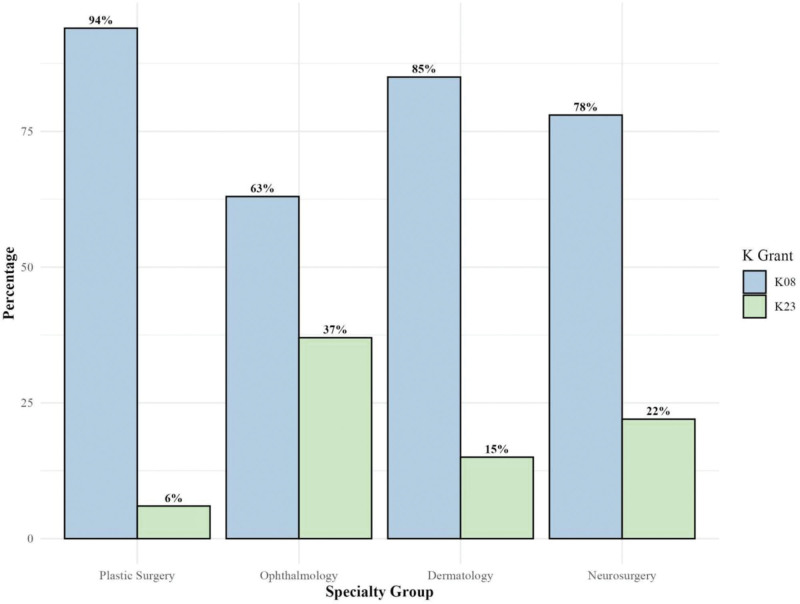
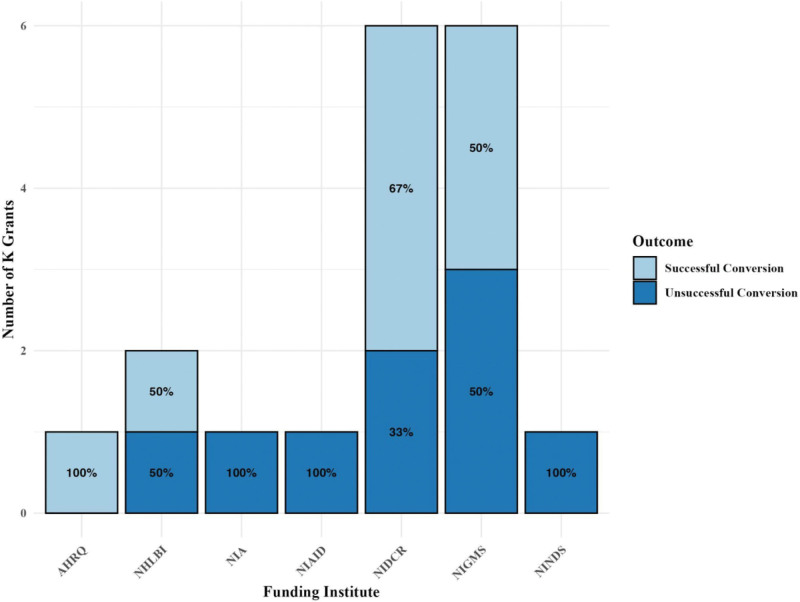
Comparison of pathway initiation rates demonstrate that plastic surgeons receive significantly fewer K grants relative to the size of their field when compared with other specialties (all < 0.01). Of the analyzed plastic surgeons, 52.9% successfully converted to an R-series grant within 5.4 years of beginning their K-series grant. Conversion rates were not significantly different between plastic surgeons and physicians within the selected departments. Logistic regression analyses revealed that the time-adjusted mean relative citation ratio of K series-associated publications is a positive predictor of successful conversion ( = 0.047).
With regard to increasing National Institutes of Health funding via the K-to-R pathway, we believe the field of plastic surgery could benefit from an increased effort to pursue a pathway of K-to-R conversion with a focus on quality over quantity when publishing articles associated with a K-series grant.
我们评估整形外科医生在将早期职业生涯中获得的美国国立卫生研究院(NIH)K类资助转换为面向资深研究者的R类资助方面的表现。我们还研究可能对从K类资助成功过渡到R类资助有积极预测作用的特征。
收集授予整形外科医生以及眼科、皮肤科和神经外科部门内科医生的K08、K23和R01(或同等类型)资助。对选定部门内整形外科医生和内科医生从K类资助成功转换为R类资助的成功率进行分析。通过逻辑回归对已确定的整形外科医生的特征进行横断面分析,以阐明成功转换的可能预测因素。
对资助起始率的比较表明,与其他专业相比,整形外科医生获得的K类资助相对于其所在领域的规模明显更少(所有P<0.01)。在分析的整形外科医生中,52.9%在开始K类资助后的5.4年内成功转换为R系列资助。选定部门内整形外科医生和内科医生的转换率没有显著差异。逻辑回归分析显示,K系列相关出版物的时间调整平均相对引用率是成功转换的一个积极预测因素(P = 0.047)。
关于通过K到R途径增加美国国立卫生研究院的资金,我们认为整形外科领域可能会受益于加大努力来追求K到R的转换途径,在发表与K系列资助相关的文章时注重质量而非数量。