Institute for Bio- and Geosciences 1, Forschungszentrum Jülich GmbH, IBG-1, 52425, Jülich, Germany.
Microb Cell Fact. 2024 Oct 14;23(1):276. doi: 10.1186/s12934-024-02556-1.
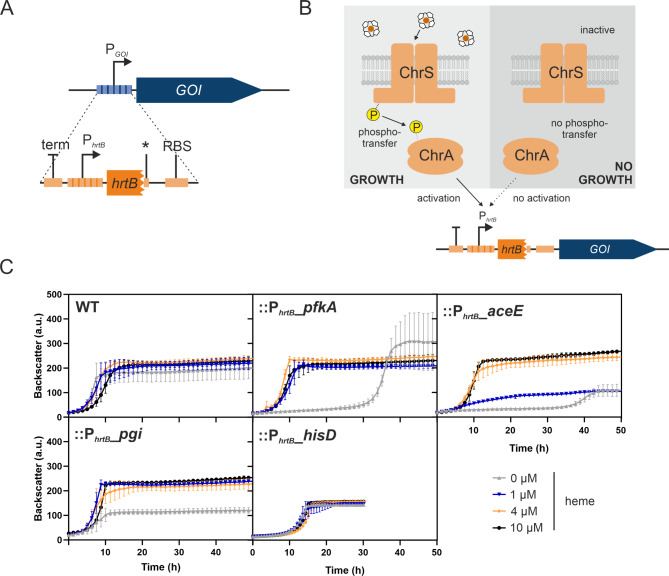
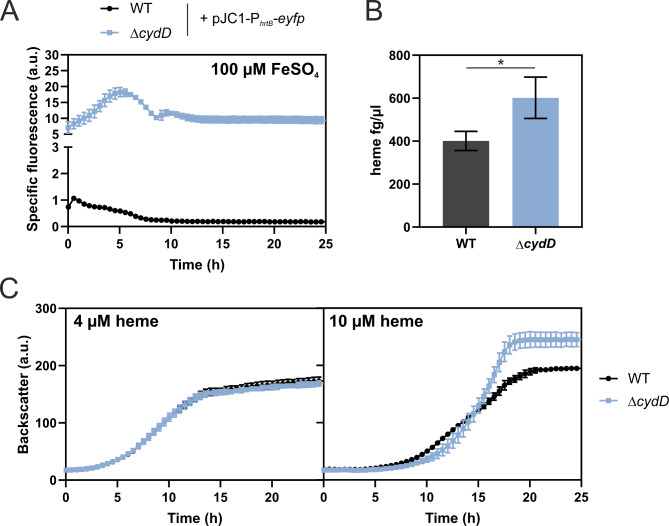
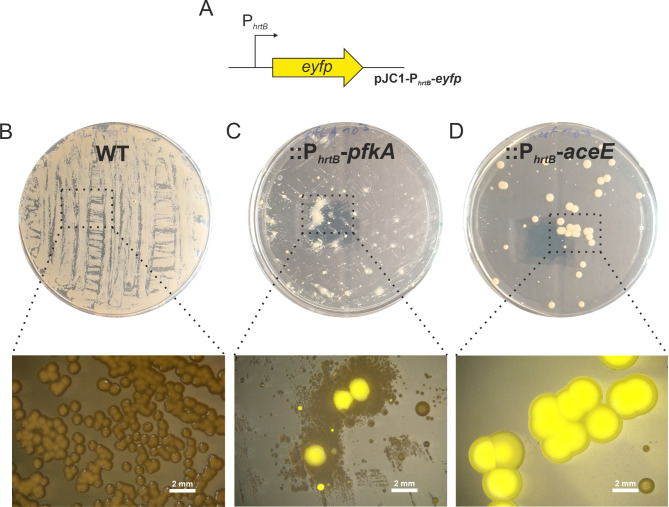
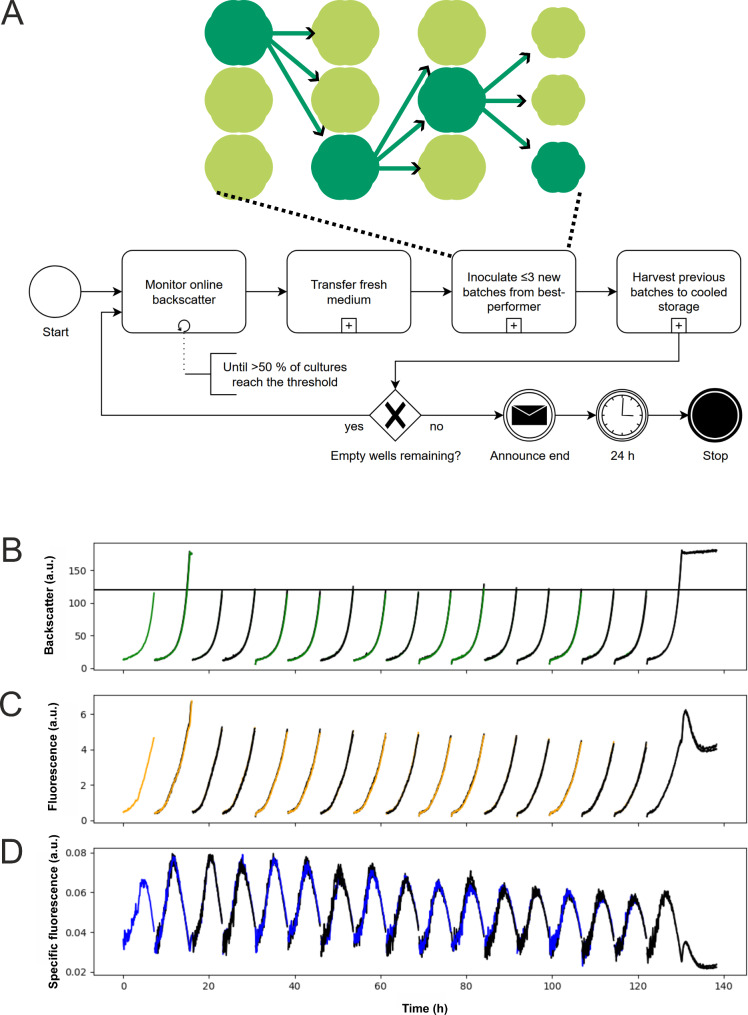
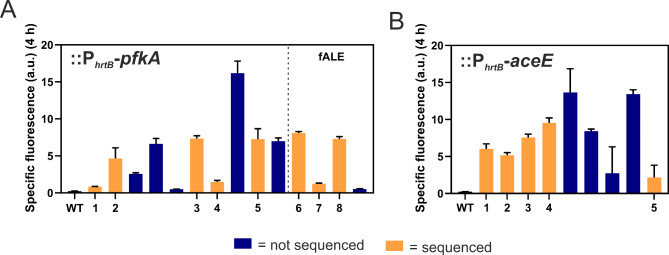
The iron-containing porphyrin heme is of high interest for the food industry for the production of artificial meat as well as for medical applications. Recently, the biotechnological platform strain Corynebacterium glutamicum has emerged as a promising host for animal-free heme production. Beyond engineering of complex heme biosynthetic pathways, improving heme export offers significant yet untapped potential for enhancing production strains. In this study, a growth-coupled biosensor was designed to impose a selection pressure on the increased expression of the hrtBA operon encoding an ABC-type heme exporter in C. glutamicum. For this purpose, the promoter region of the growth-regulating genes pfkA (phosphofructokinase) and aceE (pyruvate dehydrogenase) was replaced with that of P, creating biosensor strains with a selection pressure for hrtBA activation. Resulting sensor strains were used for plate-based selections and for a repetitive batch f(luorescent)ALE using a fully automated laboratory platform. Genome sequencing of isolated clones featuring increased hrtBA expression revealed three distinct mutational hotspots: (i) chrS, (ii) chrA, and (iii) cydD. Mutations in the genes of the ChrSA two-component system, which regulates hrtBA in response to heme levels, were identified as a promising target to enhance export activity. Furthermore, causal mutations within cydD, encoding an ABC-transporter essential for cytochrome bd oxidase assembly, were confirmed by the construction of a deletion mutant. Reversely engineered strains showed strongly increased hrtBA expression as well as increased cellular heme levels. These results further support the proposed role of CydDC as a heme transporter in bacteria. Mutations identified in this study therefore underline the potential of biosensor-based growth coupling and provide promising engineering targets to improve microbial heme production.
含铁卟啉血红素是食品工业生产人造肉以及医学应用的研究热点。最近,生物技术平台菌株谷氨酸棒杆菌已成为无动物血红素生产的有前途的宿主。除了对复杂血红素生物合成途径进行工程改造外,提高血红素输出为提高生产菌株的产量提供了巨大但尚未开发的潜力。在这项研究中,设计了一种生长偶联生物传感器,对谷氨酸棒杆菌中编码 ABC 型血红素外排泵的 hrtBA 操纵子的过表达施加选择压力。为此,用 PfkA(磷酸果糖激酶)和 AceE(丙酮酸脱氢酶)的生长调节基因的启动子区域替换了 P 的启动子区域,构建了具有 hrtBA 激活选择压力的生物传感器菌株。由此产生的传感器菌株用于平板选择和使用全自动实验室平台进行重复批 f(荧光)ALE。具有增加的 hrtBA 表达的分离克隆的基因组测序揭示了三个不同的突变热点:(i)chrS,(ii)chrA 和(iii)cydD。鉴定出 ChrSA 双组分系统基因中的突变,该系统响应血红素水平调节 hrtBA,是增强外排活性的有希望的靶标。此外,编码细胞色素 bd 氧化酶组装所必需的 ABC 转运蛋白的 cydD 基因中的因果突变通过构建缺失突变体得到了证实。反向工程菌株显示出强烈增加的 hrtBA 表达以及增加的细胞血红素水平。这些结果进一步支持了 CydDC 作为细菌中血红素转运蛋白的作用。本研究中鉴定的突变因此强调了基于生物传感器的生长偶联的潜力,并为提高微生物血红素生产提供了有希望的工程靶标。