Iiristo Johannes, Karling Pontus
Department of Public Health and Clinical Medicine, Umeå University, Umea, Sweden.
Department of Public Health and Clinical Medicine, Umeå University, Umea, 901 87, Sweden.
Therap Adv Gastroenterol. 2024 Oct 13;17:17562848241288851. doi: 10.1177/17562848241288851. eCollection 2024.
Treatments and strategies for inflammatory bowel disease (IBD) have gradually evolved in the 2000s.
We investigated whether the prescription of corticosteroids (prednisolone and budesonide) in patients with IBD in the first 5 years after diagnosis changed in patients diagnosed between 2006 and 2018.
Retrospective observational study.
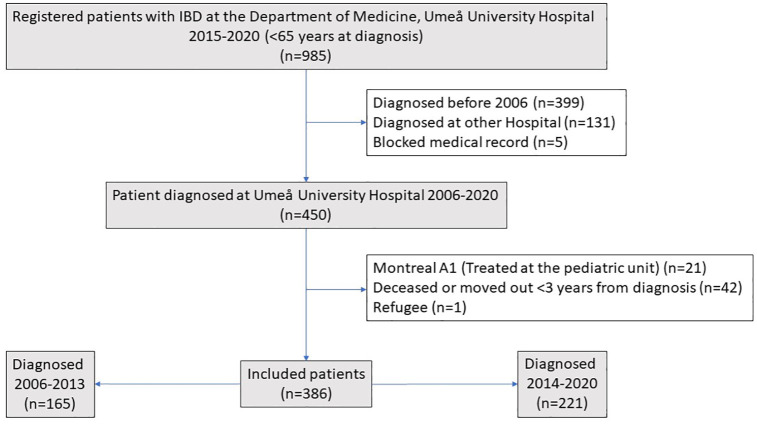
The cumulative prescribed dosage of corticosteroids for the first 5 years after diagnosis was registered in all patients with IBD ( = 386) at our clinic for those diagnosed between 2006 and 2018.
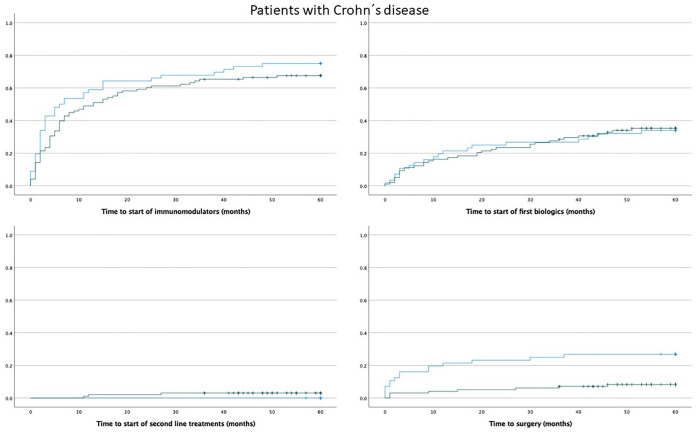
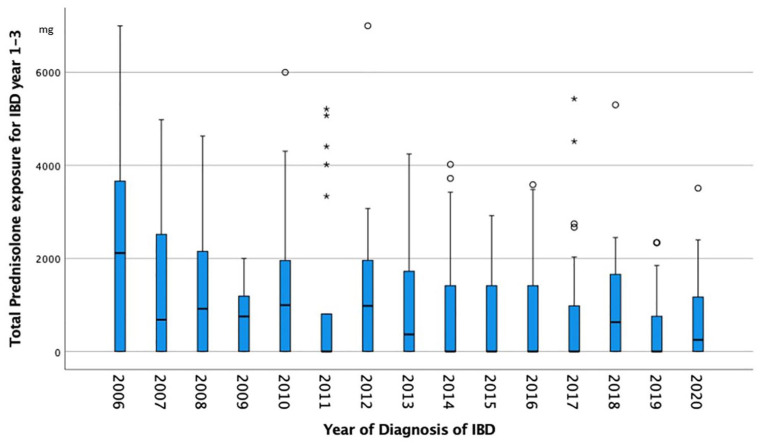
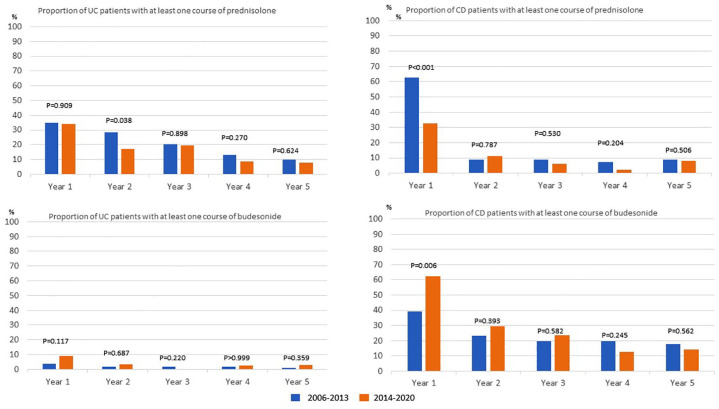
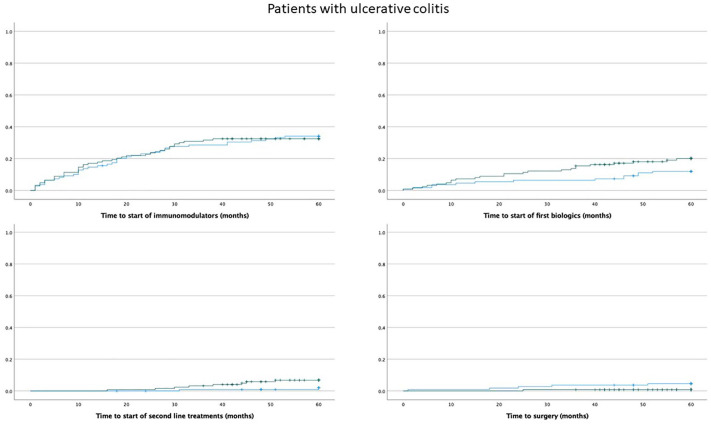
The proportion of patients with IBD who were prescribed at least one prescription of corticosteroids in year 1-5 after diagnosis was 55.3%, 27.9%, 22.7%, 14.1%, and 14.6%, respectively. The proportion of patients who had a cumulative dose of prednisolone >1 g in the first 5 years after diagnosis was 40.1% for ulcerative colitis and 34.9% for Crohn's disease (CD). The cumulative prescribed dosage (within 3 years after diagnosis) of prednisolone had declined (rs = -0.164, = 001), but had increased for budesonide (rs = 0.202, < 0.001) between 2006 and 2020. The prescription of any immunomodulator for IBD in the first 5 years from diagnosis was stable between 2006 and 2018 (rs = 0.056, = 0.257), but there was a minor increase in the prescription of Tumor Necrosis Factor (TNF)-inhibitors (rs = 0.119, = 0.020). The use of five-acetyl salicylic acid (5-ASA) decreased in patients with CD (rs = -201, = 0.012).
There was a decrease in the prescription of prednisolone and an increase in the prescription of budesonide treatment from 2006 to 2023; however, the cumulative exposure to corticosteroids in patients with IBD remains at a relatively high level.
21世纪以来,炎症性肠病(IBD)的治疗方法和策略逐渐演变。
我们调查了2006年至2018年确诊的IBD患者在诊断后的前5年中,皮质类固醇(泼尼松龙和布地奈德)的处方情况是否发生了变化。
回顾性观察研究。
记录了2006年至2018年在我们诊所确诊的所有IBD患者(n = 386)诊断后前5年皮质类固醇的累计处方剂量。
诊断后第1 - 5年中,接受至少一次皮质类固醇处方的IBD患者比例分别为55.3%、27.9%、22.7%、14.1%和14.6%。诊断后前5年泼尼松龙累计剂量>1g的患者比例,溃疡性结肠炎为40.1%,克罗恩病(CD)为34.9%。2006年至2020年期间,泼尼松龙的累计处方剂量(诊断后3年内)有所下降(rs = -0.164,P = 0.01),但布地奈德的剂量有所增加(rs = 0.202,P < 0.001)。2006年至2018年期间,IBD患者诊断后前5年任何免疫调节剂的处方情况稳定(rs = 0.056,P = 0.257),但肿瘤坏死因子(TNF)抑制剂的处方略有增加(rs = 0.119,P = 0.020)。CD患者中5 - 氨基水杨酸(5 - ASA)的使用减少(rs = -0.201,P = 0.012)。
2006年至2023年,泼尼松龙的处方减少,布地奈德治疗的处方增加;然而,IBD患者皮质类固醇的累计暴露水平仍处于相对较高水平。