Qi Jing, Cao Xuemin, Bao Hongyi, Zhang Tuodi, Wang Yichen, Wen Ya, Yang Junling, Ge Guixuan, Wang Ping, Chen Lin, Wang Feng
Research Center of Clinical Medicine, Affiliated Hospital of Nantong University, Medical School of Nantong University, Nantong, 226001, China.
Department of Laboratory Medicine, Affiliated Hospital of Nantong University, Medical School of Nantong University, Nantong, 226001, China.
Mater Today Bio. 2024 Sep 27;29:101272. doi: 10.1016/j.mtbio.2024.101272. eCollection 2024 Dec.
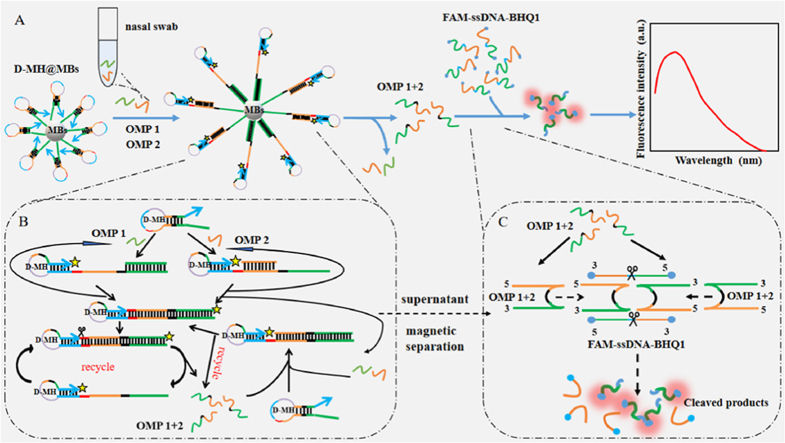
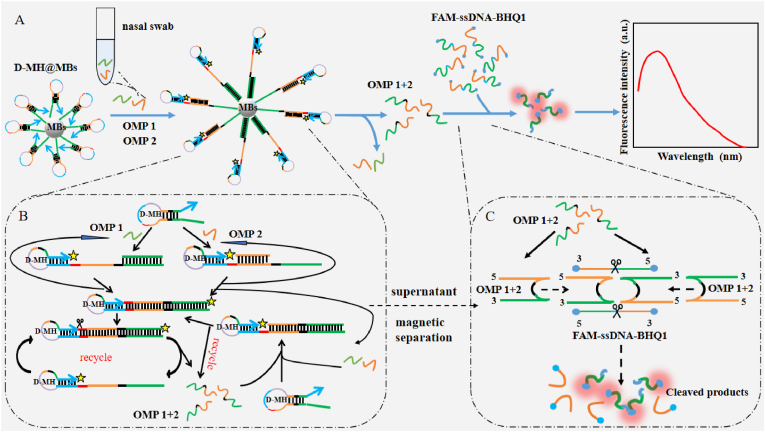
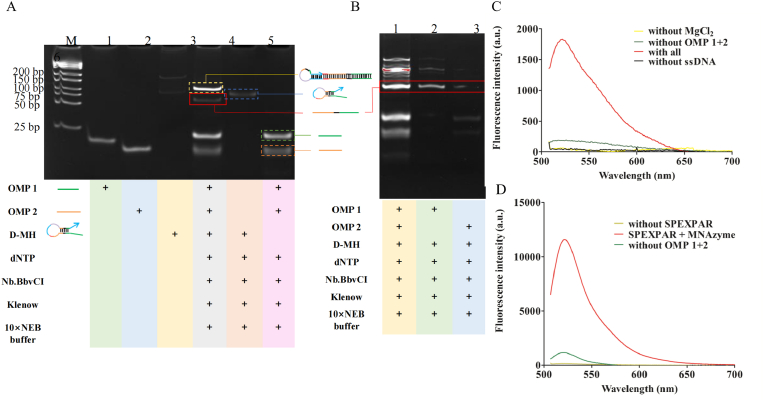
Fig. 1: Schematic illustration of the principle of the Dual targets driven SPEXPAR assisted MNAzyme (D-S-M) fluorescent biosensor for olfactory marker protein (OMP) detection. A. Workflow for detection of OMP in nasal swab. B. Isothermal Self-Primer EXPonential Amplification Reaction (SPEXPAR) amplification. C. The production of fluorescent signal by Multicomponent Nuclear Acid Enzyme (MNAzyme). The signal of OMP was amplified and changed into the detectable fluorescence signal based on the reactions of SPEXPAR and MNAzyme in the D-S-M fluorescence biosensor. The qualitative or quantitative analysis of OMP can be measured by the analysis of the fluorescence intensity.Image 1.
图1:用于嗅觉标记蛋白(OMP)检测的双靶点驱动的SPEXPAR辅助MNAzyme(D-S-M)荧光生物传感器原理示意图。A.鼻拭子中OMP的检测流程。B.等温自引物指数扩增反应(SPEXPAR)扩增。C.多组分核酸酶(MNAzyme)产生荧光信号。基于D-S-M荧光生物传感器中SPEXPAR和MNAzyme的反应,OMP的信号被放大并转化为可检测的荧光信号。OMP的定性或定量分析可通过荧光强度分析来测量。图1。