Department of Radiology and Research Institute of Radiology, Asan Medical Center, University of Ulsan College of Medicine, Seoul, Korea.
J Korean Med Sci. 2024 Oct 14;39(39):e260. doi: 10.3346/jkms.2024.39.e260.
The pragmatic role of dynamic contrast-enhanced magnetic resonance lymphangiography (DCMRL) needs to be evaluated and compared across distinct lymphatic disorders. We aimed to evaluate the performance of DCMRL for identifying the underlying causes of lymphatic disorders and to define the potential benefit of DCMRL for planning lymphatic interventions.
Patients who underwent DCMRL between August 2017 and July 2022 were included in this retrospective analysis. DCMRL was performed with intranodal injection of a gadolinium-based contrast medium through inguinal lymph nodes under local anesthesia. Technical success of DCMRL and feasibility of percutaneous embolization were assessed based on the lymphatic anatomy visualized by DCMRL. Based on the underlying causes, clinical outcomes were evaluated and compared.
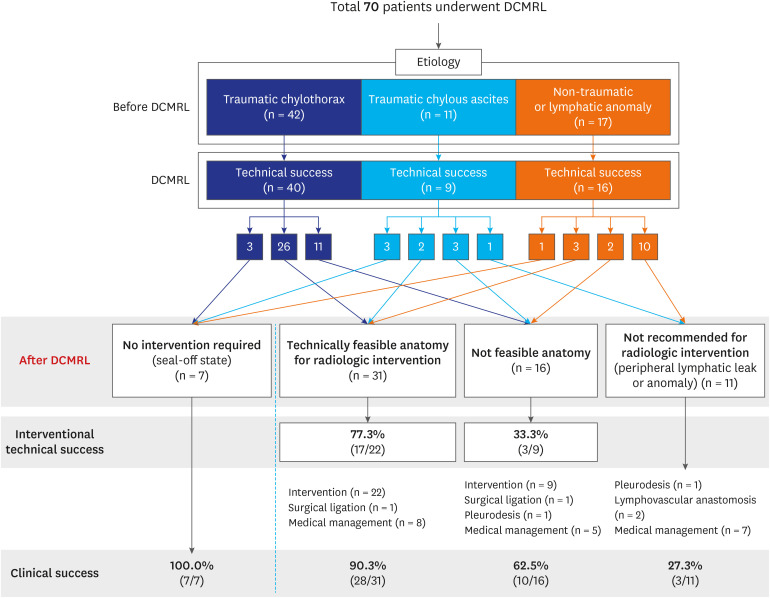
Seventy consecutive patients were included. The indications were traumatic chylothorax (n = 42), traumatic chylous ascites (n = 11), and nontraumatic lymphatic leak (n = 17). The technical success rate of DCMRL was the highest in association with nontraumatic lymphatic disorders (94.1% [16/17]), followed by traumatic chylothorax (92.9% [39/42]) and traumatic chylous ascites (81.8% [9/11]). Thirty-one (47.7%) patients among 65 patients who underwent technically successful DCMRL had feasible anatomy for intervention. Clinical success was achieved in 90.3% (28/31) of patients with feasible anatomy for radiologic intervention, while 62.5% (10/16) of patients with anatomical challenges showed improvement. Most patients with traumatic chylothorax showed improvement (92.9% [39/42]), whereas only 23.5% (4/17) of patients with nontraumatic lymphatic disorders showed clinical improvement.
DCMRL can help identify the underlying causes of lymphatic disorders. The performance of DCMRL and clinical outcomes vary based on the underlying cause. The feasibility of lymphatic intervention can be determined using DCMRL, which can help in predicting clinical outcomes.
动态对比增强磁共振淋巴造影术(DCMRL)的实际作用需要在不同的淋巴疾病中进行评估和比较。我们旨在评估 DCMRL 识别淋巴疾病潜在原因的性能,并确定 DCMRL 对规划淋巴介入的潜在益处。
本回顾性分析纳入了 2017 年 8 月至 2022 年 7 月间接受 DCMRL 的患者。DCMRL 在局部麻醉下通过腹股沟淋巴结向淋巴结内注射钆基造影剂进行。根据 DCMRL 可视化的淋巴解剖结构,评估 DCMRL 的技术成功率和经皮栓塞的可行性。根据潜在原因评估并比较临床结果。
连续纳入 70 例患者。适应证为创伤性乳糜胸(n=42)、创伤性乳糜性腹水(n=11)和非创伤性淋巴漏(n=17)。DCMRL 的技术成功率在非创伤性淋巴疾病中最高(94.1%[16/17]),其次是创伤性乳糜胸(92.9%[39/42])和创伤性乳糜性腹水(81.8%[9/11])。在 65 例技术成功的 DCMRL 患者中,有 31 例(47.7%)患者具有可行的干预解剖结构。在具有可行放射干预解剖结构的 31 例患者中,90.3%(28/31)获得了临床成功,而在具有解剖学挑战的 16 例患者中,62.5%(10/16)得到了改善。大多数创伤性乳糜胸患者得到了改善(92.9%[39/42]),而非创伤性淋巴疾病患者仅 23.5%(4/17)得到了改善。
DCMRL 可以帮助确定淋巴疾病的潜在原因。DCMRL 的表现和临床结果因潜在原因而异。可以使用 DCMRL 确定淋巴介入的可行性,这有助于预测临床结果。